
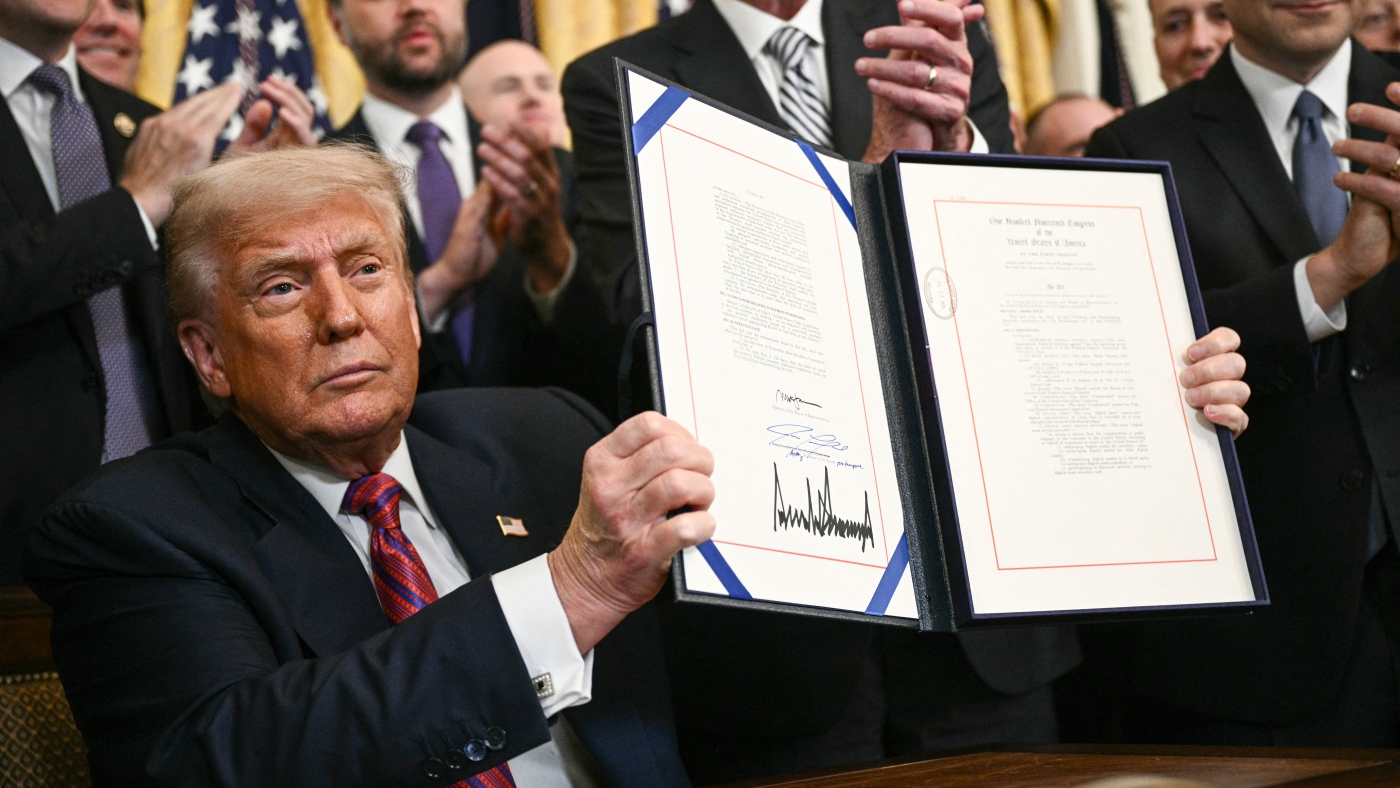
President Trump showcases the GENIUS Act, landmark crypto legislation approved by Congress, at a White House signing ceremony in Washington, D.C., July 18, 2025.
Brendan Smialowski/AFP via Getty Images
hide caption
toggle caption
Brendan Smialowski/AFP via Getty Images
For many years, the United States government has largely avoided regulating cryptocurrencies, considering them too dangerous for everyday investors and too unstable for the nation’s economy.

That’s changing now.
Earlier this week, a landmark vote in the House of Representatives saw Congress pass the first significant piece of crypto legislation. This event signals a major shift in the U.S. government’s view on digital currencies.
Following the vote, the total market value of cryptocurrencies surged to a record high of $4 trillion, reflecting widespread optimism across the industry.
President Trump, who has pledged to establish the U.S. as the “crypto capital of the world,” officially signed the bill into law on Friday during a ceremony celebrated by Republican legislators.
“This afternoon marks a pivotal moment as we solidify America’s leadership in global finance and crypto technology with the enactment of the groundbreaking Genius Act,” President Trump stated.
The new law introduces regulations for stablecoins, a specific and promising area within the crypto market. It also sets the stage for future legislation, with two additional crypto-related bills currently under consideration in Congress.

One particular piece of legislation that the crypto industry is eager to see passed is the CLARITY Act. This bill, approved by the House on Thursday as part of what Republican representatives have dubbed “crypto week,” would transfer regulatory oversight of the crypto sector to the Commodity Futures Trading Commission, a smaller regulatory body.
Such a move would fundamentally alter the way digital currencies are regulated in the U.S. Critics are concerned that this change could lead to weaker oversight of what they view as a risky segment of the financial industry.
The CLARITY Act now moves to the Senate, where its future is uncertain. Opponents of the bill have pledged to resist it fiercely.
Crypto Advocates See Financial Innovation
For those in the crypto community, this week has been cause for celebration.
They firmly believe that digital currencies are the future of finance.
While acknowledging that some aspects of the crypto world are less than ideal, such as “meme coins” based on internet trends, they assert that cryptocurrencies can offer significant benefits.
Stablecoins serve as an example. They’re considered a more secure form of cryptocurrency because each stablecoin is backed by an equivalent amount of a traditional currency like U.S. dollars or euros. This means that for every $1 of stablecoin issued, the provider must hold $1 in reserve.
Stablecoin companies see great promise in their product. Because they are backed by traditional currencies, stablecoins are essentially considered as reliable as cash.