
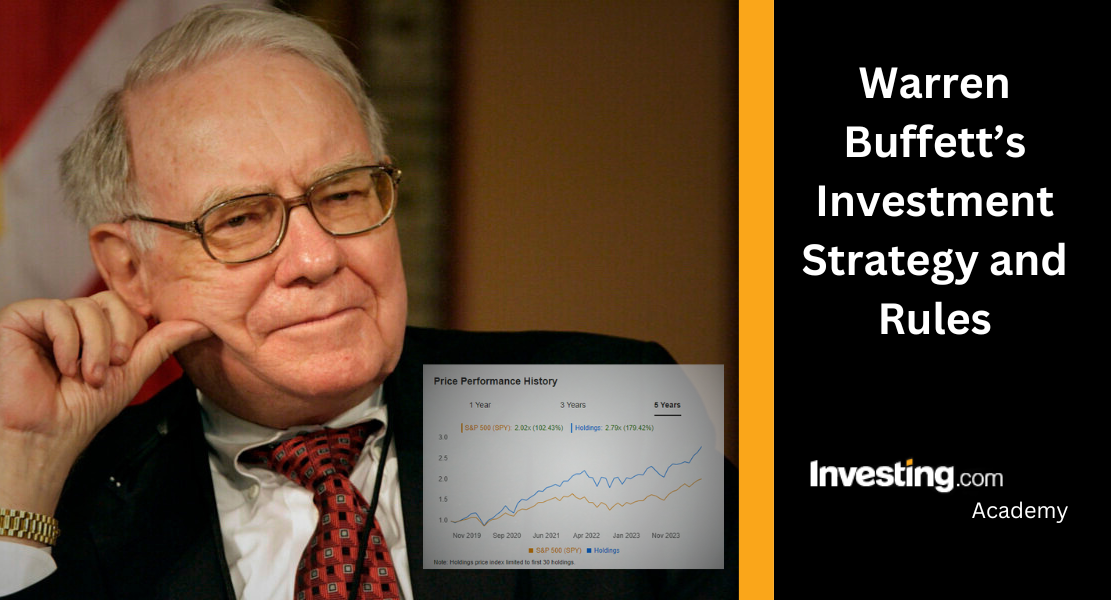
Considered by many to be the most successful investor alive, Warren Buffett boasts a net worth exceeding $100 billion. His enduring investment strategy has consistently generated impressive returns for shareholders, establishing him as a figure of unparalleled respect thanks to his clear and unwavering investment philosophy.
As Chairman and CEO of Berkshire Hathaway, Buffett has amassed immense wealth by concentrating on value investing. This entails pinpointing companies whose stock price is below their actual worth and maintaining these investments for extended durations. His core beliefs revolve around logical reasoning and steadfastness, presenting a contrast to the rapid-fire nature of today’s investment environment.
This exploration examines Warren Buffett’s investment path, including his proven investing strategy, its transformation through the years, the resulting growth of his wealth, and valuable insights for investors extracted from his renowned letters to shareholders.
Warren Buffett’s fascination with finance and investment emerged very early in his life. Growing up in Omaha, Nebraska, where his father managed a stock brokerage and later served in the U.S. House of Representatives, Buffett exhibited a distinct interest in numbers and financial matters.
By the age of six, he was selling chewing gum door-to-door; by eleven, he made his first stock purchase with his father’s help, acquiring three shares of Cities Service Preferred at $38 each. Even then, he gleaned an important lesson about patience and long-term thinking: the stock price initially declined to $27 before rising to $40, at which point he sold, realizing a 4.6% profit. Seeing the stock continue to rise afterward solidified the concept that maintaining emotional composure is crucial in the stock market.
Before turning 14, Warren saved $1,000, and by the time he reached high school, he had already executed several successful investments.
After studying economics and finance at the University of Nebraska and the Wharton School at the University of Pennsylvania, he pursued studies at Columbia University, where he was introduced to the value investing principles of Benjamin Graham. This would have a profound effect on his investment approach and establish him as one of history’s greatest investors.
        <p>
            <h3 class="wp-block-heading">Benjamin Graham’s Influence on Warren Buffett</h3>
        </p>
Benjamin Graham, frequently referred to as the originator of value investing, considerably molded Buffett’s investment strategy. As a student at Columbia Business School, Buffett encountered Graham’s highly influential book, *The Intelligent Investor*, which became his investment guide. The book’s emphasis on intrinsic value and a margin of safety harmonized with Buffett’s analytical mindset.
Buffett seized the opportunity to study directly under Graham during the latter’s security analysis course. Impressed by Graham’s methodology, Buffett sought employment at Graham’s firm, Graham-Newman, following graduation, and worked there for several years during the 1950s.
During his time there, Buffett refined his value investing techniques and gained a solid grasp of the principles that would inform his investment decisions for the duration of his career. Graham’s sway on Buffett is commonly recognized, with Buffett attributing to his mentor a framework for investing that emphasizes a methodical, data-driven strategy. This helped Buffett formulate the disciplined investment approach that has since defined Berkshire Hathaway’s success.
        <p>
            <h3 class="wp-block-heading">Buffett’s Early Investment Career</h3>
        </p>
During the initial stages of his investment journey, Buffett made several successful investments, including those in companies like GEICO and Rockwood. He showed a knack for identifying undervalued companies. His ability to perceive opportunities from multiple perspectives and to understand the motivations of different parties enabled him to determine the optimal stance to adopt. His inherent appreciation for the tenets of value investing established a base for future accomplishments.
In 1956, after dedicating years to enhancing his expertise and developing a reputation as a successful investor, Buffett established Buffett Associates, LP, a hedge fund that ultimately evolved into the multinational conglomerate Berkshire Hathaway.
Mimic Buffett’s Investment Selections – Through InvestingPro 🔎
Many seek to replicate Warren’s investing strategy. However, imagine surpassing it!
Leveraging state-of-the-art AI, we’ve analyzed every holding within Buffett’s portfolio to identify the top 15 standout stocks from an already distinguished array.
To maintain accuracy, these stock evaluations are conducted upon the public release of each quarterly 13F filing revealing Buffett’s holdings.
Warren Buffett’s investment strategy has consistently revolved around the core principle of long-term value investing over the decades.
        <p>
            <h3 class="wp-block-heading">Buffett’s Value Investing Strategy</h3>
        </p>
The central concept of value investing is purchasing undervalued companies possessing robust fundamental qualities and maintaining these investments for the extended term. Stemming from Benjamin Graham’s instruction, Buffett initially targeted “cigar butt” stocks; these were businesses trading below their liquidation value. Over time, this approach was refined through the influence of his long-standing business partner, Charlie Munger. Together, they changed the focus toward high-caliber businesses that benefit from sustained competitive advantages, also known as “economic moats.” These moats may include elements like a dominant brand, high barriers to entry, or an expansive and devoted customer base, regardless of very low valuations. The result was a sharper strategy: allocating fair prices (which still provides a margin of safety) for exceptional businesses instead of seeking low prices for only average businesses.
        <p>
            <h3 class="wp-block-heading">Long-Term Investment Mindset</h3>
        </p>
Buffett’s investment planning focuses on spans measured in decades instead of fiscal quarters. His 1988 investment in Coca-Cola, a flagship holding of Berkshire Hathaway, is a superb example of this strategy. He did not view it merely as a soft drink company; he saw a brand with global reach and price-setting potential. Similarly, his substantial investment in Apple during the 2010s demonstrates his modern approach: investing in businesses generating considerable cash flow that feature loyal customer relationships, also in the technology sector.
Buffett has exhibited a continuous reluctance to follow trends or attempt to time the market over the decades. Instead, he puts capital in businesses he thoroughly understands, managed by competent individuals, that offer predictable earnings. This level of discipline, in conjunction with his willingness to hold cash reserves until suitable opportunities emerge, has enabled him to successfully navigate market downturns and outperform over extended periods.
He is noted for his frugality and avoids overpaying for companies, choosing to patiently await favorable opportunities. This self-discipline, coupled with a thorough grasp of the sectors in which he invests, has established him as a highly successful investor. Berkshire Hathaway’s shareholders have seen over 20% in compounded annual returns since 1965, about double the S&P 500 index’s returns during that same period.
Buffett’s investment philosophy has proven effective, yielding considerable returns for both Berkshire Hathaway and its shareholders through the years. Buffett has famously expressed skepticism toward investing in elevated-risk, high-reward industries such as technology. Instead, he emphasizes investing in well-established sectors like retail, insurance, and finance. He is recognized for making long-term investments, retaining companies for years or decades, and avoiding the pitfalls of frequent trading. This methodology enables him to harness the strength of compound interest, giving the companies he invests in the opportunity to grow and generate substantial gains.
As pointed out previously, Buffett has always been a committed proponent of value investing. Despite his known discipline, his methods have never been static. His core values, involving value investing and long-term visions, have stayed consistent, his strategies have adapted in response to market fluctuations, economic shifts, and refined understanding of businesses.
        <p>
            <h3 class="wp-block-heading">Adaptation to Change</h3>
        </p>
Buffett had avoided the technology sector, explaining that his understanding of the sector was insufficient for confident investing. That hesitancy shifted with his investment in Apple, initially procured between 2016 and 2018. Instead of categorizing Apple as a typical technology company, Buffett framed it as a consumer-based brand known for customer loyalty, strong cash flow, and a durable moat—qualities he has historically valued. This move signaled a marked change in strategy, highlighting that staying within your range of expertise doesn’t require ignoring changes, but rather expanding your understanding of sustainable value.
He has also modified his investment behavior during financial crises. In 2008, he aggressively purchased distressed firms like Goldman Sachs. In contrast, he remained cautious during the COVID-19 crash of 2020, maintaining significant cash reserves and limiting large investments until market conditions normalized.
        <p>
            <h3 class="wp-block-heading">Diversification Across Sectors</h3>
        </p>
Buffett’s initial investments were primarily concentrated in traditional industries, including insurance, banking, and consumer products. With time, Berkshire Hathaway’s portfolio has become extensively diversified. His portfolio presently encompasses technology (Apple), energy (Chevron, Occidental Petroleum), logistics (BNSF Railway), finance (American Express, Bank of America), and even Japanese trading firms, marking a deviation into the global equities sector.
Today, Buffett consistently applies this “superior company at a reasonable price” strategy to investments, giving emphasis to companies with robust growth prospects, competent management, and a sustainable competitive edge.
Nevertheless, he has broadened his focus and become sector-agnostic to find companies with necessary attributes for investment. His diversification serves not only to spread risk but also showcases a flexible mindset that has kept him relevant for over seven decades, solidifying his status as one of history’s top investors.

Warren Buffett’s method may seem straightforward, yet it depends on self-control, tenacity, and detailed awareness. His investment rules serve both as a checklist and a framework, emphasizing long-term value above momentary trends.
        <p>
            <h3 class="wp-block-heading">What Are Warren Buffett’s Biggest Investing Rules?</h3>
        </p>
Rule 1: Never Lose Money
Buffett’s most recognized guideline is straightforward and powerful. While losses are unavoidable in investing, this rule prioritizes preserving capital and avoiding unwarranted risks.
Rule 2: Never Forget Rule 1
The purpose of this tongue-in-cheek reminder is to reinforce Buffett’s belief in prioritizing capital preservation. This encompasses reducing long-term drawdown to the greatest extent possible.
Rule 3: Buy Quality Businesses
Buffett looks for organizations with steady earnings, a sustainable competitive edge, and robust brand equity. He values businesses that can flourish with little capital and consistently deliver substantial profits annually.
Rule 4 Management Matters
Buffett invests in both individuals and products. He defines exceptional leadership as having traits such as sincerity, intellect, and drive. A strong management team with significant personal investment is key to achieving sustainable success.
Rule 5: Keep It Simple
Buffett only invests in businesses he understands. He avoids complexity and popular trends, choosing clarity over sophistication.
Rule 6: Margin of Safety
Inspired by Benjamin Graham, this rule entails buying stocks at prices considerably below their actual worth to create a safeguard should predictions prove inaccurate.
Rule 7: Think Long Term
Buffett says his ideal holding period is “forever.” He disregards market distractions, concentrating on business fundamentals, often holding investments for decades if the company maintains good performance.
Rule 8: Be Patient and Disciplined
Buffett keeps cash reserves when he sees no appealing opportunities and can wait. His strategy involves knowing when *not* to act until the right time arrives.
Buffett’s wisdom has been summarized in numerous quotations that investors refer to regularly. Here are some of the most enduring lessons:
“Be fearful when others are greedy, and greedy when others are fearful.”
This emphasizes Buffett’s contrarian approach to investing. It underscores the importance of keeping emotions away from value investing, with the understanding that opportunities often appear in times of panic, not euphoria. He takes advantage of market panics and crashes to acquire companies at a discount, aware that their value will eventually recover. He also avoids overpriced companies, even if they are the popular stock, because their value is likely to decrease.
“It’s far better to buy a wonderful company at a fair price than a fair company at a wonderful price.”
This underlines Buffett’s focus on quality above price. He argues that it is more productive to allocate capital to a company with a proven record of success, a sustainable competitive advantage, and strong growth possibilities, even if it entails paying a fair price, rather than to invest in a company with a lower price but weaker foundational qualities.
“The stock market is a device for transferring money from the impatient to the patient.”
Patience is more than just a strength, it’s a competitive advantage. This highlights Buffett’s belief that sustained discipline can surpass short-term speculation. Investors who become anxious during downturns or aim for quick earnings generally lose out to those who stay invested in solid companies, allowing compounding to work.
“Only buy something that you’d be perfectly happy to hold if the market shut down for 10 years.”
Buffett strengthens his philosophy of investing as business ownership, not merely trading. A financially sound investment should be supported by the intrinsic value of the business, regardless of day-to-day price movements. If you wouldn’t be willing to hold it without these price updates, avoid purchasing it.
“Risk comes from not knowing what you’re doing.”
Buffett defines risk as a lack of knowledge, not volatility. For him, the real danger is making decisions without grasping a business’s fundamentals, its industry, or its future prospects. Informed investing reduces risk.
“Price is what you pay, value is what you get.”
Buffett emphasizes value investing and suggests focusing on the value a company delivers rather than merely its stock price. He looks for companies exhibiting robust fundamentals, sustainable advantages, and an upward trend, and he’s willing to pay a fair price for these companies, confident their value will rise.
In totality, these guidelines and quotes build the bedrock of Buffett’s prosperity. They are not magical, but rather common sense applied consistently and decisively.
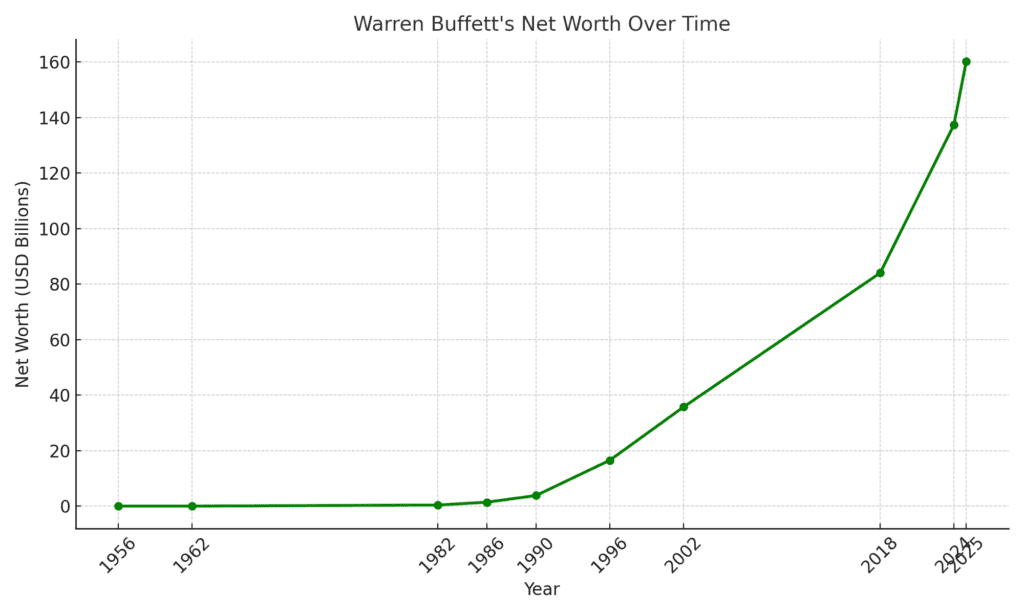
Warren Buffett’s wealth was not amassed through one large wager but rather through a disciplined strategy, astute acquisitions, and the compounding strength of time. His net worth is the consequence of consistency, patience, and long-term value.
Buffett’s investment success can also be attributed to his willingness to take a contrarian approach to investing and to hold onto his investments for the long term. He avoids trendy investments and instead focuses on investing in companies that have a proven track record of success and strong growth potential. By following his investment principles, he has been able to consistently outperform the market and generate strong returns over time.
        <p>
            <h3 class="wp-block-heading">Buffett’s Key Acquisitions and Investments</h3>
        </p>
Several cornerstones played a vital role in Buffett’s rise to becoming a billionaire:
- Geico: Buffett first invested in Geico during the 1950s and completely acquired the company in 1996. Geico’s direct-to-consumer model and underwriting discipline made it a prime example of an enduring competitive advantage. It also helped fund further acquisitions through its insurance float.
- See’s Candies (1972): Although a smaller acquisition in dollar terms, See’s taught Buffett the value of buying quality businesses with strong customer loyalty and pricing power. It became a high-margin cash generator and shaped his future investment philosophy.
- Coca-Cola (1988): Buffett invested over $1 billion in Coca-Cola shares following the 1987 market crash. He observed the company’s global brand strength, pricing power, and consistent cash flow. This holding has created billions in value over time. Berkshire Hathaway maintains ownership today.
- BNSF Railway (2009): Buffett called this acquisition “an all-in wager on the economic future of the United States.” BNSF provided steady, regulated cash flow and gave Berkshire exposure to a critical part of American infrastructure.
These deals revealed Buffett’s ability to spot sustainable businesses, buy them reasonably, and maintain them through market cycles.
        <p>
            <h3 class="wp-block-heading">Compounding Wealth</h3>
        </p>
Buffett’s secret is time. By starting investment at a young age and maintaining consistency for over 80 years, he let compound interest do the majority of the work. As he states, “My wealth stems from living in America, lucky genetics, and compound interest.”
Buffett rarely withdraws funds, unlike many investors who trade often. Rather, he reinvests earnings into businesses, enabling Berkshire’s portfolio and his net worth to grow over decades. Most of his wealth accumulated after age 50, proving the power of compounding paired with long-term patience.
Buffett’s journey demonstrates that steady wealth creation, with discipline and mindset, can be more effective than pursuing short-term gains.
Warren Buffett’s estimated net worth is over $157.5 billion as of June 2025, making him among the wealthiest in the world. Though he has enormous wealth, his investment approach remains the same.
Warren Buffett’s annual letters to Berkshire Hathaway shareholders (generally sent each February) have offered a masterclass in investing for decades. Free of corporate jargon and PR spin, these letters are known for clarity, wit, and insight, making them essential for all investors.
        <p>
            <h3 class="wp-block-heading">Insights and Transparency</h3>
        </p>
These letters are so powerful because of Buffett’s consistency. He discusses both successes and failures, offering a look into Berkshire’s decision-making. Buffett’s voice is educational whether he explains his reasoning behind acquiring a company or expressing his views on market speculation.
These letters express his investing philosophy to buy businesses you understand, focus on long-term value, and avoid unnecessary complexity. Buffett helps readers understand the reasoning behind his moves, not just the outcomes, by putting big ideas into plain language.
Examples of Key Lessons
Some key lessons from Buffett’s letters have guided investors:
- On Market Behaviour (1987 Letter):
“Be fearful when others are greedy and greedy when others are fearful.”
His most famous advice encapsulates Buffett’s contrarian mindset and ability to stay calm during irrational markets. - On Long-Term Thinking (1988 Letter):
“Our favourite holding period is forever.”
This explains Buffett’s buy-and-hold strategy. He looks for companies that can grow over decades. - On Risk and Simplicity (2006 Letter):
“Risk comes from not knowing what you’re doing.”
Buffett says risk isn’t in volatility but in misunderstanding investments. His strategy avoids complex instruments and sticks to businesses he can understand. - On Reputational Capital (2010 Letter):
“Lose money for the firm and I will be understanding; lose a shred of reputation for the firm and I will be ruthless.”
He places importance on integrity in business partners, leadership, and corporate culture.
In Buffett’s 2022 shareholder letter, released in February 2023, he discussed Berkshire Hathaway’s “secret sauce.” Berkshire finished buying its Coca-Cola and American Express positions in 1994 and 1995. Each position cost $1.3 billion and produced $116 million in dividends (a 4.5% dividend yield ). Those positions are now worth $1.06B, with Berkshire receiving over 38% of its investment back in dividends annually.
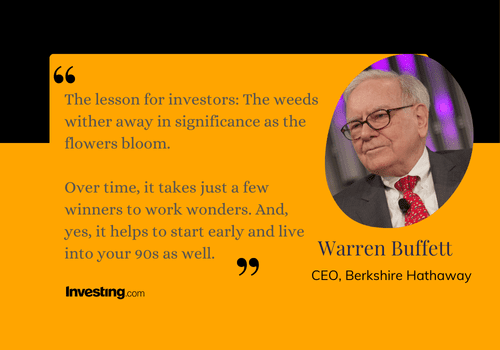
Buffett wrote, “These dividend gains, though pleasing, are far from spectacular. What have proven more important are the capital gains, as the positions are worth $25 billion and $22 billion, respectively. Making the right decision and holding on to it is, evidently, Berkshire’s secret sauce.” Buffett put it:
Buffett also holds an annual meeting with shareholders in Omaha each May, a highly awaited event. Buffett and Munger openly discuss current and timeless investing topics in these letters and events.
While ongoing tactical adaptations are needed, Buffett’s investing philosophy remains to seek strong businesses with competitive advantages for long-term holding. But, he recognizes adapting to market volatility. At the 2025 Annual Meeting, Buffett emphasized, “Adapt to reality; reality won’t adapt to your risk tolerance,” underlining flexibility in investing.
Berkshire’s cash reserves show a cautious approach in high market valuations. Buffett will invest capital when opportunities arise but remains disciplined, avoiding investments that fail his value and risk criteria. He prefers blue-chip companies with proven success and consistent growth. He focuses on the long term, avoids short-term trades, and looks to hold investments for years.
With Buffett transitioning leadership to Greg Abel, the company’s investment is expected to maintain its principles and adapt to the global economy.
His firm, Berkshire Hathaway, has opened positions in technology companies like Amazon, Taiwan Semiconductor, and Apple, per his 13F filings. Apple expresses many of Buffett’s principles and has become one of Buffett’s biggest winners thanks to its brand value and continued rise.
Warren Buffett’s approach to investing has withstood the test of time for its common sense, patience, and discipline. During market booms, busts, and revolutions, Buffett’s principles have remained consistent: buy quality businesses, think long-term, and stay within your competence.
Buffett’s philosophy is relevant due to fast markets and constant noise. His discipline offers a balance to the hype that dominates headlines. His strategy focuses on fundamentals over fads and holds solid decisions over decades.
Investing isn’t about predicting the future, but preparing wisely and holding steady. In a world chasing shortcuts, Buffett proves that consistency, clarity, and patience are still essential.
        <p>
            <h3 class="wp-block-heading">What are Warren Buffett’s thoughts on diversification?</h3>
        </p>
Buffett famously said, “Diversification is protection against ignorance. It makes little sense if you know what you are doing.” He believes that while diversification can protect investors, those who understand their investments may achieve better returns with a portfolio.
        <p>
            <h3 class="wp-block-heading">Does Warren Buffett invest in technology companies?</h3>
        </p>
Yes. Buffett’s Berkshire Hathaway has invested in technology firms like Apple Inc., which has become one of its largest holdings.
        <p>
            <h3 class="wp-block-heading">How does Buffett define a good company?</h3>
        </p>
Buffett looks for companies with an advantage that allows them to maintain capital returns. He likes businesses that are simple to understand and have earnings.
        <p>
            <h3 class="wp-block-heading">What does Buffett say about stock market volatility?</h3>
        </p>
Buffett sees market volatility as an opportunity. He tells investors to stay calm during fluctuations and focus on the value of their investments.
        <p>
            <h3 class="wp-block-heading">How does Buffett view economic downturns?</h3>
        </p>
Buffett sees economic downturns as chances to acquire companies at discounted prices. He emphasizes preparing to act when opportunities arise during market lows.
        <p>
            <h3 class="wp-block-heading">What role does patience play in Buffett’s investing?</h3>
        </p>
Patience is central to Buffett’s strategy. He believes in holding investments to allow interest to work, saying, “The stock market is a device for transferring money from the impatient to the patient.”
        <p>
            <h3 class="wp-block-heading">How important is ethical management to Buffett?</h3>
        </p>
Buffett places high importance on management. He says that a manager’s actions, if reported on the front page of a newspaper, should be comfortable.
        <p>
            <h3 class="wp-block-heading">What advice does Buffett give to new investors?</h3>
        </p>
Buffett recommends that new investors focus on index funds and invest consistently, understanding their investments and avoiding speculation.
        <p>
            <h3 class="wp-block-heading">How has Buffett adapted to digital transformation?</h3>
        </p>
Buffett has acknowledged the value in technology companies and has invested in firms like Apple, recognizing their brand and customer loyalty.
        <p>
            <h3 class="wp-block-heading">What are Buffett’s views on index investing?</h3>
        </p>
Buffett advocates for index investing for most individuals, suggesting a low-cost S&P 500 index fund for those who may not have the time or expertise to pick stocks.
        <p>
            <h3 class="wp-block-heading">How does Buffett manage risk?</h3>
        </p>
Buffett manages risk by investing in businesses he understands, with earnings. He avoids complex investments and emphasizes safety in his decisions.
        <p>
            <h3 class="