
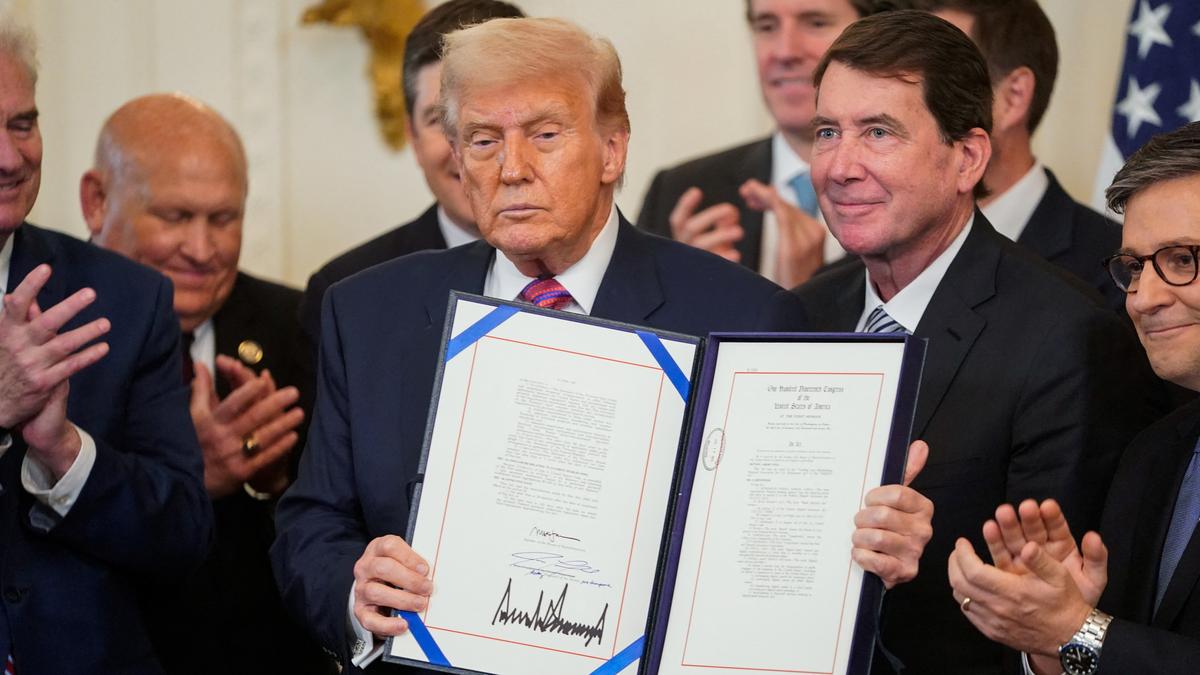
U.S. President Donald Trump holds the signed “Genius Act”, which will develop regulatory framework for stablecoin cryptocurrencies and expand oversight of the industry, next to U.S. Senator Bill Hagerty and U.S. House Speaker Mike Johnson, at the White House in Washington, D.C.
| Photo Credit: Reuters
In a move that could revolutionize digital payments, President Donald Trump signed into law on Friday, July 18, 2025, legislation designed to regulate stablecoins, cryptocurrencies pegged to the U.S. dollar. This landmark achievement could potentially transform these digital assets into mainstream payment methods for everyday transactions.
The GENIUS Act, as the bill is known, garnered significant bipartisan support, passing with a vote of 308 to 122. Nearly half of the Democratic representatives and the majority of Republicans voted in favor. This law represents a substantial victory for crypto advocates who have been pushing for a clear regulatory framework to legitimize the industry, which began in 2009 and has been characterized by both innovation and volatility.
“This law validates the hard work and pioneering spirit of everyone involved in the cryptocurrency space,” stated Mr. Trump during the signing ceremony, which was attended by several crypto industry leaders.

Stablecoins are designed to maintain a stable value, typically pegged 1:1 to the U.S. dollar. Their popularity has surged, particularly among cryptocurrency traders who use them to transfer funds between different digital tokens. The crypto industry hopes this new law will bring stablecoins into widespread use for instant payments and fund transfers.
Under the new regulations, stablecoins must be backed by highly liquid assets such as U.S. dollars and short-term Treasury bills. Issuers will also be required to provide monthly public disclosures detailing the composition of their reserves.
Cryptocurrency businesses and executives contend that this legislation will significantly enhance the credibility of stablecoins, encouraging banks, retailers, and consumers to adopt them for instant financial transactions.
According to CoinGecko, a crypto data provider, the stablecoin market is currently valued at over $260 billion. Standard Chartered bank predicted earlier this year that the market could potentially expand to $2 trillion by 2028 as a result of the new law.
The passage of this law is the culmination of extensive lobbying efforts by the cryptocurrency industry, which contributed over $245 million to pro-crypto candidates, including Mr. Trump, during the last election cycle, according to data from the Federal Election Commission.
President Trump, who has since launched his own digital coin, has embraced the cryptocurrency industry, stating at a crypto conference during his presidential campaign that he would make the United States “the crypto capital of the planet.”
However, some Democrats and critics argue that the law should have included provisions to prevent major tech companies from issuing their own stablecoins, which could increase the power of an already influential sector. They also believe the legislation should have incorporated stronger anti-money laundering safeguards and prohibitions against foreign stablecoin issuers.
Potential Boost for Treasury Bill Demand
Major U.S. banks are reportedly exploring potential forays into the cryptocurrency market as regulatory support for digital assets strengthens. However, Reuters reported in May that initial bank involvement would likely be cautious, focusing on pilot programs, partnerships, or limited trading activities.
Meanwhile, several crypto firms, including Circle and Ripple, are seeking banking licenses. This would enable them to expedite payment settlements, reduce costs by bypassing traditional intermediary banks, and enhance their legitimacy. Supporters of the bill suggest that it could generate a new source of demand for short-term U.S. government debt, or T-bills, as stablecoin issuers increase their holdings of these assets to back their digital currencies.
Conversely, concerns have been raised that this activity could introduce greater volatility into the Treasury bill market. In an April research note, JPMorgan analysts estimated that stablecoin issuers could emerge as the third-largest purchasers of Treasury bills in the coming years.
Trump Creates Bitcoin Reserve
President Trump has initiated a broad restructuring of U.S. cryptocurrency policies, including signing an executive order in March to establish a strategic bitcoin reserve.
Mr. Trump has also personally ventured into the digital asset space, launching a meme coin called $TRUMP in January and acquiring a partial ownership stake in the crypto company World Liberty Financial.
Congressional Democrats have become increasingly critical of Mr. Trump and his family’s promotion of their personal cryptocurrency projects, and their disapproval at one point threatened to stall the legislation’s progress.
The White House has asserted that no conflicts of interest exist for Mr. Trump, and that his assets are held in a trust managed by his children.
Published – July 19, 2025 01:21 am IST