

The landscape of digital currencies could be on the verge of a major shift. Increased investment from institutions and the proliferation of trading instruments within the Web3 ecosystem are making it simpler than ever to engage with digital assets, potentially ushering in an extended period of growth.
Certain market observers are suggesting the possibility of a cryptocurrency “supercycle.” This concept challenges the established four-year cycle traditionally linked to Bitcoin (BTC) halving events, proposing that digital asset values could climb to unprecedented heights beyond the constraints of this historical pattern.
For Ether (ETH), the second-largest cryptocurrency by market capitalization, this potential supercycle may be fueled by the growing integration of blockchain technology by major Wall Street firms, according to BitMine Immersion Technologies, a leading corporate holder of Ether.
BitMine, a significant corporate investor in ETH, stated that the primary catalyst for Ether’s potential surge could be “Wall Street’s deep dive into blockchain,” as indicated in their analysis.
Related: BlackRock reaping substantial revenue from Bitcoin and Ether ETFs
While the prospect of a supercycle is generating excitement, not every participant on Wall Street shares this optimistic outlook for Ether’s future price.
Citigroup, a prominent U.S. investment bank, has projected a year-end target price of $4,300 for Ether. This projection is considerably lower than Ether’s record high of $4,953, reached on August 24th.
“The present valuation surpasses estimates based on actual activity, potentially driven by recent purchasing trends and heightened enthusiasm surrounding potential applications,” Citigroup explained in a research note released Monday, as reported by Reuters.
Over the past six months, Ether has appreciated by approximately 108% and was trading at $4,177 at the time of this report, according to data from TradingView.
Related: Machi Big Brother incurs losses exiting HYPE position
The Role of AI Agents
BitMine also highlights the expanding use of AI agent protocols as a second factor potentially contributing to an Ethereum supercycle.
AI agents will necessitate a “neutral platform” such as a public blockchain, possibly driving further adoption and use cases for Ethereum, a dominant smart contract platform.
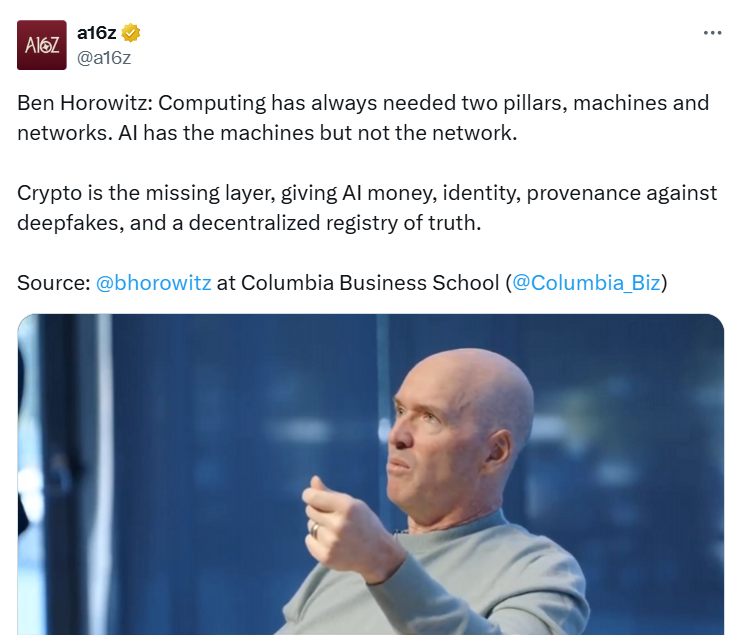
According to Ben Horowitz, co-founder and general partner at Andreessen Horowitz (a16z), “For AI to achieve its full potential, it must participate in the economy. This necessitates AI agents being capable of making purchases and generating revenue.”
Horowitz further elaborated in a Tuesday X post: “AIs cannot utilize credit cards. Therefore, cryptocurrency, the internet’s native form of money, emerges as the logical solution. Crypto is like the economic network for AI.”
“Credit cards are not suitable as currency for AI. Crypto is the logical internet native money.”
AI agents are specialized software designed to automate and perform designated tasks on behalf of users.
Autonomous on-chain agents possess the capability to interact directly with blockchain protocols, enabling a range of functionalities including automated trading, token swaps, portfolio management, and engagement with decentralized finance (DeFi) platforms.
Leading fintech companies are investing significantly in AI agent technology. For example, on September 2nd, PayPal Ventures spearheaded an $18 million Series A funding round for Kite AI, a provider of decentralized AI infrastructure. This investment brings Kite AI’s total funding to $33 million, as reported by Cointelegraph.
Magazine: The story of the Ethereum and Polkadot co-founder absent from Time Magazine’s spotlight