

Automated trading, frequently referred to as “algo trading,” boasts a substantial history, initially dominating equities trading before expanding into the currency exchange and commodities sectors. Within the digital currency sphere, it began as a specialized tool utilized by technically proficient traders. Today, its popularity has soared. Automated systems now manage a sizable portion of the daily trading activity.
Fueled by increased acceptance among institutions, enhanced exchange Application Programming Interfaces (APIs), and more transparent regulations, automated strategies have evolved, becoming more sophisticated and universally accessible. Regardless of whether you are an individual investor or managing a significant investment fund, overlooking the potential benefits of algo-driven trading could put you at a disadvantage.
Algo trading offers cryptocurrency markets speed, streamlined operations, and automation. Software programs can rapidly interpret data, execute transactions, and respond to changes in prices—in mere milliseconds. This gives traders a significant advantage over manual trading techniques. Strategies such as market-making, arbitrage, and high-frequency transactions enable higher potential revenue while minimizing emotional decision-making.
However, it’s important to note that automated trading isn’t solely about generating profits and passive income. Excessive optimization of a trading system can lead to unforeseen malfunctions, while market instability may quickly eradicate potential gains. Furthermore, traders are dependent on the stability of exchange APIs; should an API fail during a transaction, the situation can quickly become problematic. The effectiveness of a well-designed strategy hinges on prudent risk management.
Key Elements to Consider in an Algo Trading Platform
The success of algorithmic trading depends on the ability to execute a well-developed strategy on a dependable platform. For those involved in algo trading, speed, dependability, and security are essential. Below are the most important elements.
API Performance and Reliability
Your automated trading system interacts with a platform via an API (Application Programming Interface). An unreliable API can significantly impair performance. Critical attributes include:
- Comprehensive Documentation – Well-organized, thorough API documents enable developers to integrate their bots effectively.
- Low Latency – In algorithmic trading, every millisecond counts. A delayed API increases slippage and can derail high-speed trading strategies.
- High Data Throughput – Some platforms limit the number of API requests permitted each second, which can hinder a bot’s capacity to trade efficiently.
A dependable API should have virtually no downtime, as API failures invariably disrupt trading activities.
Market Data and Analytics Tools
Algo traders rely on timely and precise market data to effectively execute trades. Without this data, the bots are trading without adequate market information.
- Real-time data feeds – Delayed prices result in missed opportunities. The best platforms provide price updates in real-time.
- Historical data access – Backtesting is vital for refining trading strategies. Platforms that offer extensive historical data enable traders to simulate the effectiveness of strategies before deployment.
- Order book visibility – Deep order book access is vital for strategies like market-making, as it provides essential insights into market liquidity and the impact of trades.
Inaccurate data leads to unprofitable trades. It’s important to select a platform with a robust data infrastructure.

Security Measures and Governance
A compromised trading bot or API key could lead to immediate losses. A secure platform should include:
- Cold storage & insurance – The majority of assets should be stored in offline storage to minimize the risk of cyber-attacks.
- Regulatory compliance – Adherence to KYC (Know Your Customer) and AML (Anti-Money Laundering) regulations signals a more reliable and secure platform.
- API key protections – Security features such as IP whitelisting and restrictions on withdrawals can effectively prevent unauthorized entry.
Security ensures the continued functionality of your trading operations.
Leading Crypto Platforms for Algo Trading in 2025
| Platform | Algo-Friendly Features | Pros | Cons | Futures Fees | Subscription Fees |
|---|---|---|---|---|---|
| Binance | REST & WebSocket APIs, Futures API, sub-accounts, Binance Broker Program |
|
|
0.02% (maker) / 0.05% (taker) | No subscription fees |
| Kraken | REST & WebSocket APIs, Futures API, Kraken Terminal, dark pool trading |
|
|
0.02% (maker) / 0.05% (taker) | No subscription fees |
| KuCoin | REST & WebSocket APIs, Futures API, built-in trading bots, sub-accounts |
|
|
0.02% (maker) / 0.06% (taker) | No subscription fees |
| Pionex | REST & WebSocket APIs, 16 free built-in bots, grid and DCA bots |
|
|
0.02% (maker) / 0.05% (taker) | No subscription fees |
| 3Commas | REST & WebSocket APIs, Smart Trading Terminal, copy trading, bot marketplace |
|
|
Dependent on the integrated exchange |
$49/month for Pro $79/month for Expert |
| OKX | REST, WebSocket & FIX APIs, algo orders, high API rate limits, portfolio margining |
|
|
0.02% (maker) / 0.05% (taker) | No subscription fees |
| SpeedBot | REST & WebSocket APIs, multi-exchange compatibility, pre-built & custom bots |
|
|
Dependent on the integrated exchange | $15 – $250 per month |
Binance
Binance provides a platform suitable for both high-frequency trading and automated bot operations. Its offers high transaction speeds, abundant liquidity, and a comprehensive API structure.
👉 Sign Up For Binance – Exclusive 20% Trading Fee Discount For Life + $600 Bonus
Algo-Friendly Features
Binance provides both RESTful and WebSocket APIs, positioning it as an efficient solution for automation.
- REST API – Facilitates trade execution, account management, and the retrieval of market data.
- WebSocket API – Provides real-time market updates with minimal latency.
- Futures API – Tailored for high-speed leveraged transactions.
- Supported Languages – Integrates smoothly with Python, Java, C++, and other languages, facilitating bot integration.
Beyond APIs, Binance provides a selection of sophisticated tools suitable for algo traders:
- Sub-accounts & API Key Management – Perfect for organizations managing multiple strategies.
- Binance Broker Program – Provides institutional traders with enhanced market liquidity.
Pros
- High liquidity facilitates smooth execution.
- Quick API supports thousands of requests per second.
- Supports spot, margin, futures, and options trading.
Cons
- Regulatory difficulties in some regions.
- API usage limitations can affect high-speed traders.
Fees
- Spot: 0.10% for makers/takers (lower with VIP levels & BNB discounts).
- Futures: 0.02% (maker) / 0.05% (taker).
Find our Binance review here!
Kraken
Kraken has established a solid reputation as a secure and regulation-compliant crypto platform. Though its trading volume is less than Binance, its robust API support, enterprise-level security features, and sophisticated trading tools make it a good option for automated trading.
Algo-Friendly Features
Kraken has a well-documented API structure, facilitating diverse automation needs:
- REST API – Facilitates trade execution, retrieves account balances, and handles orders.
- WebSocket API – Provides real-time market updates with low latency.
- Futures API – Designed for leveraged trading with support for advanced order types.
- Supported Languages – Compatible with Python, JavaScript, and C++, and caters to a wide spectrum of developers.
Kraken also provides supplemental tools to improve automated trading:
- Kraken Terminal – A professional interface for in-depth technical analysis and executing strategies.
- Dark Pool Trading – Allows traders to execute large transactions discreetly without altering market prices.
- Advanced Order Types – Includes stop-loss, take-profit, and conditional close orders to automate risk management.
Pros
- Highly secure – A trusted platform with solid regulatory adherence.
- Advanced trading functionalities – Supports complex order types and dark pool trading.
- Good liquidity – While it does not have the highest liquidity, it is adequate for major crypto pairs.
Cons
- Lower trading volume compared to Binance, resulting in higher spreads.
- API latency is higher than some competitors, potentially impacting high-frequency traders.
Fees
- Spot Trading: Starts at 0.25% (maker) / 0.40% (taker), and may be reduced with discounts for high-volume traders.
- Futures Trading: Starts at 0.02% (maker) / 0.05% (taker).
Find our comprehensive Kraken review here.
KuCoin
KuCoin distinguishes itself as the “People’s Exchange” because of its extensive selection of cryptocurrencies and a range of useful features for traders. While its liquidity does not match that of Binance, it makes up for this with sophisticated API functionalities, affordable trading costs, and a primary focus on automation, positioning it as a stellar option for algorithmic traders.
👉 Sign Up For Kucoin – Trading Fee Discount of Up To 60% + FREE Trading Bot!
Algo-Friendly Features
KuCoin offers an organized API framework developed for automated and bot-assisted trading:
- REST API – Manages trade execution, order management, and the retrieval of account balances.
- WebSocket API – Provides real-time market data updates with minimal latency.
- Futures API – Supports perpetual contracts and leveraged trading.
- Supported Languages – Compatible with Python, Java, Go, Node.js, which simplifies the integration of trading bots.
KuCoin also offers a range of tools specifically for algo traders:
- KuCoin Trading Bot – Allows users to automate trading without using third-party software.
- Sub-Accounts & API Permissions – Suitable for institutions and traders running diverse strategies.
- Advanced Order Types – Includes stop-market, stop-limit, and iceberg orders for automated trading.
Pros
- Low trading costs – Some of the most competitive fees in the industry.
- Integrated trading bots – Eliminates the need for external automation tools.
- Good trading volume on major pairs – Guarantees smooth execution.
Cons
- Security risks – KuCoin has experienced cyber-attacks in the past, although security measures have since been enhanced.
- Lower liquidity on niche altcoins – Traders dealing with less common tokens may experience slippage.
Fees
- Spot Trading: Starting at 0.1% (maker/taker), with discounts available for high-volume traders and holders of KCS (KuCoin token).
- Futures Trading: Starting at 0.02% (maker) / 0.06% (taker).
You can find our detailed KuCoin review here.
Pionex

Pionex, a bot-focused crypto platform, provides 16 integrated trading bots, making it a stellar option for traders seeking to automate their trading strategies without needing third-party software. Its low fees and intuitive design appeal to both experienced and inexperienced algo traders.
Algo-Friendly Features
Pionex offers an API structure suited to advanced traders:
- REST API – Enables traders to execute orders, manage accounts, and retrieve data.
- WebSocket API – Delivers real-time market data with low latency.
- Supported Languages – Works with Python and JavaScript, enhancing its accessibility to developers.
Pionex’s hallmark feature is its integrated trading bots, including:
- Grid Trading Bot – Automates buying low and selling high within a specific price range.
- Infinity Grid Bot – Like the grid trading bot, but without an upper price limit.
- Leveraged Grid Bot – Adds leverage to potentially increase returns.
- DCA (Dollar-Cost Averaging) Bot – Automates regular purchases to facilitate long-term investing.
Pros
- 16 complimentary built-in trading bots – Eliminates the need for third-party automated software.
- Low trading costs – Lower than most major exchanges.
- User-friendly interface – Ideal for new entrants into algorithmic trading.
Cons
- Limited API customization – Not as sophisticated as the APIs on Binance or Kraken for personalized bots.
- No futures trading – Focuses on spot trading, limiting high-speed trading strategies.
Fees
- Spot Trading: Flat 0.05% maker/taker fee, which is lower than industry standards.
- Futures Trading: 0.02% (maker) / 0.05% (taker).
Read our detailed Pionex analysis here.
3Commas

Unlike conventional exchanges, 3Commas links to multiple exchanges, allowing traders to implement algorithmic strategies across various markets. It includes a powerful API, ready-made strategies, and portfolio management tools.
Algo-Friendly Features
3Commas delivers a robust API that connects to major cryptocurrency exchanges, facilitating smooth automation:
- REST API – Links bots to supported exchanges to enable trade execution and portfolio tracking.
- WebSocket API – Streams live price data for real-time decision-making.
- Supported Languages – Compatible with Python, JavaScript, and C++, facilitating customized bot development.
Besides APIs, 3Commas provides powerful automation tools, including:
- Smart Trading Terminal – Enables advanced trade management, including stop-loss, take-profit, and trailing orders.
- Pre-Built & Custom Bots – Includes grid bots, DCA bots, and futures bots.
- Copy Trading & Signal Marketplace – Enables users to replicate the tactics of successful traders and automated signals.
Pros
- Supports multiple exchanges – Trade on Binance, Kraken, KuCoin, and others.
- Powerful automation tools – Customizable bots and portfolio monitoring tools.
- User-friendly interface – Appeals to new and seasoned traders.
Cons
- Subscription-based model – 3Commas charges a monthly fee, unlike conventional exchanges.
- Dependent on third-party exchanges – Does not facilitate direct trading and instead relies on API connections.
Fees
- Subscription Plans: Vary from $49 to $79 monthly, based on whether you select Pro or Expert options. Subscriptions come with price reductions if you select annual or biannual payment options.
- Trading Fees: Does not levy additional charges beyond those assessed by the linked exchange.
Read our detailed 3Commas review here.
OKX
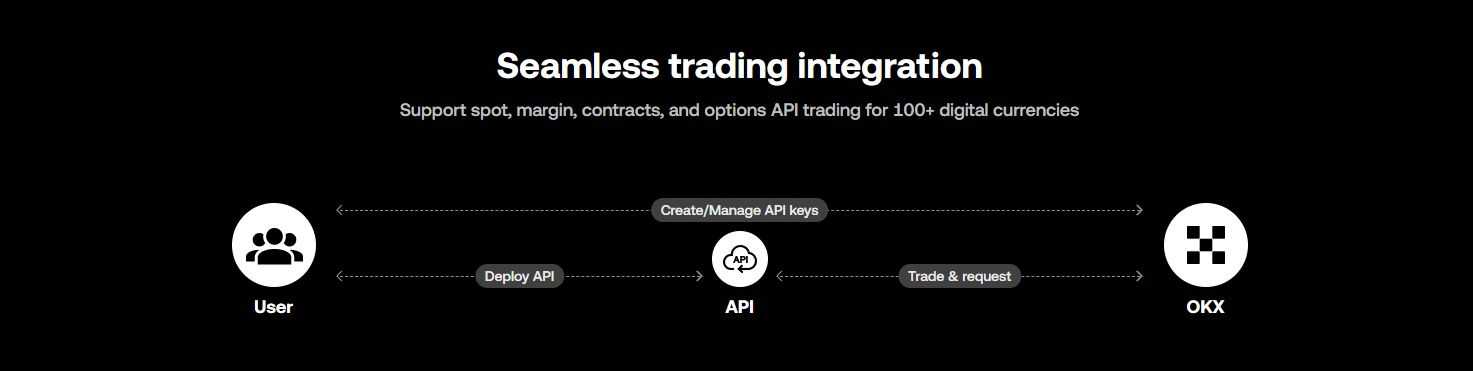
OKX is a high-performance exchange marked by impressive APIs, high liquidity, and sophisticated trading functionalities. OKX is optimal for both retail and institutional traders seeking quick execution and automation features.
👉 Sign Up For OKX – Exclusive 40% Spot Trading Fee Discount + Get Up To $20K In Bonuses
Algo-Friendly Features
OKX’s sophisticated API infrastructure is ideal for high-frequency and automated trading applications:
- REST API – Allows for executing trades, retrieving market information, and account administration.
- WebSocket API – Conveys real-time price updates and order book information.
- FIX API – Low-latency protocol designed for use by institutional traders.
- Supported Languages – Compatible with Python, Java, and C++, and is easily accessible for algo developers.
Supplemental tools that support automated trading applications include:
- Algo Order Types – Facilitates iceberg orders, TWAP (Time-Weighted Average Price), and stop orders.
- High API Rate Limits – Works well for high-frequency traders needing to rapidly execute orders.
- Portfolio Margining – Lessens the margin obligations for traders running multiple strategy portfolios.
Pros
- Fast API with minimal execution latency.
- Significant liquidity across derivatives and spot markets.
- Complex order types and risk management tools.
Cons
- Regulatory limitations in select regions.
- The user interface may be complex for beginners.
Fees
- Futures Trading: Beginning at 0.02% (maker) / 0.05% (taker), but can be lower for VIP traders.
- API Trading: Does not add to standard trading charges.
A complete overview of OKX can be found here.
SpeedBot
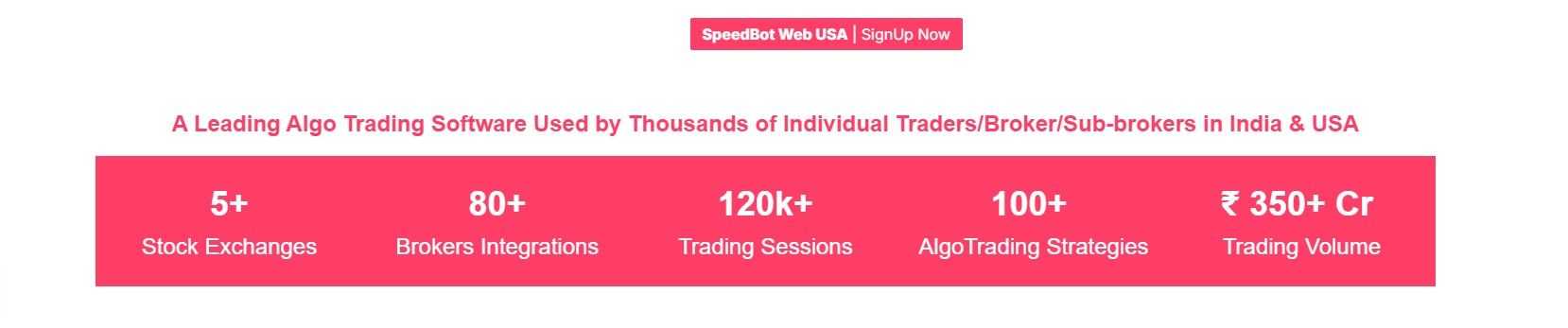
SpeedBot, tailored to high-speed and algorithmic trading, provides configurable algorithmic strategies, real-time execution, and the ability to trade on multiple exchanges, making it a good choice for traders seeking precision automation.
Algo-Friendly Features
SpeedBot delivers a versatile API infrastructure and automation tools, which appeals to both retail and institutional traders:
- REST API – Stream