

Author: Stephen Katte
Compiled by: TechFlow
A fresh study from CoinGecko, published this week, reveals that 10% of those surveyed have yet to acquire any Bitcoin. Furthermore, only 55% of newcomers to the crypto space include Bitcoin as part of their initial investment strategy.

The recent CoinGecko analysis points to a trend where just over half – precisely 55% – of new cryptocurrency investors begin their journey with Bitcoin. Analysts are interpreting this data as an indicator of the growing sophistication within the digital asset market.
CoinGecko’s research, encompassing responses from 2,549 individuals involved in cryptocurrency, highlights that a significant portion, 10%, have intentionally avoided Bitcoin purchases altogether.
According to Yuqian Lim, a research analyst at CoinGecko, “The rising influence of alternative cryptocurrencies and their associated communities is making Bitcoin less of a default starting point for new investors.”
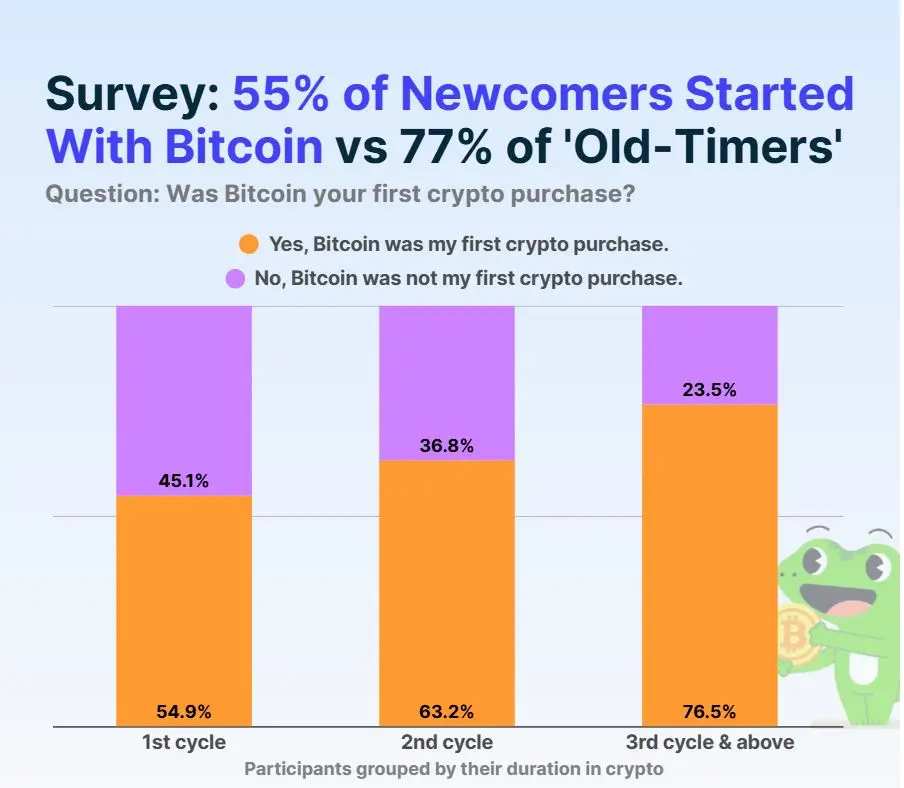
Among those new to crypto, just 55% started with Bitcoin.
Source: CoinGecko
Altcoins Gain Traction: A Sign of Market Evolution
In a recent interview with Cointelegraph, Jonathan Miller, Managing Director at the Kraken exchange, suggested that investors are now finding their way into the crypto space through different channels, such as Decentralized Finance (DeFi) projects or even meme-inspired coins.
Miller explained, “This evolution signifies the maturing of the crypto landscape. Bitcoin is no longer the sole dominant asset, and the accessibility of cryptocurrency acquisition has improved. This allows newcomers to engage more readily with developing trends.”
However, Miller also anticipates that those who initially sidestepped Bitcoin might eventually reconsider, especially given the increasing global instability, currency devaluation, and Bitcoin’s standing as a reliable and robust form of digital money.
“Many who entered the market driven by short-term trends will, in time, come to understand Bitcoin’s significance and adjust their investment strategies accordingly,” Miller added.
The Appeal of Alternative Cryptocurrencies
Hank Huang, CEO of Kronos Research, a quantitative trading firm, shared with Cointelegraph his view that newcomers often find altcoins attractive due to their lower individual coin price and the strong community support they often foster.
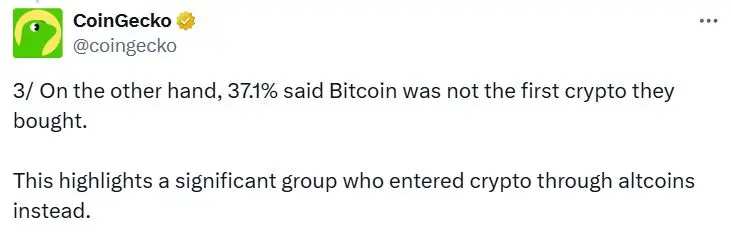
CoinGecko’s survey reinforces this point, revealing that 37% of respondents began their crypto journey with altcoins rather than Bitcoin.
Source: CoinGecko
Huang stated, “As cryptocurrencies gain broader acceptance, more individuals are likely to bypass Bitcoin and focus on altcoins that offer lower market capitalizations and strong community engagement. This reflects the market’s increasing maturity and the role diversification plays in user participation.”
“Currently, market momentum favors Solana (SOL), Ethereum (ETH), and meme coins, transforming Bitcoin from the automatic entry point into just one option among many within the crypto ecosystem.”
Huang further suggested that the long-term future of cryptocurrencies will not hinge solely on Bitcoin, as it faces competition from newer technologies and its adoption is being influenced by a “dynamic environment where innovation, culture, and community are just as critical as perceived value.”
Fear of Missing Out (FOMO) on Altcoins
Tom Bruni, head of markets at Stocktwits, a social media platform for investors, explained to Cointelegraph that a lack of understanding and Bitcoin’s consistently rising price could also be factors.
Bruni commented, “While those already familiar with crypto feel the industry is still nascent, outsiders might believe they’ve missed their chance to invest in Bitcoin, especially since its price has climbed past $100,000.”
“In the recent surge, certain altcoins outperformed Bitcoin substantially, leading investors to search for ‘cheaper’ alternatives, pushing them toward riskier altcoins and meme coins.”
In 2025, Bitcoin repeatedly reached new all-time highs, most recently surpassing $124,000 on August 14th.
Furthermore, Bruni pointed out that as altcoins, stablecoins, and other blockchain-based technologies progress, Bitcoin’s dominance could diminish, though it would likely remain a core holding in many investment portfolios.
He concluded, “Ultimately, returns on investment dictate allocation choices. As long as Bitcoin’s returns can keep pace with the rest of the crypto landscape, widespread avoidance is unlikely.”
“At present, Bitcoin is performing strongly. However, a market downturn could prompt investors to return to Bitcoin as a more stable and institutionalized cryptocurrency choice.”
Bitcoin’s Enduring Relevance
Qin En Looi, Managing Partner at Onigiri Capital, a venture capital firm, conveyed to Cointelegraph that early adopters already own Bitcoin, while the majority of later entrants will only participate once Bitcoin is integrated into established financial systems and accessible through banks, wealth managers, or retirement accounts.
Looi stated, “As this infrastructure evolves, we may see a decrease in the number of people who hold no Bitcoin. However, this process may be slower than many anticipate, as it requires building trust systematically.”
Ultimately, Looi believes that Bitcoin’s function is changing, but it will never disappear, as it serves as a benchmark for the overall cryptocurrency market, similar to how gold remains a reference point in traditional finance.
“We’re not witnessing a decline in correlation, but an expansion of it, with stablecoins, tokenized assets, and application-layer projects now taking center stage.”