
- Under a pro-crypto President Donald Trump, the regulatory climate in the United States for cryptocurrencies is evolving toward greater clarity and more accommodating policies.
- Significant actions include the introduction of the GENIUS Act, the establishment of a Strategic Bitcoin Reserve, the launch of Trump-supported World Liberty Financial, and the appointment of regulators favorable to cryptocurrency.
- FXStreet explores how these developments could position America as a leading global center for cryptocurrency by interviewing industry experts.
The United States is aiming to become a dominant force in the global cryptocurrency arena under the leadership of President Donald Trump. This ambition is fueled by various initiatives from the Trump administration, such as the GENIUS Act, a planned Strategic Bitcoin Reserve, and the creation of Trump-affiliated ventures. Furthermore, the appointment of pro-crypto regulators signals a clear policy shift intended to foster broader adoption and bolster market confidence. FXStreet sought expert opinions to better understand the potential implications of these changes.
Pro-Crypto Policies Advanced by Trump’s Presidential Victory
The election of Donald Trump, seen as a champion of cryptocurrency, in the 2024 US presidential election marked a watershed moment for the digital currency sector. Bitcoin experienced an unprecedented surge to $76,400 on November 6, the day following the US Presidential election. This surpassed its earlier peak of $73,777 in March 2024. Crypto-related stocks, including Coinbase and Strategy, mirrored this upward trend.
Throughout his campaign, Trump pledged to fundamentally alter US crypto policy, contrasting sharply with the previous administration’s stringent approach, which saw over 100 enforcement actions by the US Securities and Exchange Commission (SEC) against cryptocurrency businesses.
An early indicator of this shift was the announcement on November 21 that Gary Gensler would step down as SEC Chair, effective January 20, President Trump’s inauguration day. This news was well-received by the crypto market, given Gensler’s perceived negative stance on digital asset regulation.
Data from CryptoQuant indicates a significant acceleration in the monthly growth rate of Bitcoin holdings among large investors. This metric jumped from -0.25% on January 14 to +2% on January 17, representing the most substantial monthly increase since mid-December. This surge in demand propelled Bitcoin to a new record high of $109,588 on January 20, Trump’s inauguration day.
December 2024: Key Appointments Signal Pro-Crypto Stance
Trump’s Investments and Interest in Digital Assets
The Trump family’s launch of World Liberty Financial (WLFI), a DeFi project built on the Ethereum blockchain and promoted by his sons (Donald Jr., Eric, and Barron) in September 2024, serves as another example of Trump’s engagement with the crypto sector. Although the project has attracted controversy due to potential conflicts of interest, many crypto enthusiasts see it as a strong indication of Trump’s commitment to digital currencies, thus boosting market sentiment.
WLFI tokens have garnered interest from a variety of prominent figures and companies within the crypto community, including Justin Sun, the Founder of Tron; Aqua 1 Foundation, a UAE-based venture capital firm; and ALT5 Sigma Corporation.
Data from Arkham reveals that WLFI currently holds $460.42 million in digital assets, including Ethereum (ETH), Aave (AAVE), Chainlink (LINK), and other cryptocurrencies. The DeFi project has also introduced its own stablecoin, USD1, designed to be backed 1:1 by the US Dollar.
Further demonstrating his increasing interest in digital assets, Trump’s Trump Media and Technology Group (DJT) has submitted an application to the US SEC for a Bitcoin ETF.
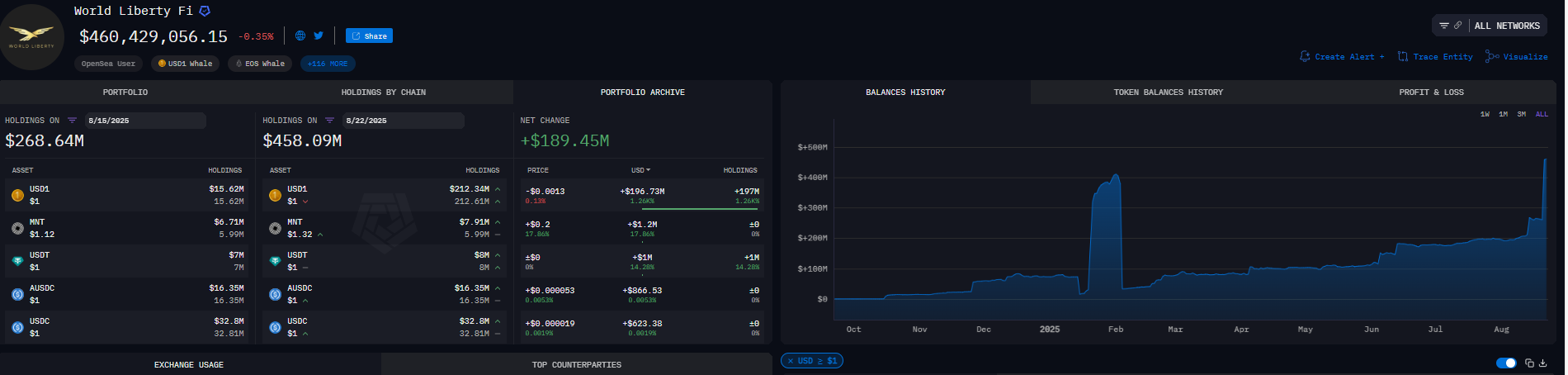
WLFI holdings chart. Source: Arkham
Beyond the DeFi venture, Trump also backed a meme coin, Official Trump (TRUMP), which briefly achieved a market capitalization of $8.79 billion in January. It has generated millions in trading fees and dollar-pegged crypto for entities linked to Trump. However, critics point out the meme coin’s limited investment value, and its current market capitalization is $1.62 billion.
Establishment of SEC Crypto Task Force
The US SEC acting Chairman, Mark Uyeda, initiated the creation of a crypto task force, headed by Commissioner Hester Peirce, with the goal of developing a comprehensive regulatory framework for digital assets. This represents an initial step toward providing clearer regulatory guidelines for the cryptocurrency industry.
Subsequently, President Trump signed an Executive Order (EO) designed to support cryptocurrency and solidify US leadership in the digital asset space. It includes a plan to establish a strategic national digital asset reserve for the United States. The order also prohibits any steps toward creating or promoting a Central Bank Digital Currency (CBDC), effectively reversing the previous Biden administration’s order 14067 on digital assets. The executive order promoted open access to blockchain networks and safeguards for dollar-backed stablecoins, signaling a preference for innovation over excessive restriction.
Inaugural White House Crypto Summit
The first White House Crypto Summit, held in March, provided a forum for discussing regulation and innovation within the cryptocurrency sector. The Summit underscores the government’s supportive attitude toward crypto and its commitment to creating clear regulatory structures, as promised by President Trump during his campaign.
Furthermore, Trump signed an executive order to establish a Strategic Bitcoin Reserve (SBR) utilizing BTC seized from “criminal or civil asset forfeiture proceedings” without allocating new capital. This will manage 207,189 BTC and other cryptocurrencies recovered from criminal cases.
This development is intended to centralize and manage federal crypto holdings, prevent losses from premature sales, and position the US as a frontrunner in digital asset ownership.
In addition, the US is actively engaged in combating crypto-related fraud and collaborating with law enforcement nationwide to seize and recover stolen funds, and safeguarding investors’ resources. The US Department of Justice (DOJ) recently announced its largest cryptocurrency seizure to date, involving over $225 million linked to crypto fraud. The FBI’s Internet Crime Complaint Center reported that cryptocurrency investment fraud resulted in over $5.8 billion in losses in 2024 alone.
US States Engage in Bitcoin Reserve Race
In addition to the Trump administration’s Strategic Bitcoin Reserve, numerous US states have begun establishing their own Bitcoin reserves, as depicted in the chart below.
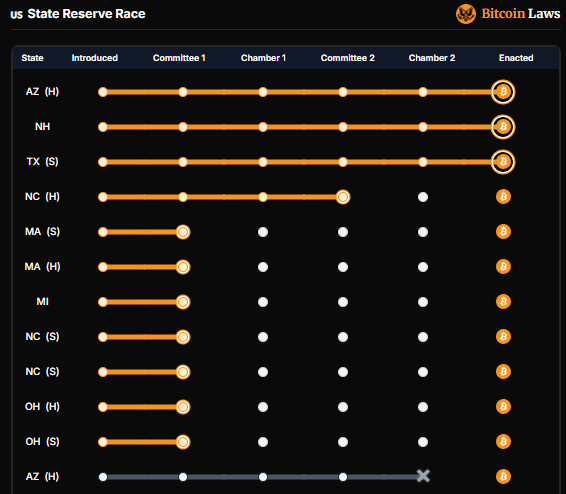
New Hampshire Governor Kelly Ayotte signed House Bill 302 (HB 302) into law, making New Hampshire the first state in the US to establish a Strategic Bitcoin Reserve. The law permits the state treasurer to allocate up to 5% of public funds to precious metals or digital assets with a market capitalization exceeding $500 billion, a criterion currently met only by Bitcoin. While the bill does not mandate the creation of such a reserve, it gives the state treasurer the option to invest in one.
Arizona Governor Katie Hobbs also signed House Bill 2749 (HB 2749) into law, allowing the state to claim ownership of unclaimed digital assets, including cryptocurrency, abandoned for at least three years. The law facilitates the creation of a Bitcoin and Digital Asset Reserve Fund, which will accumulate value from staking rewards and airdrops of these assets, without using taxpayer funds.
Following these announcements, Texas launched a state-funded Bitcoin reserve, becoming the first US state to do so independently in late June. Governor Greg Abbott approved Senate Bill 21 (SB 21), enabling the Texas Comptroller to manage the fund to allow qualified third parties to manage the reserve and requiring crypto purchases, with funds appropriated by the legislature or from reserve revenues, to be invested in digital assets, similar to the New Hampshire law.
Similar bills are under consideration in other state legislatures, including Massachusetts, Michigan, North Carolina, and Ohio, reflecting increasing crypto adoption in the US.
Stablecoin Regulations: The GENIUS Act
Donald Trump signed the GENIUS Act into law in mid-July. This legislation establishes a clear federal regulatory structure for stablecoins and their issuers in the US. It mandates full reserves backed by the US Dollar (USD) and provides clear anti-money laundering (AML) guidelines.
Deutsche Bank Research has suggested that this significant bill positions the US as a leader in stablecoin regulation, encouraging other countries to re-evaluate their own stablecoin regulations (or lack thereof).
“It is a significant milestone for the crypto industry, both in the US and globally,” Deutsche Bank analysts reported.
The report further emphasizes that the passage of the GENIUS Act will reinforce the US Dollar’s dominance. USD-denominated stablecoins currently represent over 99% of the total stablecoin market capitalization. The GENIUS Act formalizes the role of stablecoin issuers as quasi-money market funds, thereby supporting US short-term debt markets and attracting non-USD liquidity into the US dollar.
The US Treasury projects that T-bills held by stablecoin issuers (excluding interest-bearing stablecoins) will increase to approximately $1 trillion by 2028. Tether alone holds over $120 billion in Treasury bills as of Q1 2025, as depicted in the graph below, making it one of the top holders of US Treasuries.
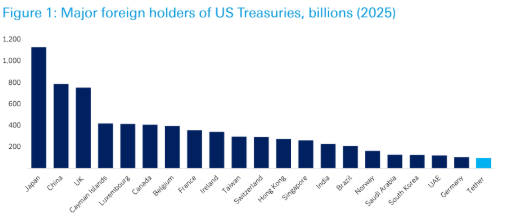
Major foreign holders of US Treasuries, billions (2025) chart. Source: Deutsche Bank Research
The GENIUS Act also incentivizes competition between traditional banks, stablecoin issuers, and corporations, prompting participants to enter the expanding stablecoin space and extend stablecoin applications beyond crypto trading.
Corporations in the retail (Walmart, Amazon, Airbnb) and payments (PayPal, Shopify) sectors are moving rapidly to capitalize on stablecoins’ advantages, including lower remittance costs, 24/7 availability, faster settlement times, and fewer transactional barriers than those required by traditional bank accounts.
US Treasury Secretary Scott Bessent predicts that the stablecoin market will grow from its current $268 billion to over $2 trillion in the next few years.
US SEC Approves In-Kind Creations and Redemptions for Bitcoin and Ethereum ETPs
The US SEC voted to approve orders enabling in-kind creations and redemptions by authorized participants for crypto Exchange Traded Products (ETPs) shares, highlighting increased regulation clarity in cryptocurrencies by the US.
This order marks a shift from the previous cash-only system used for spot BTC and ETH ETPs, which limited creations and redemptions to an in-cash basis. This new system enables investors to receive the underlying asset, deemed more efficient as it allows the fund’s authorized participants to avoid selling the assets on the market, potentially reducing transaction costs. It also aligns crypto ETPs with traditional commodity-based ETPs, like Gold and Oil.
The Commission also approved other orders that support a merit-neutral approach to crypto-based products, including exchange applications seeking to list and trade an ETP holding mixed spot Bitcoin and spot Ether, options on specific spot Bitcoin ETPs, Flexible Exchange (FLEX) options on shares of particular BTC-based ETPs, and an increase in position limits up to the generic limits for options (up to 250,000 contracts) for listed options on certain BTC ETPs.
Crypto in Retirement Plans
President Trump signed an executive order opening the door for $9 trillion to $12.5 trillion in 401(k) retirement funds to be invested in cryptocurrency, private equity, and real estate.
Critics have questioned the move, arguing that it could destabilize retirement accounts, while details of the directive remain unclear.
The order enables the provision of digital assets, precious metals such as Gold, and private loans in retirement plans as alternatives to the traditional portfolio of Stocks and Bonds.
Treasury Secretary Scott Bessent said in August, “We’re going big on digital assets,” further emphasizing the administration’s commitment and boosting market confidence.
Growing US-Based Institutional Investors
On the institutional side, the US leads globally in the number of entities with over 3.68 million in BTC treasuries and 300 companies (both public and private), outperforming countries such as Canada and the United Kingdom, as shown in the chart below.
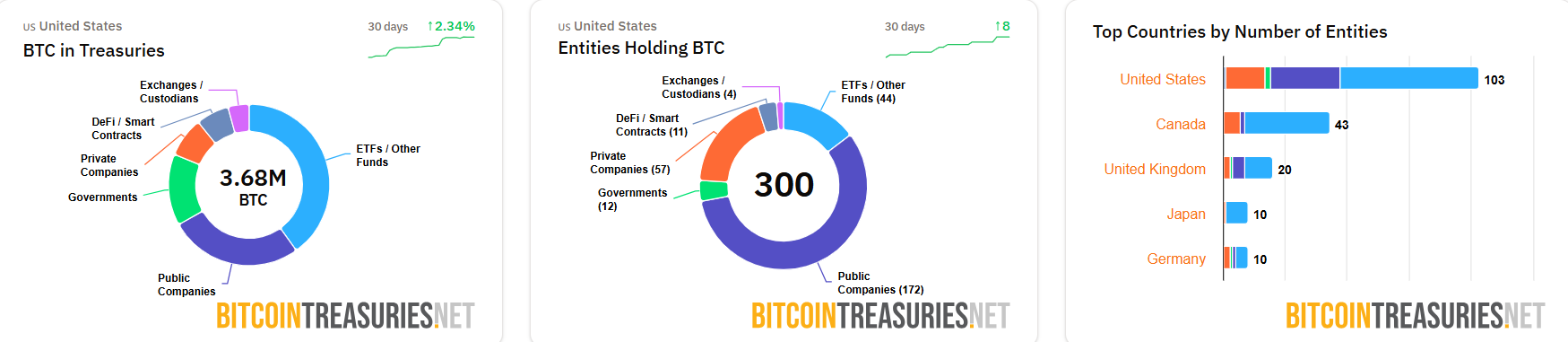
Among the US-based corporate companies, Michael Saylor’s Strategy, formerly MicroStrategy, currently holds 629,376 BTC, followed by MARA Holding with 50,639 BTC, according to BitcionTreasuried.Net data.
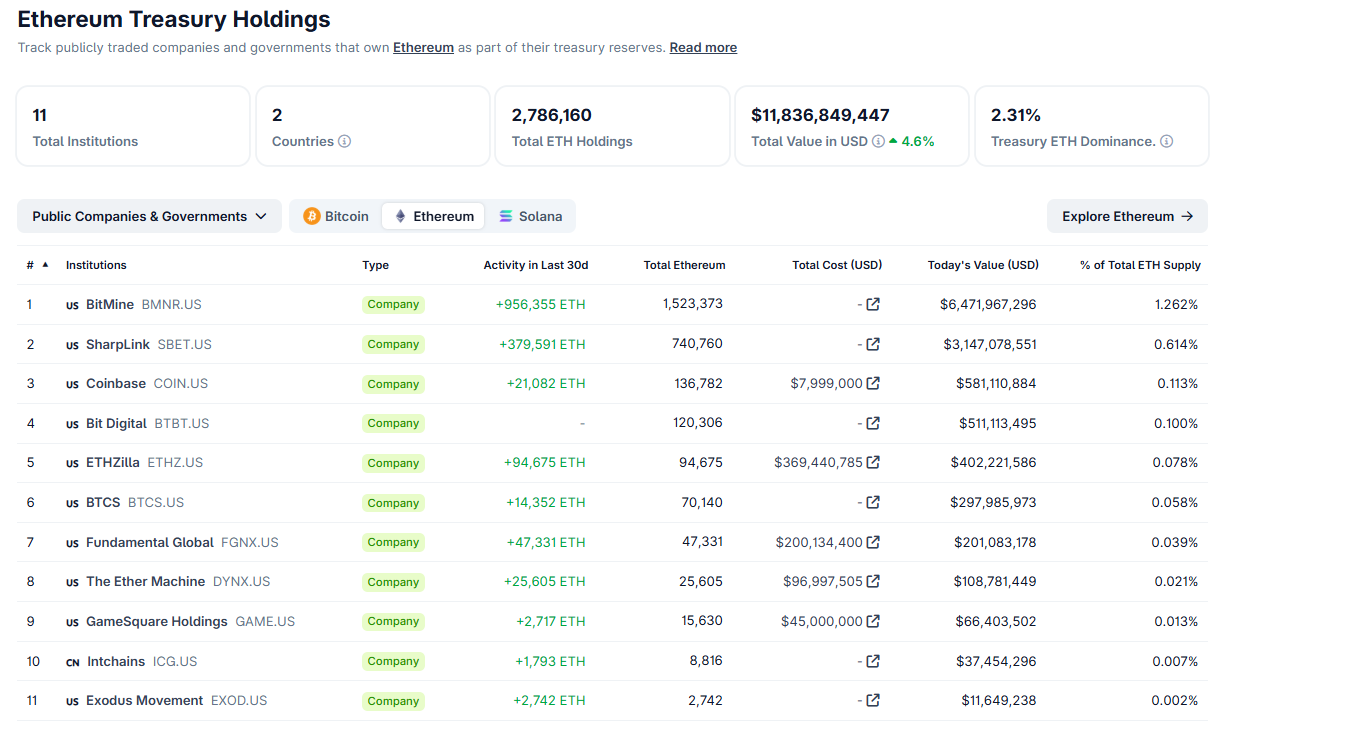
In addition to the US companies and the government increasing their BTC holdings, CoinGecko data shows that the list of public companies holding Ethereum is rising. The eleven companies tracked by CoinGecko hold 2.3% of the Ether supply, totaling over 2.78 million. Ten of these eleven companies are based in the US and have increased their Ethereum token holdings, even as retail investors have continued to take profits, in the last thirty days.
Experts comments
Fei Chen, Founder & CEO of Intellectia AI
Q: How much impact do you think the SEC’s new Crypto 2.0 Task Force, led by Commissioner Hester Peirce, could actually have in shaping fair regulations that both protect investors and encourage innovation in the US?
The newly formed Crypto Task Force has the potential to significantly reshape the crypto market landscape. Clear regulations could stimulate the development of new financial products benefiting everyday investors. A key area for clarification is the distinction between a crypto token as a security versus a commodity. The stricter regulations applied to securities are necessary, and classifying Bitcoin and Ethereum as commodities while categorizing smaller tokens as securities provides investors with clarity and security. The most significant impact is likely to be on staking rewards. Uncertainty regarding whether staking rewards are classified as securities currently deters major US companies from offering staking to their customers, as this classification would require expensive licenses and adherence to extensive rules. By creating clear rules outlining the acceptability of staking, the Task Force could encourage widespread adoption by major US platforms. Balancing innovation with investor protection is key, with rules preventing scams and protecting investments without hindering legitimate businesses.”
Q: What hurdles do you see ahead, especially considering the Trump administration’s deregulatory leanings?
A key challenge for the Trump administration will be demonstrating its ability to effectively combat criminal activities while simultaneously fostering the growth of legitimate businesses. Building public trust in the new policies is critical, as the term “deregulation” often evokes memories of past disasters such as FTX’s misuse of customer funds by Sam Bankman-Fried and Celsius’s false promises of safe returns. Without robust regulations, the risk of future crises remains high. The problem of trust is further complicated by crypto collapses. Unlike traditional banking, where FDIC insurance protects savings, crypto platforms offer no such protection, resulting in permanent loss of funds when a platform fails. This has been seen in previous cases such as Mt. Gox, QuadrigaCX, FTX, and Celsius. Strong regulation needs to address these investor concerns.
Q: With crypto-related illicit activities on the rise in 2024, how should the Trump administration strike a balance between its pro-crypto agenda, such as the Strategic Bitcoin Reserve, and lighter enforcement?
The Strategic Bitcoin Reserve is a forward-thinking initiative, signaling the government’s recognition of crypto as a legitimate asset class. It must be coupled with rigorous enforcement against criminal activities, differentiating between legitimate businesses and targeting hackers, money launderers, and scammers. Just as we do not shut down the internet to stop criminals, we must develop tools to apprehend offenders while allowing others to benefit from the technology. Crypto needs the same balanced approach.
Q: Trump’s direct involvement in crypto projects, such as World Liberty Financial and the $TRUMP meme coin, raises questions about America’s credibility as a global crypto hub.?
Government officials with direct financial interests in the industry they oversee raise legitimate concerns about credibility. The perception of fairness and neutrality in a country’s regulatory framework is crucial. The global financial markets rely on trust and fairness, and the regulatory framework must prioritize market integrity and investor protection regardless of who is in power. This approach is vital to attracting global crypto business.
Nicolai Sondergaard, Research Analyst at Nansen
Q: Could there be a conflict-of-interest concern, especially as rivals like Hong Kong and Singapore ramp up competition in stablecoin market dominance?
International conflicts of interest are unlikely, given the diverse regulatory approaches worldwide, with regions like the EU adopting extremely stringent regulations such as MiCA. The effectiveness of different approaches to balancing innovation, flexibility, and user protection remains to be seen.
Q: Trump’s direct involvement in crypto projects, such as World Liberty Financial and the $TRUMP meme coin, raises questions about America’s credibility as a global crypto hub.?
Trump’s involvement should not disqualify the US from becoming a potential global crypto hub. The presence of a robust network of builders, talent, and industry support is critical for success.
Crypto ETF FAQs
An Exchange-Traded Fund (ETF) is an investment vehicle that tracks the performance of an underlying asset or index. ETFs can track single assets, groups of assets, or entire sectors. For instance, a Bitcoin ETF tracks the price of Bitcoin, enabling investors to gain exposure to a specific asset.
Yes, the US Securities & Exchange Commission approved the first Bitcoin futures ETF in October 2021. To date, seven Bitcoin futures ETFs have been approved, and over 20 more are awaiting regulatory approval. The SEC has cited the cryptocurrency industry’s newness and potential for manipulation as reasons for delaying crypto-related futures ETFs in recent years.
Yes. In January 2024, the SEC approved the listing and trading of several Bitcoin spot Exchange-Traded Funds. This decision was hailed as a game changer that opens up opportunities for institutional capital and mainstream investors to trade the leading cryptocurrency.
The primary advantage of crypto ETFs is the ability to gain exposure to a cryptocurrency without direct ownership, thereby reducing the risks and costs associated with holding the asset. Other benefits include a reduced learning curve and enhanced security for investors, as ETFs manage the security of the underlying asset holdings. The main drawback is the lack of direct asset ownership (“not your keys, not your coins”). Additional disadvantages include higher costs due to active management fees. While ETFs reduce the risk of holding the asset, price fluctuations in the underlying cryptocurrency are still likely to affect the investment vehicle.