

Key Points to Consider
Why ASTER Faces Potential Trouble
ASTER’s vulnerability stems from a large concentration of holdings by a few major players and the use of high leverage, making it susceptible to significant price drops if these holders sell off their assets.
What Could Cause Another Price Decline?
Starting in mid-October, a vesting schedule will release 53.5 million tokens each month. A leading market observer suggests that even the largest ASTER wallets may not be able to absorb this level of supply entering the market.
The debut of Aster [ASTER] was characterized by intense price swings.
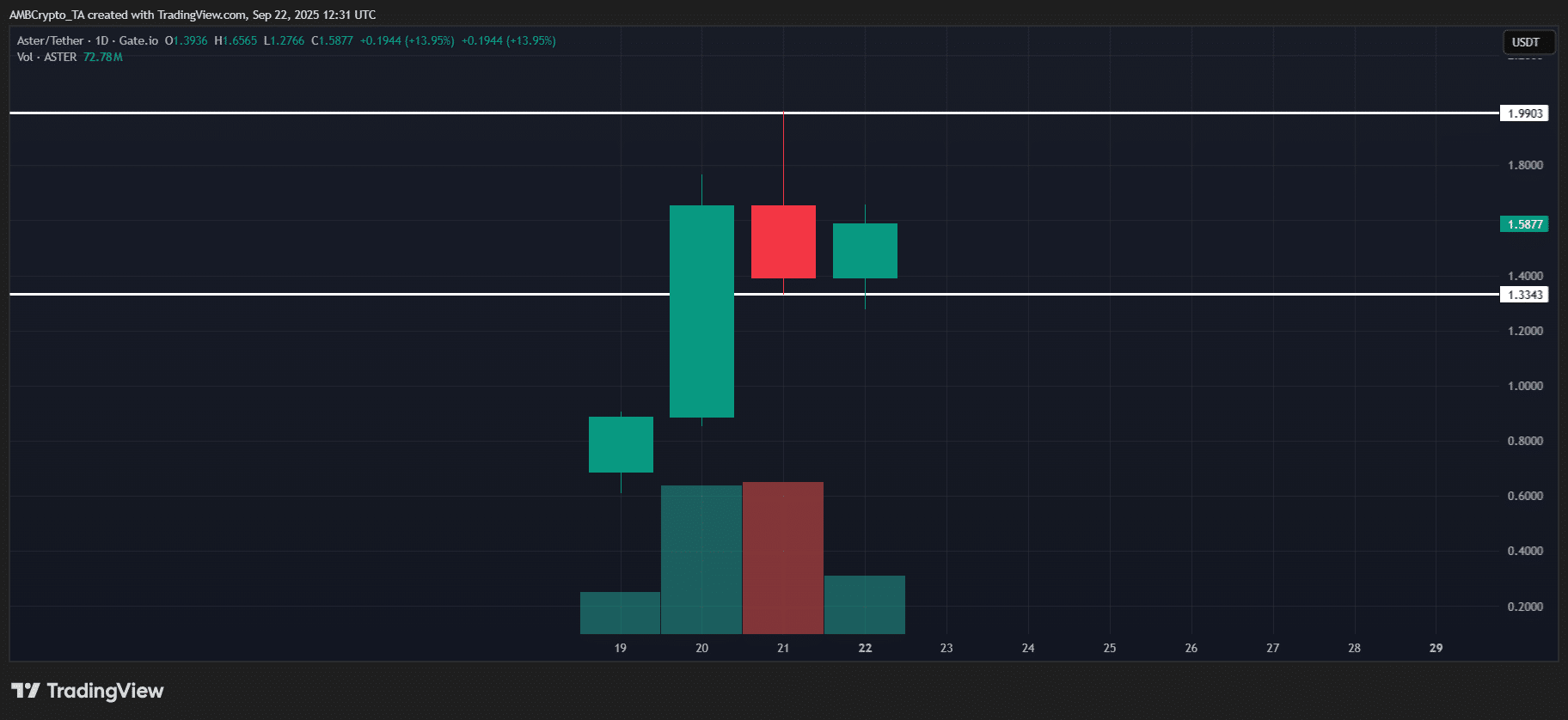
Within a short period of three days, investors saw substantial gains as the cryptocurrency surged to $2, representing an increase of over 1,700%. This rapid ascent generated considerable interest. However, market liquidity soon became a concern.
After reaching its peak, ASTER experienced a 15.8% decline as major holders took profits, including one entity that sold $60 million worth of tokens in a single day. Essentially, the launch unfolded as a classic example of a “pump and dump” scenario.
However, speculative interest continues.
ASTER’s Open Interest on derivative platforms has increased sharply to $822 million – representing a 31% climb from the previous trading session. That equates to $200 million in newly injected speculative capital, driven by traders seeking to leverage their positions.
Typically, such a development would indicate strong risk-taking behavior. However, ASTER presents a unique situation with potentially higher risks. The market has already seen evidence of large holders rotating their assets, meaning further buying pressure could trigger another rapid sell-off.
ASTER’s Concentrated Token Supply Raises Concerns of Market Manipulation
The recent price decrease of ASTER goes beyond a simple burst of speculative enthusiasm.
The market is becoming increasingly concerned about the concentration of ASTER tokens. With 8 billion tokens distributed amongst roughly 46,000 holders, the concentration of supply is causing heightened volatility and significant price swings.
Notably, the top 3 wallets control a substantial 77.9% of the ASTER supply (6.2 billion tokens), with a single wallet holding 44.7% of the total. Looking further, the top 10 wallets collectively hold 96% of the supply (7.69 billion tokens). This centralization makes the market extremely vulnerable to large-scale selling.
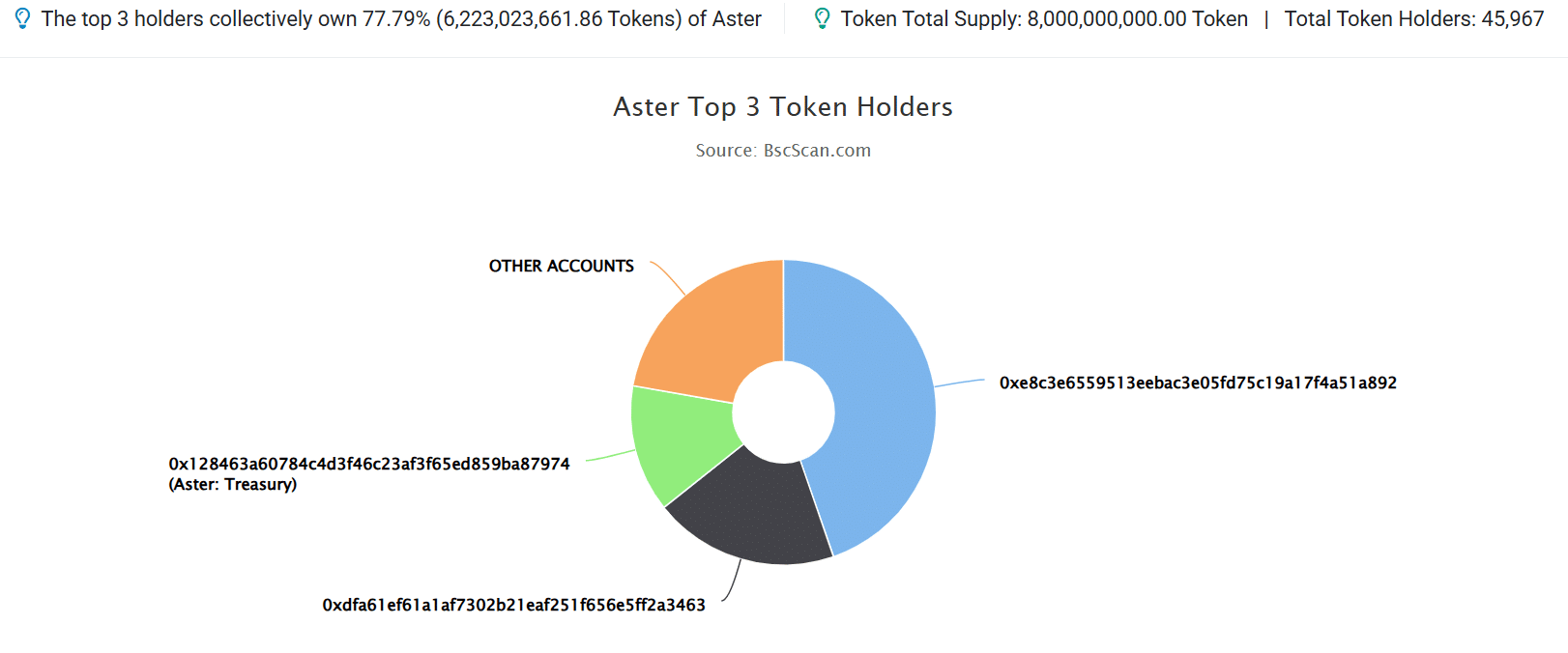
Source: BSCscan
In summary, the recent 15% drop in ASTER’s price is largely attributable to this extreme concentration of its supply.
The significance of this concentration is amplified as such patterns are more commonly observed in tokens with smaller market capitalizations. With sophisticated investors taking profits at the top, fear has spread through the market, leaving ASTER vulnerable to future price fluctuations.
Adding to the uncertainty, ASTER’s vesting schedule will begin in mid-October, releasing 53.5 million tokens monthly over a period of 80 months. According to analysts, even the top four wallets may struggle to absorb this level of selling pressure, potentially setting the stage for a significant correction in ASTER’s price.