

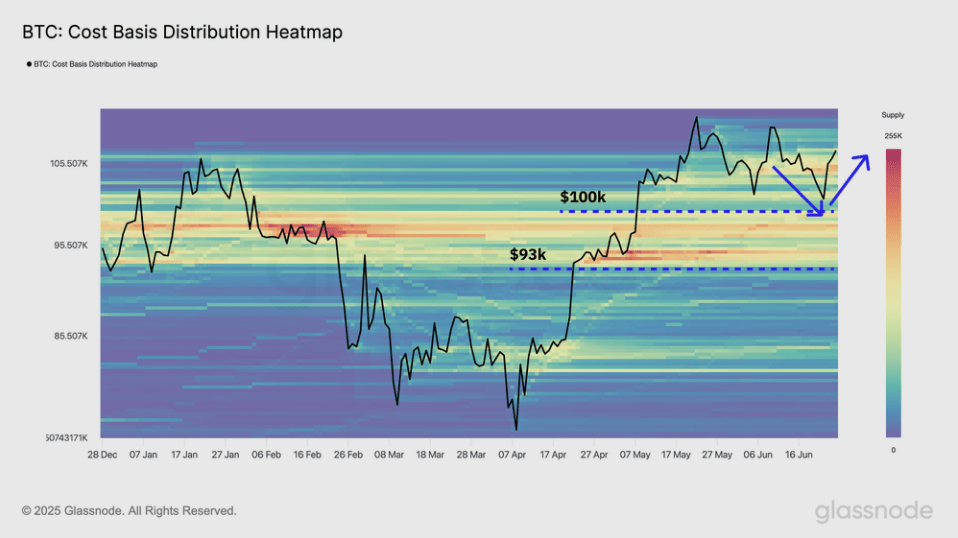
Bitcoin’s price briefly surpassed $100,000 earlier this month, nearing the $108,000 mark before experiencing a retracement. While the surge appeared promising initially, analyses from Glassnode suggest that a significant portion of this upward movement was driven by traders leveraging borrowed funds, rather than new investors entering the market.
Rally Appears to Be Fueled by Speculation
On-chain data reveals that Bitcoin futures trading volume remained elevated throughout late June as prices increased. The market’s activity was primarily propelled by traders pursuing short-term profits, even as the overall enthusiasm surrounding the rally diminished. Key indicators such as funding rates and the three-month futures basis experienced declines, indicating a decrease in long-term bullish sentiment. This suggests that fewer participants were committing to substantial, long-term Bitcoin investments.
Spot Market Activity Lags Behind
The spot market did not mirror the surge observed in Bitcoin futures. During its peak in May, reaching $111,910, daily spot trading volume hovered around $7.65 billion. This figure remains significantly lower than the highs observed in previous market cycles, which surpassed $20 billion on certain days. Indications suggest that new capital from retail investors or long-term holders remained on the sidelines rather than actively participating in the market.
Institutional Buyers Continue Accumulation
Significant corporate entities have sustained their buying activity. This week, Michael Saylor’s Strategy, Metaplanet, and ProCap BTC collectively acquired approximately $1 billion worth of Bitcoin. Concurrently, Bitcoin ETFs listed in the US absorbed over $1.5 billion in new supply. These consistent acquisitions point to sustained interest from institutional investors, even if short-term traders have recently dictated the market’s pace.
Scarcity Could Push Bitcoin’s Price
According to Glassnode data, approximately 7 million BTC remain readily available on exchanges. An estimated 14 million BTC are held by long-term holders who have not moved their holdings in an extended period. This supply constriction has the potential to buoy prices if demand persists. Conversely, it also implies that a sudden wave of selling pressure could have a pronounced impact if exchange reserves become depleted.
Bitcoin’s Future Trajectory
In summary, the recent surge above $100,000 appears to be predominantly driven by leveraged trading rather than a sustainable influx of new long-term investors. Rallies fueled by substantial margin activity often precede market corrections. However, ongoing purchasing by major corporations and ETFs provides a stabilizing influence. Should this trend persist, Bitcoin might experience a consolidation phase, but a subsequent rally remains a possibility.
As of June 28, Bitcoin was trading at $106,500, representing a 0.85% decrease for the day. Market analysts will closely monitor the return of spot market demand or a stabilization of futures positions before confirming a resumption of the upward trend.
Featured image from Unsplash, chart from TradingView