
Sticking a “Web3” label on a game doesn’t automatically make it decentralized.
Genuine decentralization is more challenging but far more rewarding.
In a landscape saturated with trendy terms, truly decentralized games distinguish
themselves not just through blockchain integration but through the significant
empowerment they provide to players. Whether through decentralized NFTs, on-chain
mechanics, or DAO-based governance, the future of gaming depends on transferring
control from game developers to player communities.
But what precisely defines a decentralized blockchain game? Let’s explore the
intricacies of blockchain game creation
and what qualifies a game as truly decentralized.
Decentralized Games Versus Games Using Cryptocurrency
First, let’s clarify a key point. A game utilizing NFTs for cosmetic items or
rewarding players with crypto tokens isn’t automatically decentralized. True
decentralization involves empowering users to participate in critical decisions
through a DAO. The defining characteristic isn’t the presence of tokens or NFTs,
but rather the location of power.
If players can:
- Maintain ownership of their digital assets
- Have a say in shaping the game’s rules or core gameplay
- Engage directly with the underlying protocol
- Continue playing even if the original developers cease operations
Then, it qualifies as a decentralized game.
The Cornerstones of Authentic Blockchain Decentralization
So, what does this shift in control look like in reality? Let’s break it down
into four fundamental components.
1. Asset Ownership Through NFT Decentralization
The first level of decentralization occurs at the asset level. Most Web3 games
highlight NFTs, but can the developer alter or revoke them? If so, the asset isn’t
truly decentralized.
True NFT decentralization necessitates:
- Immutable metadata or hosting via IPFS (not solely centralized image servers)
- On-chain creation and transferability
- Trading on marketplaces without needing permission
- Asset utility that isn’t dependent on a central API
Games such as Loot and Treasure have demonstrated how NFTs can become building
blocks across multiple projects, not limited to a single game.
2. Blockchain Game Mechanics: On-Chain Execution is Key
Another vital element is how the game functions. Blockchain game mechanics imply
that core processes, such as crafting, combat, or economic rules, are executed
via smart contracts, not centralized backend servers. This enables:
- Verifiable outcomes (eliminating cheating)
- Transparent modifications and updates
- Community oversight and auditing
That said, placing everything on-chain is costly and often unnecessary. The aim
isn’t complete immutability; it’s reliable and trustworthy core mechanics.
3. DAO-Driven Governance
DAO governance is the strongest instrument for decentralization. A Decentralized
Autonomous Organization (DAO) empowers players and token holders to:
- Propose and vote on alterations to the game
- Allocate treasury funds for fresh content, incentives, or partnerships
- Decide on upgrades, forking the game, or expansions
- Moderate conduct within the game through community consensus
DAO governance ensures the game’s future isn’t determined by a CEO or dev team;
it’s community-owned and directed. However, not all players desire to vote on
every proposal. The best decentralized games construct layered governance with
delegate models, working groups centered on particular subjects, and quadratic or
weighted voting to avert domination by wealthy individuals or groups (“whales”).
4. Open Infrastructure and Interoperability
Decentralization encompasses more than gameplay; it’s about barrier-free
development. If a game’s mechanics, assets, and governance can be combined and
utilized by anybody, it transcends being merely a product; it evolves into a
platform. This is where decentralization truly accelerates, with the game becoming
a foundation for others to build upon. Genuinely decentralized games permit:
- User interfaces or frontends created by others
- Open APIs or SDKs
- Community-developed mods, quests, or even creating derivative forks of the game
- Compatibility of assets across diverse gaming ecosystems
Also Read: How Blockchain is Unlocking New Monetization Models in Play-to-Earn
Games?
Features That Don’t Represent True Decentralization
Let’s examine features frequently presented as decentralized but are merely
gimmicks.
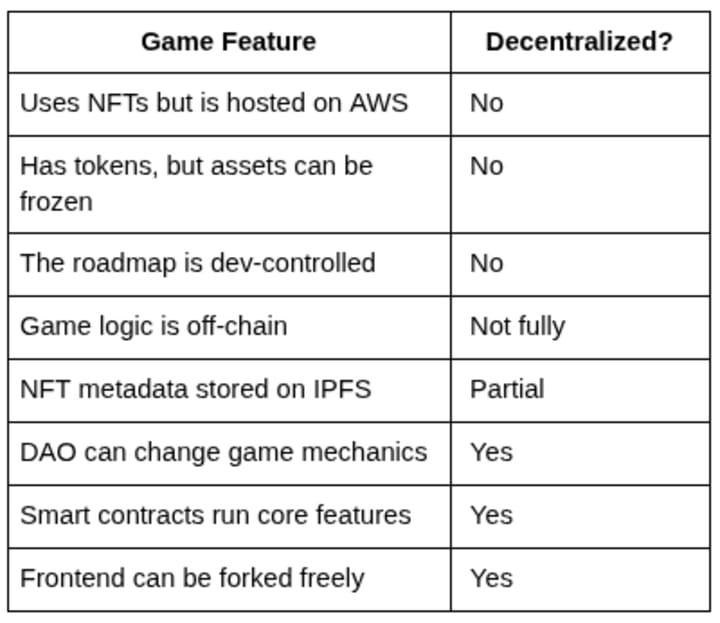
What Constitutes Real Decentralization?
Most Blockchain games presently exhibit partial decentralization at best. And
that’s perfectly acceptable. The transition to full decentralization needs time, a
mature community, and a commitment to openness. Here’s how it typically unfolds:
-
Stage 1: Centralized Power: Developers
control assets, mechanics, and governance. -
Stage 2: Gradual Decentralization: The
community provides feedback, and some mechanics move onto the blockchain. -
Stage 3: Autonomous Game Environments: DAOs
govern the game, smart contracts execute gameplay, and frontends can be forked.
Games such as Skyweaver and Aurory are in Stage 2, while Treasure DAO has reached
Stage 3.
Why Player Independence is Paramount
Decentralization extends beyond technology; it taps into player psychology. Players
evolve from mere consumers into co-owners. They invest their time, funds, and
energy, and then vote on pivotal game-related decisions. This builds games with
lasting value, unlike easily replaceable products. Decentralizing a game involves
decentralizing:
- Decision-making processes
- Economic influence
- Cultural direction
- Creative input
Concluding Remarks
A truly decentralized Blockchain game need not emphasize “play-to-earn” mechanics
or promote a token launch. Its worth stems from the community’s authority, the
transparency of the code, and the long-term viability of its assets. It’s about
what resides on the blockchain, not merely what is superficially presented. If
you’re shaping the future of gaming, decentralization isn’t just an add-on; it’s
the very base upon which you build.