
Much like the iconic opening crawls of Star Wars or the world-building introductions in stories like James Gunn’s Superman, the new series Alien: Earth kicks off with a block of introductory text. This isn’t about introducing characters; it’s about reshaping the very foundation of the *Alien* universe. This FX series, in a matter of a few sentences, shakes up the established norms of the Alien saga, throwing new challenges and sci-fi concepts into a world already overflowing with them. This bold move could even redefine how we view the original 1979 film and all the subsequent sequels and offshoots.
Right from the start of Alien: Earth, showrunner Noah Hawley (of Legion fame) lays out the central conflict: a corporate power struggle, not just a battle between humans and aliens. The opening text explains:
In the years ahead, the pursuit of eternal life will manifest in three forms:
Humans enhanced with cybernetics: Cyborgs
Sentient artificial intelligence: Synths
Synthetic bodies housing human consciousness: Hybrids
Followed by a critical point:
The corporation that masters this technology will dominate the universe.
This concise introduction reshapes the entire *Alien* narrative. To fully grasp its impact, we need to delve a bit deeper into the first episode…
Babou Ceesay plays Morrow, a new type of character called a Cyborg introduced to the franchise in Alien: Earth
The episode’s opening scene provides further context. We see the crew of a research vessel, owned by the notorious Weyland-Yutani corporation, awakening from cryosleep and gathering for a meal.
“We work for Weyland-Yutani. They control North and South America,” one crew member helpfully explains. Another replies, “And the Moon, right?” A third interjects, “No, Dynamic controls the Moon. Yutani has Mars and Saturn.”
Suddenly, the entire crew is engaged, rattling off essential backstory like a futuristic Greek chorus.
“There are four companies. They govern the entire planet.”
“Don’t forget the new player: Prodigy.”
“Prodigy focuses on synths and AI, founded by a kid. The youngest trillionaire ever.”
To summarize, by 2120, the setting of Alien: Earth, five powerful corporations are battling for control of Earth and space. Their competition revolves around achieving immortality, whether by technologically enhancing humans (cyborgs), replacing them with robots (synthetics), or transferring human minds into synthetic bodies (hybrids). While the concept is straightforward, its implications for the franchise are profound.
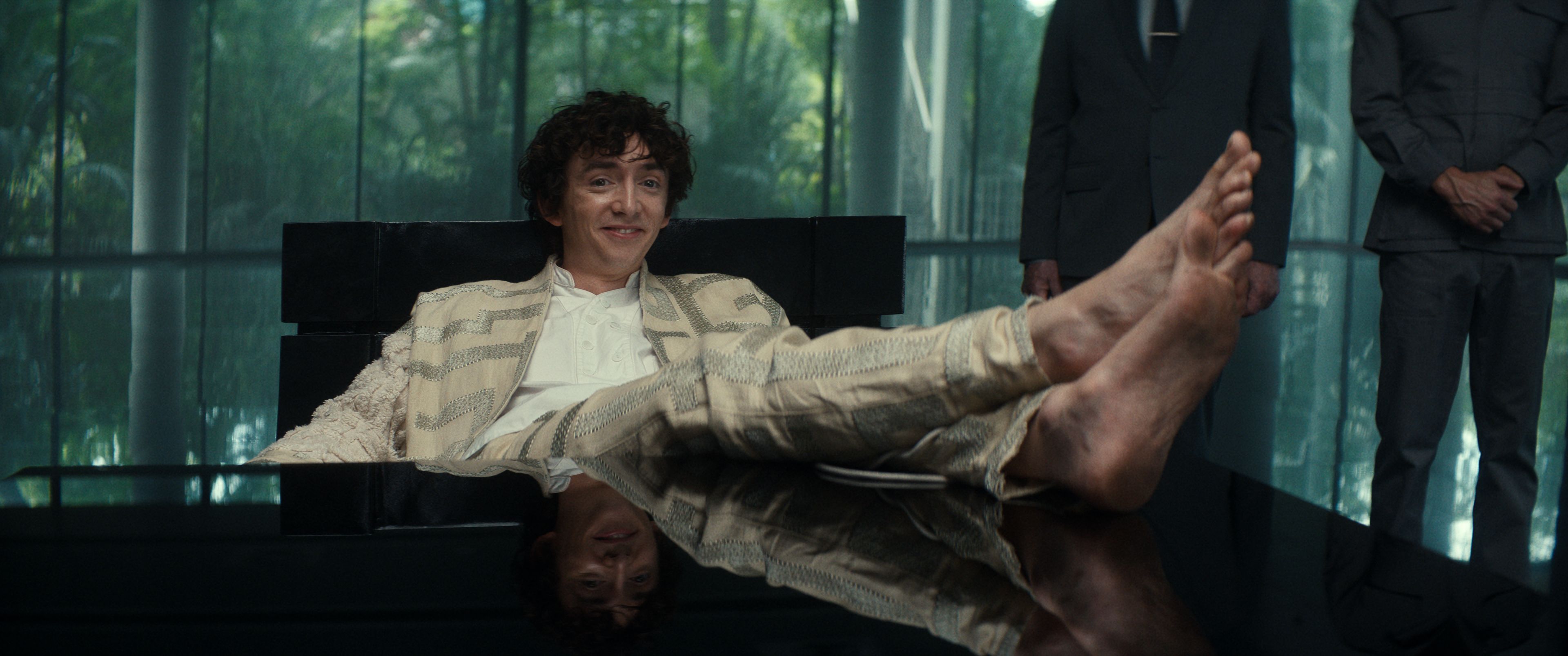
“Youngest trillionaire ever.”
The *Alien* universe, spanning movies, comics, novels, and more, has predominantly focused on the exploits of one powerful entity: Weyland-Yutani. (Even in the prequel Prometheus, it was Weyland, pre-merger.) Weyland-Yutani is renowned for creating and mass-producing synthetics, alongside manufacturing computers and starships. Famously ruthless, the corporation is obsessed with capturing a Xenomorph, sacrificing countless lives to develop it into a weapon.
Throughout most *Alien* stories, Weyland-Yutani stands largely unchallenged. Other corporations, like Hyperdyne (which created its own synthetics, including Ash from the original *Alien*, after Weyland-Yutani’s patent expired) or Seegson (which pioneered faster-than-light travel), remain relatively insignificant.
Alien: Earth immediately alters this dynamic. Weyland-Yutani is now just one of several powerful corporations vying for control of the planet and the cosmos. The series also introduces synthetics as just one avenue of technological development. We can expect to see more of hybrids and cyborgs, technologies previously unseen in the *Alien* franchise, as the show progresses.
Given the established timeline of the *Alien* universe, it’s likely that Weyland-Yutani and their synthetics will ultimately triumph. However, the prospect of witnessing these corporations clash offers a fresh and exciting perspective on the *Alien* saga and the central, malevolent corporation at its core.