

Bitcoin’s recent climb is facing headwinds, as its price finds itself in a holding pattern between $93,000 and $97,000. Despite a brief surge near the end of last month, Bitcoin has since struggled to maintain a consistent upward trajectory.
Currently, BTC is being traded at around $94,305, showing a slight decrease of 1.3% from yesterday. Although price movement has slowed, behind the scenes, market activity indicates potential changes in how investors are behaving.
Fresh data from the blockchain reveals a noticeable decrease in Bitcoin holdings on Binance, which is the world’s biggest cryptocurrency exchange by trading volume.
Amr Taha, a contributor at CryptoQuant, pointed out this development in a recent QuickTake article, noting that over 51,000 BTC have been moved out of Binance wallets since the middle of April.
This reduction, from approximately 595,000 BTC to roughly 544,500 BTC, might suggest a shift in investor strategy, with increasing interest in long-term storage or moving assets to places other than centralized exchanges.
Reasons Behind Bitcoin Leaving Binance
According to Taha, a number of things could be causing this sharp decline in reserves held on the exchange. One possibility is that institutional investors and those holding for the long term are moving their Bitcoin to cold storage.
This action of taking Bitcoin off exchanges is usually seen as a sign of long-term confidence, as these players want to secure their assets and reduce the chance of selling them off quickly. The growing popularity of custodial services and higher-quality wallets could show a maturing market.
Another important factor could be the increasing use of Bitcoin in decentralized finance (DeFi) and strategies that take advantage of price differences across platforms. Taha mentioned that entities might be withdrawing BTC to earn yield or use capital in other blockchain systems.
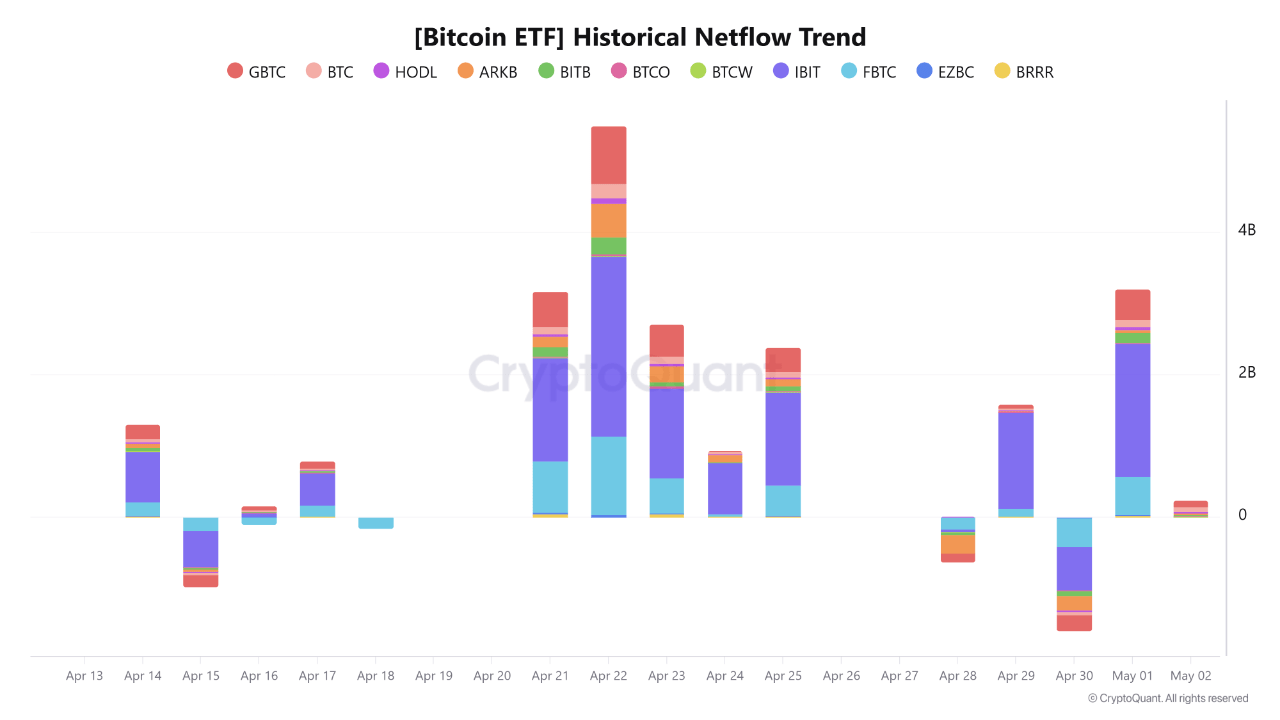
Furthermore, the recent positive trend in Bitcoin spot exchange-traded funds (ETFs), particularly between April 21 and May 1, where daily net inflows exceeded $2 billion on multiple days, may have encouraged larger players to accumulate and withdraw Bitcoin with the expectation of further price increases.
What Exchange Reserve Trends Signal During Price Stability
Even though Bitcoin’s price has been relatively stable recently, changes in exchange reserve data could have big implications for future price movements.
Historically, a drop in exchange reserves, especially from major platforms like Binance, has been linked to a tightening of supply. With fewer coins readily available for purchase, reduced liquidity can increase the impact of incoming demand, particularly during bullish periods.
Taha emphasized that while the market might seem uncertain in the short term, tracking reserve metrics provides valuable insights into underlying sentiment.
A consistent removal of BTC from exchange platforms often prepares the market for renewed price activity, especially when combined with accumulation by institutions and long-term holding behavior.
If these trends continue, they could reduce selling pressure, potentially allowing Bitcoin to challenge its next resistance levels, including the psychologically significant $100,000 mark.
Featured image created with DALL-E, Chart from TradingView