


In 2025, Binance’s trading volume has reached unprecedented levels, dwarfing the combined volumes of its main competitors. This signifies an evolving trend of exchange activity consolidation.
CryptoQuant’s data reveals that Binance’s trading volume is now more than twice that of all other exchanges combined. This development is sparking debates about the overall structure of liquidity in the worldwide cryptocurrency markets.
According to TokenInsight data, Binance achieved approximately $8.39 trillion in trading volume during the first quarter of 2025. This accounts for 36.5% of the total global activity, even amidst an overall reduction in total market volume.
During the first quarter, Binance’s average daily trading volume hovered around $36.6 billion. This is substantially higher than Bybit’s $7.9 billion, OKX’s $6.5 billion, and Coinbase’s $5.6 billion, positioning Binance significantly ahead of its rivals. CryptoQuant research further demonstrates that Binance’s spot trading volume for the year has surpassed $1.9 trillion, exceeding the combined volume of Coinbase, Crypto.com, and OKX.
Market share concentration became increasingly evident by the middle of the year. Binance’s spot trading volume was almost eight times greater than Coinbase’s, giving it a market share of approximately 42%.
By June, Binance’s spot trading activity was nearing the collective total of all other exchanges. Such a scenario had not been observed since early 2024, a period when Bitcoin’s price surged beyond $70,000.
The platform’s dominance extends beyond spot trading. Its mid-2025 performance also includes strong activity in futures markets, stablecoin transactions, capital inflows, and on-chain metrics.
During Bitcoin’s peak price this summer, Binance’s total trading volume was almost double that of all its competitors combined, even as overall market activity slowed.

This concentration has important implications for the market. Officials at the European Securities and Markets Authority have previously cautioned about systemic risks when a single platform handles a disproportionate share of trading volume, describing it as a “considerable concern” in regulatory communications, as reported by Reuters in April 2024.
Market structure is also influenced by liquidity distribution. While Binance leads in spot trading, other platforms like OKX exceed it in liquidation volumes, indicating different risk profiles across various exchanges.
The historical correlation between Binance’s dominance and price fluctuations remains a key point of interest. A similar volume imbalance in early 2024 preceded a significant increase in Bitcoin’s price. The question is whether high trading concentration could again influence the directional momentum of major assets.
The scale of activity also intersects with regulatory scrutiny. In late 2023, some viewed the U.S. Department of Justice’s settlement with Binance as implicitly recognizing the exchange’s position as being too large to dissolve without causing wider market instability. That view has persisted into 2025 as the exchange continues to extend its dominance despite a shrinking market.
Daily and quarterly statistics highlight the extent of the gap. Binance’s $36.6 billion daily average puts it nearly nine times larger than Coinbase, and its 42% spot market share was the highest in ten months.
While trading volumes are currently down across the cryptocurrency industry, Binance’s trading volumes still match or exceed those of all its competitors, reshaping the exchange landscape in 2025.
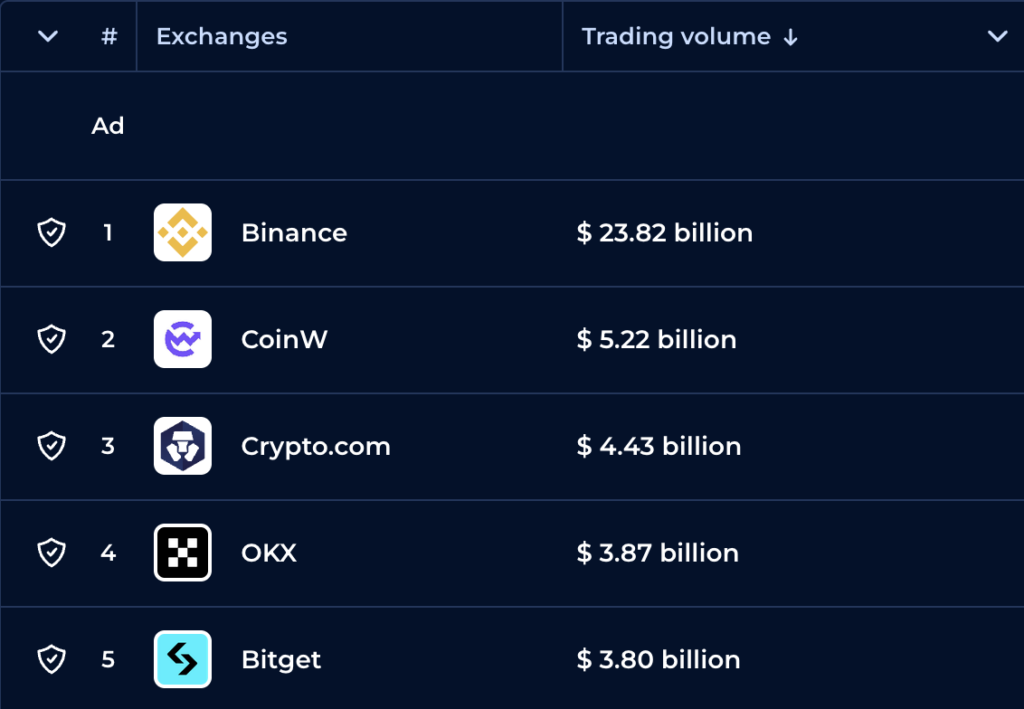
The concentration of activity highlights the degree to which one dominant platform has emerged as the primary portal for liquidity, impacting both the opportunities and the risks in global cryptocurrency markets.