
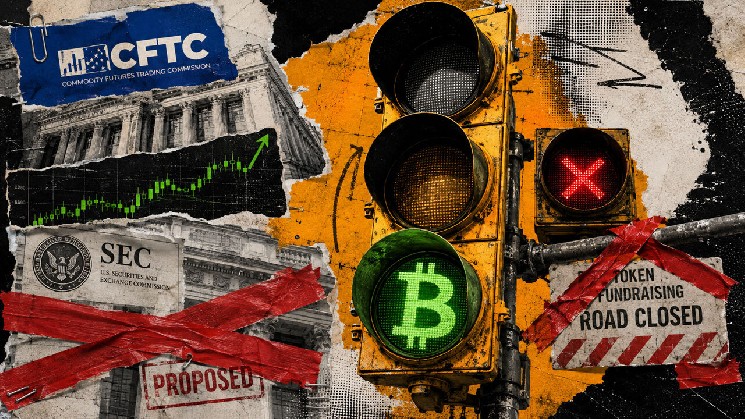
On May 29, the CFTC gave the green light for a Bitcoin perpetual contract on a regulated US exchange. Nearly three months later, on August 18, the SEC suggested a legal path that might enable crypto projects to raise funds from the public based on regulations tailored for token networks.
This sequence of events is quite unique, as Washington reshapes the American crypto landscape. The existing trading and hedging regulations for a well-established asset have already led to the launch of live products, while the proposal enabling creators to finance new assets is still pending public comment and further voting by the SEC.
As of August 21, Bitcoin was trading at approximately $77,000, reflecting a 22% increase over a week. CoinGlass reported around $154.6 billion in Bitcoin futures volume over 24 hours and $56.2 billion in open interest. In addition, the latest data noted roughly $840 million in Bitcoin futures liquidations, while the previous day’s figures indicated $3.1 billion in liquidations for bearish crypto positions as $BTC surpassed $72,000. These figures are overlapping, representing different phases of the same rally instead of separate totals.
Both sets of data encompass global platforms, including offshore markets, highlighting the extent to which a rapid Bitcoin price adjustment impacts derivatives, even while the domestic perpetual market is still under development.
Kalshi’s approval for BTCPERP confirmed that a US platform can offer a genuine crypto perpetual in accordance with current derivatives regulations. Bitnomial has also introduced a similar offering.
The SEC’s Regulation Crypto Assets is still a proposal, meaning it’s not available for issuers to utilize at this time. Currently, regulated institutions have a clearer path for trading crypto derivatives in the US than the token founders who are seeking to fund the tokens that may later trade alongside them.
Perpetual Contracts Seamlessly Fit into Existing Regulations
Standard futures contracts come with a defined expiration date, requiring traders wishing to maintain their position to either close it or roll it into a subsequent contract. Conversely, a perpetual contract has no expiration; rather, ongoing payments between long and short traders help maintain its price alignment with the underlying market, allowing traders to hold positions indefinitely, provided they keep sufficient collateral.
International crypto exchanges have adopted this model as the primary form of derivatives, as it allows for continuous exposure without the need to frequently close and reopen positions. Meanwhile, US exchanges have primarily relied on outdated futures contracts, including those with long expiration dates that mimic perpetual behavior yet ultimately expire on a set date. Essentially, the domestic market lacked a legal framework for true perpetual contracts.
The CFTC could address this gap by employing a framework it already uses for new futures products. Kalshi submitted BTCPERP under Regulation 40.3, enabling the commission to evaluate the contract’s terms and determine its compliance with designated contract market rules. Upon approval, Kalshi’s perpetual platform could launch a Bitcoin contract with the potential for exposure up to six times the collateral provided by a trader.
In conjunction with the individual approval, the CFTC released a policy statement regarding perpetual contracts, clarifying how its existing principles apply. Exchanges now receive clearer guidance on contract design and funding mechanisms, though each must still file individually and adhere to standard rules concerning margin, surveillance, customer protection, and clearing. The approval of one product sets a precedent for others to follow but does not grant blanket permission to list every perpetual contract.
The commission also briefly offered an alternative route on June 12, issuing no-action relief to Bitnomial and Coinbase Derivatives. This made it possible for both exchanges to remove expiration dates from specific existing contracts without categorizing the change as an entirely new listing. However, this relief expired on June 30, limiting it to a short window for conversion instead of an ongoing option for exchanges.
Bitnomial claims it has successfully rolled out US perpetual futures, including a live Bitcoin contract. Meanwhile, Coinbase’s public documentation still describes its domestic perpetual-like offerings as long-dated futures, featuring expirations of five years, with an update from May indicating that eligible US customers will gain access to Deribit perpetuals in the future. Without an updated public contract specification, Coinbase’s status should not be considered as a verified true-perpetual launch.
The CFTC’s Innovation Advisory Committee convened on August 20 to discuss crypto regulation alongside topics such as artificial intelligence and prediction markets. Although the committee provides advisory support to the commission, its recaps revealed no new approvals for perpetual contracts, leaving the product status unchanged while the process has moved from initial contract filings to live US markets on Kalshi and Bitnomial.
Different Stages of Regulatory Actions
Regulatory announcements can sound definitive in headlines, even when they stem from vastly different stages. A clearer understanding emerges when distinguishing between approved products, expired reliefs, open comment periods, and proposed regulations:
Derivatives took the lead because the CFTC could integrate them within an existing exchange system. A designated contract market is bound by requirements concerning capital and customer protection, as well as mechanisms for clearing and trade surveillance. The commission needed only to ascertain whether a particular contract met these requirements, rather than having to invent an entirely new framework for each potential issuer.
Conversely, token fundraising necessitates the SEC to tackle broader issues. The agency must outline disclosure requirements for issuers, establish limits on capital raising, dictate financial statement prerequisites, and set guidelines for how tokens can be resold. Additionally, it must determine when a token can diverge from the investment contract used to fund it and assess whether federal regulations take precedence over state registration rules.
The proposal was entered into the Federal Register on August 21, allowing the public until October 20 to share feedback before the agency considers modifications and votes on a final version.
Congress is operating on a separate timeline. The Senate Banking Committee ratified the CLARITY Act in May, and a motion for cloture is scheduled to advance on September 15. Senate Banking Chair Tim Scott noted on August 20 that he still believes there is a viable path to a vote in September, while a review by CryptoSlate outlined how the bill would clarify the boundary between the SEC and CFTC within federal law, making changes to that allocation more challenging for future commissions.
These differing timelines have implications for who can engage in the American market. A regulated entity can take larger Bitcoin positions than their posted collateral allows and maintain contracts indefinitely, whereas a founder aiming to distribute tokens is left without any active SEC pathway.
Thus, trading companies can transition more of their operations to domestic exchanges without awaiting the next token issuer, while projects continue to depend on traditional securities exemptions, private funding options, or offshore frameworks.
The Evolution of Perpetuals Beyond Crypto
Perpetual contracts are also expanding outside the asset class that popularized them. On July 23, the CFTC extended its request for public input on 24/7 trading and perpetual contracts in US energy derivatives until August 26, incorporating a model refined on offshore crypto exchanges into discussions surrounding oil, gas, and power markets.
The advantages of perpetual contracts are clear. Traders of these contracts do not need to select a maturity date or frequently roll their positions, thanks to the exchange’s continuous funding and liquidation mechanisms that keep the contract aligned with its reference price. This can result in more convenient exposure and improved capital efficiency, although these systems must operate consistently and effectively manage risk without a designated reset.
Energy markets illustrate why the adoption of crypto’s design cannot be applied universally. Bitcoin, unlike oil, does not involve physical storage, delivery logistics, or seasonal production cycles, with a barrel of oil having its own associated costs. The CFTC’s case-by-case method allows regulated exchanges to explore the mechanics of perpetual contracts while addressing these variations, and its policy statement does not grant the right to list every asset with any specified margin setting.
The SEC aims to create a more expansive and versatile structure for fundraising purposes. Regulation Crypto Assets proposes a $5 million exemption for startups, along with public tiers of $20 million and $75 million, and a safe harbor enabling a token to separate from its original investment contract once the issuer’s primary obligations are fulfilled.
Since this system would encompass various projects and stages throughout their lifecycle, it necessitates a more robust legal framework before it can be utilized.
Establishing the trading layer first presents practical advantages if the SEC eventually finalizes its proposal. Newly funded tokens could integrate into a regulated domestic market with established hedging and improved price discovery already in place.
However, this leads to the issue that sophisticated trading infrastructures can develop while the number of projects able to obtain legal funding through public token sales remains limited, leaving the United States better equipped to trade assets than to create them.
The current market therefore reflects the sequence in which regulations were introduced: Kalshi and Bitnomial have operational true perpetual contracts, the June conversion window has concluded, and the CFTC is evaluating whether crypto’s continuous design can be adapted for energy markets. Meanwhile, the SEC has only commenced the process for token fundraising, meaning that successfully bringing the creation of tokens back home will hinge on the commission’s ability to finalize that proposal into an actionable rule.