LAS VEGAS – The strategy of holding Bitcoin as a treasury asset, which significantly boosted Strategy’s market capitalization beyond $80 billion, is now being copied by a range of entities. This includes meme stock companies, media organizations, and large international corporations. However, skepticism remains among many on Wall Street.
Recently, Trump Media announced intentions to acquire $2.5 billion worth of Bitcoin. Simultaneously, GameStop revealed they had allocated $500 million for Bitcoin purchases. In related news, Tether, SoftBank, and Strike’s Jack Mallers have introduced Twenty One, a new publicly traded entity focused on Bitcoin, poised to launch with over 42,000 Bitcoin on its books. This holding could potentially rank them as the third-largest corporate owner of Bitcoin globally.
Despite the announcements, the market isn’t readily accepting these companies as the next Strategy. Trump Media’s stock value has decreased by more than 20% since their Bitcoin announcement, while GameStop’s shares are down nearly 17%. In contrast, Strategy, previously known as MicroStrategy, has seen its value multiply 26 times since the close of 2022, accumulating a Bitcoin portfolio valued at over $60 billion.
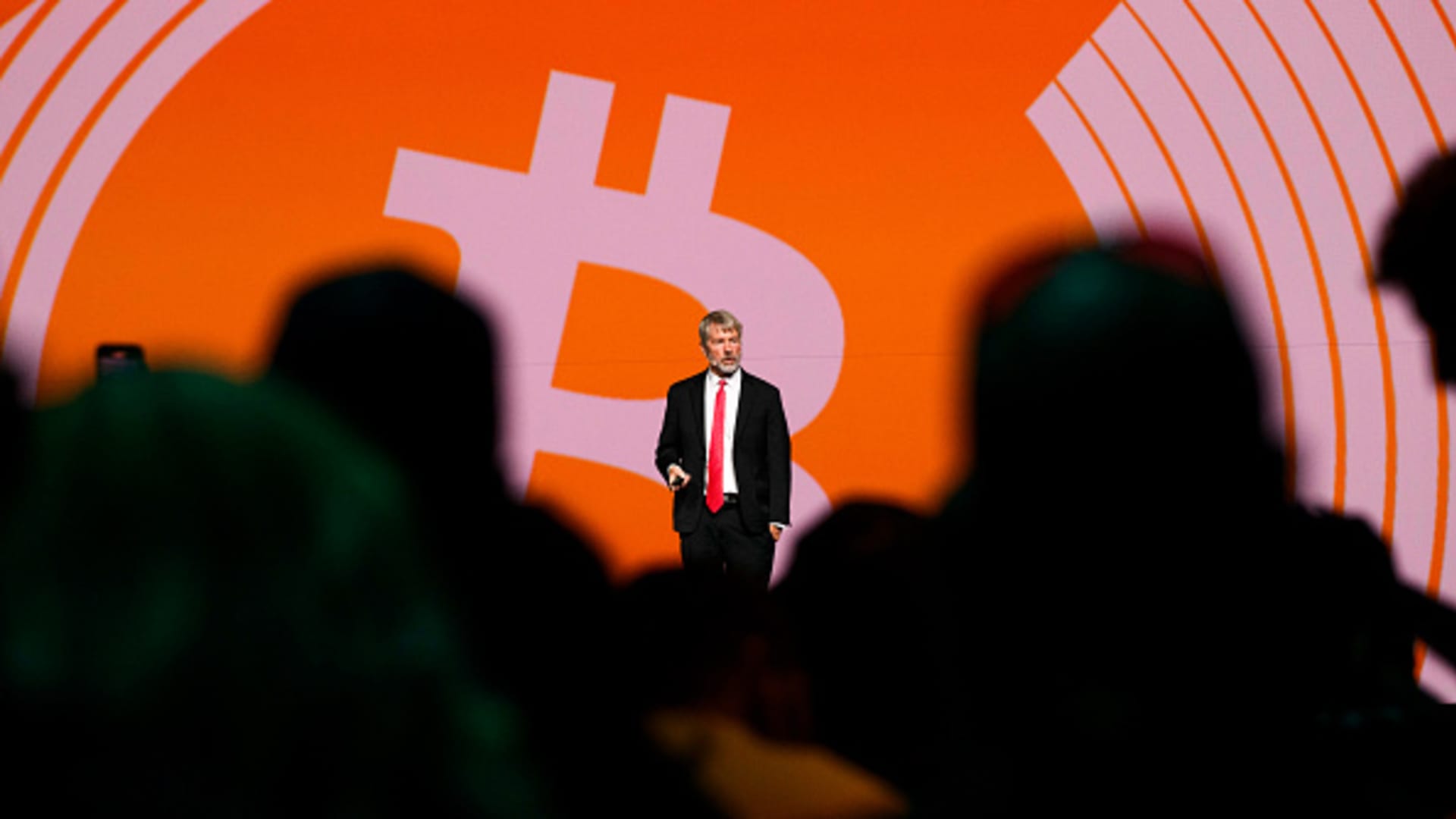
Strategy Chairman Michael Saylor commented in an interview during Bitcoin 2025 in Las Vegas, stating, “Perhaps the market anticipated larger Bitcoin acquisitions. However, these are only temporary fluctuations. The long-term benefits of holding Bitcoin on a corporate balance sheet have proven to be exceptionally positive.”
Saylor described Trump Media’s action as “bold, proactive, and intelligent” and suggested that the increase in similar declarations signifies a fundamental change within corporate finance worldwide.
“At this conference, I constantly hear of initiatives in various locations, such as Hong Kong, Korea, Abu Dhabi, the Middle East, and the U.K., to establish Bitcoin treasury companies,“ Saylor mentioned. “Currently, there’s a surge in interest.”
He added that Bitcoin proponents are “planting the Bitcoin flag globally.”
What once seemed like an alternative financial strategy is rapidly evolving into a worldwide competition. Under the Biden administration, corporate Bitcoin adoption was often viewed cautiously from a regulatory perspective. However, with President Donald Trump, this attitude has shifted.
Earlier this year in March, President Trump signed an executive order to create a U.S. Strategic Bitcoin Reserve, instructing federal agencies to recognize Bitcoin as a long-term store of value. According to White House Crypto and AI Advisor David Sacks, this reserve will be solely funded by Bitcoin recovered from criminal and civil forfeiture cases. The order further allows the government to investigate further methods of acquiring Bitcoin without impacting the federal budget.
The federal government will also be conducting a thorough audit of its digital asset holdings, presently estimated to be over 200,000 Bitcoin. The executive order explicitly prohibits the selling of any Bitcoin from the reserve, establishing it as a permanent sovereign asset.
‘No force on Earth’
Vice President JD Vance recently made history as the first sitting vice president to address the Bitcoin community directly, positioning cryptocurrency as a safeguard against inflation, censorship, and “unelected officials.” Reinforcing this pro-Bitcoin stance, the Department of Labor rescinded previous guidance that had discouraged Bitcoin investments within retirement accounts.
“No power on Earth can stop an idea that has arrived,” Saylor asserted. “Bitcoin represents digital capital and is arguably the most innovative concept of our time.”
Some elements within the corporate world are still hesitant. In late 2024, Microsoft shareholders declined a proposal advocating the allocation of a portion of the software giant’s vast cash reserves to emulate Saylor’s Bitcoin strategy. In a video presentation endorsing the proposal, Saylor advised investors that “Microsoft cannot afford to overlook the next significant technological advancement.”
While Strategy has realized substantial benefits as an early adopter, Saylor proposed that the less favorable market response to Trump Media and GameStop might be attributed more to financial structure challenges rather than reservations about Bitcoin.
He highlighted GameStop’s initial announcement exploring a Bitcoin strategy, which led to a 50% surge in their stock price and a tenfold increase in trading volume. The company promptly leveraged this momentum by successfully issuing a $1.5 billion convertible bond. Trump Media employed a similar strategy, generating capital through a substantial convertible bond offering.
Saylor explained that these financing methods could lead to temporary downward pressure on stock prices, but ultimately, investors will reap the rewards.
Regarding Strategy’s plans, Saylor communicated that there’s no upper limit to their Bitcoin acquisition goals. His company currently holds by far the largest corporate reserve of the cryptocurrency.
“We will continue to acquire Bitcoin,” he informed CNBC. “We anticipate the price of Bitcoin will continue to rise. We understand that acquiring Bitcoin will become increasingly challenging, but we will become exponentially more efficient in our acquisition strategies.”
To critics concerned that the adoption of Bitcoin by state and media actors will compromise its decentralized principles, Saylor argues the contrary.
“The network is highly resilient, and there’s a balance of influence within it,” he stated. “The increasing number and diversity of participants in the ecosystem strengthens the protocol, making it more incorruptible and reliable, thereby encouraging larger economic entities to confidently integrate into the network.”
WATCH: Bitcoin heads for winning month despite return of trade war fears: CNBC Crypto World