


As the U.S. government shutdown continues, Bitcoin investors are keenly awaiting the September Consumer Price Index (CPI) figures, scheduled for release on October 24th. This economic data is particularly significant due to the shutdown.
The Kobeissi Letter’s analysts highlighted the importance of this CPI update. This marks the first Friday CPI release since January 2018 and comes only days before the Federal Reserve convenes on October 29th.
Furthermore, due to the Labor Department’s pause on other key data publications until the government reopens, this CPI announcement will be the primary inflation indicator for the Fed.
This singular focus amplifies the report’s importance, as there will be no corresponding jobs, payroll, or producer price information to offer a more balanced perspective.
Inflation Outlook
The last CPI reading showed U.S. inflation at 2.9% in August, slightly up from 2.7% the month prior.
Given these trends, Wells Fargo economists now predict a small increase in September’s CPI to 3.1%. They believe this remains in line with a gradual decrease in inflation. Excluding food and energy, core prices are expected to hold steady, suggesting that while inflationary pressures are easing, they haven’t disappeared entirely.
Across the financial landscape, market participants are already factoring in potential easing of monetary policy. The CME FedWatch Tool indicates futures market data showing a high likelihood (99%) of the Fed lowering rates at the October 29th meeting, along with a substantial probability (85%) of another rate reduction in December.
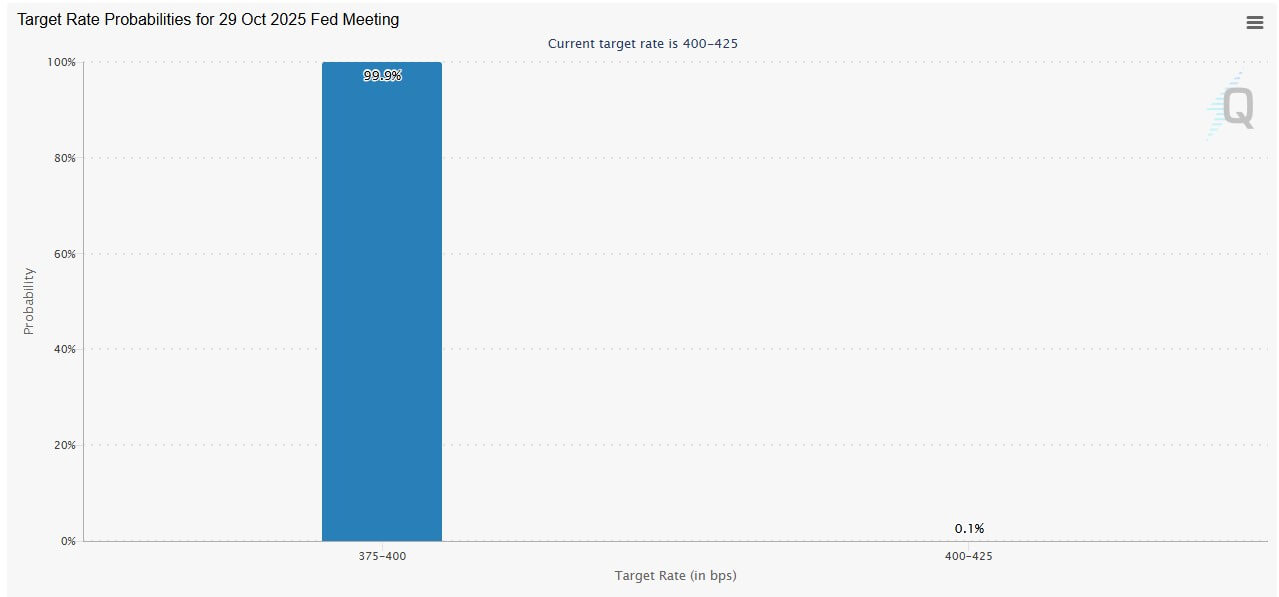
A lower-than-expected CPI figure would likely strengthen this expectation and weaken the US dollar. Conversely, a higher-than-anticipated result could briefly reignite discussions about potential rate increases.
Bitcoin’s Potential Reaction
Analysts at Kautious Data suggested the CPI data has a direct effect on crypto, noting that in a current environment with few broad economic indicators, “thinner macro signals can be a near‑term bullish setup for crypto narratives while adding tail risk for broader markets.”
The firm believes a core CPI reading below 0.3% month-over-month would support a more accommodative monetary policy, putting downward pressure on the dollar and benefiting assets like gold, stocks, and Bitcoin.
However, a more persistent inflation rate, especially with services and shelter costs rising above 0.4%, could strengthen the dollar and negatively impact riskier assets.
The firm also pointed out that cryptocurrency markets often exhibit “pre-release rallies and post-print sell-the-news reactions” with volatility spiking and funding rates changing.
Dean Chen, an analyst with digital asset company Bitunix, shared with CryptoSlate that the market’s reaction hinges on how investors adjust their risk assessments following the report’s release.
He stated that if the data aligns with current expectations of a “high-for-longer but stable” scenario, the market may maintain its current position, allowing Bitcoin to continue consolidating near its recent high values.
However, stronger core inflation numbers may cause Treasury yields and the dollar to increase, potentially triggering a temporary pullback from Bitcoin’s upper trading range.
Chen also added that a lower CPI could revive investment into ETFs, potentially boosting Bitcoin towards the $117,000-$120,000 range, while a higher CPI could prompt investors to move capital to safer investments, potentially testing support near $100,000.
He further elaborated:
“Traders should carefully observe real-time shifts in US yields and the dollar after the announcement. A simultaneous rise in both factors would likely put downward pressure on Bitcoin, while a decline could reignite risk appetite. Volatility will likely remain elevated in this context, and the continued strength of ETF inflows will determine Bitcoin’s ability to regain momentum after the data release.”