
On September 12th, Bitcoin saw an uptick of 1.2%, reaching a trading price of approximately $115,600. A general positive trend swept through the digital currency landscape, demonstrated by a 1.68% increase in the overall market capitalization. This recovery comes as optimism regarding future regulations and renewed investment in Exchange Traded Funds (ETFs) overshadows profit-taking activities by large-scale investors.
Regulatory Clarity Gains Traction
During an Organization for Economic Cooperation and Development (OECD) conference on September 11th, Securities and Exchange Commission (SEC) Chairman Paul Atkins voiced his support for more customized cryptocurrency regulations. These regulations would operate under a new structure tentatively called “Project Crypto.” Atkins also expressed reservations about the SEC’s previous “forceful enforcement” strategies and suggested a uniform licensing system might be beneficial.
This development builds upon the GENIUS Act, approved in July 2025, which set the stage for supervising stablecoins. Experts point out that clearly defined regulations tend to encourage greater participation from institutional investors. Highlighting this trend, Galaxy Digital increased its XRP holdings by $34.4 million. Additionally, Anchorage Digital, the custodian for BlackRock’s ETF, has reported an increase in incoming funds.
Market participants are now keenly anticipating the upcoming joint SEC-Commodity Futures Trading Commission (CFTC) roundtable. This event, scheduled between September 15th and 20th, will focus on Decentralized Finance (DeFi) and tokenization, and is considered the next major regulatory milestone.
ETF Inflows Boosting Bitcoin’s Position
Bitcoin’s surge has also been fueled by net inflows of $300 million into U.S. spot Bitcoin ETFs during the four-day period ending September 10th. In contrast, Ethereum ETFs experienced nearly $700 million in outflows over the same timeframe. Data from Bitget indicates that globally, Bitcoin Exchange Traded Products (ETPs) attracted $520 million in new capital.
This shift has prompted a rotation back towards Bitcoin, seen as a relatively “safe haven” within the crypto market. Bitcoin’s dominance has risen to 57%, increasing from 58.9% a month prior, while the Altcoin Season Index has declined from 87 in late 2024 to 66.
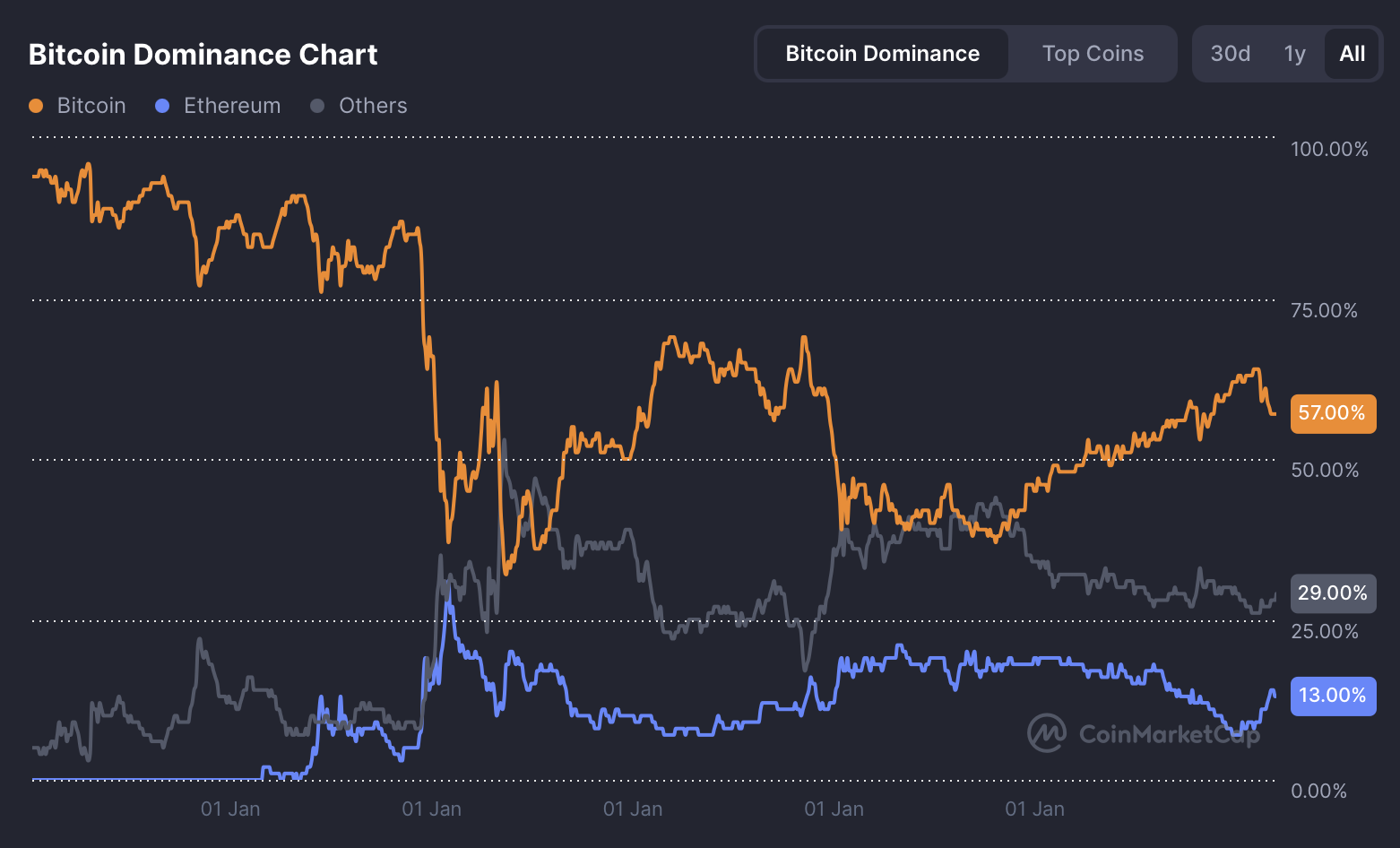
The increase in ETF purchases is coinciding with a persistent decrease in exchange reserves. Approximately 820,000 BTC have been withdrawn from exchanges in the last six months. Traders are also closely watching the upcoming Federal Reserve meeting scheduled for September 18th. CME Group’s FedWatch Tool is currently indicating a 100% probability of an interest rate reduction, which could further enhance liquidity for higher-risk assets.
Whales Balancing Profit-Taking with Accumulation
Analysis of on-chain data presents a varied picture of activity from major Bitcoin holders. New whales, defined as those holding between 1,000 and 10,000 BTC, have reportedly secured approximately $3.2 billion in profits since April. A significant transfer of 4,166 BTC to the Kraken exchange took place on September 10th.
Concurrently, long-term investors remain in an accumulation phase, having added 218,570 BTC since March, according to data from Santiment. The Mean Coin Dollar Age metric has risen to 18.03 million, indicating strong holding behavior. Additionally, corporate treasuries, such as MicroStrategy’s holdings of 199,000 BTC, continue to support market demand.
Despite the positive trends, analysts advise caution, noting that the Exchange Whale Ratio currently stands at 0.50. A climb above 0.7 could signal a distribution phase, based on historical patterns.
Outlook
With more favorable regulation emerging and ETFs channeling institutional investment, Bitcoin’s underlying factors appear robust despite short-term selling pressures. Analysts suggest that if upcoming macroeconomic events align favorably, Bitcoin could further solidify its position relative to altcoins as we move into the final quarter of 2025.