
“I maintain a positive outlook on cryptocurrency, artificial intelligence, and emerging technologies over the long term, but investors have valid reasons to be discerning at this moment,” Ahuja commented, highlighting that inflation, elevated tech valuations, and tight borrowing conditions are impacting investor confidence. “Until there’s reassurance in the markets regarding corporate earnings being able to support current valuations and that financial conditions are improving, I anticipate that investors will remain quite cautious.”
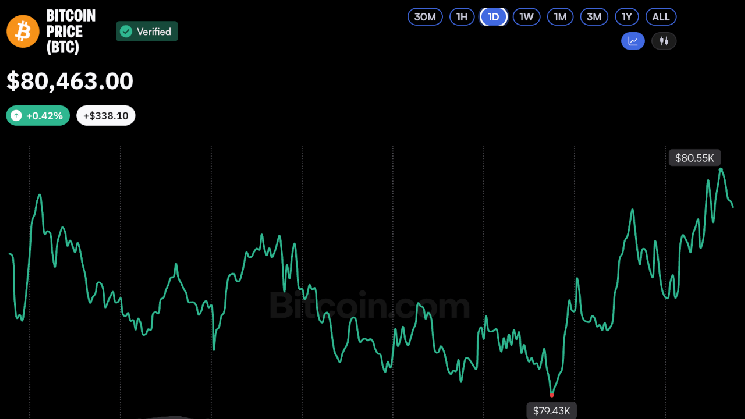
According to Bitstamp data from the past 24 hours, Bitcoin almost reached $80,700 on Monday morning as buyers briefly gained momentum. However, this surge was short-lived, with the price quickly falling back under $80,000, eventually hitting a low near $79,600. The cryptocurrency then entered a narrow trading pattern, facing resistance just below $80,500 and finding support near $79,500. Shortly after 6 a.m. EST, Bitcoin broke through the $79,500 support level for the first time during this session before bouncing back above $80,300.
Four-Year Cycles and Economic Uncertainty
As of 12:25 p.m. ET, Bitcoin’s value was just under $80,500, reflecting a 0.4% increase over the past 24 hours, with its market cap stable at around $1.61 trillion. Ahuja pointed out that while October is proving to be a challenging month for cryptocurrencies, despite typically favorable seasonal trends, Bitcoin’s four-year cycle and the overall market dynamics are still relevant.
“Cryptocurrency is still highly sensitive to liquidity, institutional investments, and general risk tolerance, leaving investors with little motivation to take on more exposure amid uncertain monetary policies,” Ahuja elaborated. “The institutional adoption of crypto has altered capital flow within the market, but it hasn’t eradicated Bitcoin’s historical cycles. For the time being, I recommend keeping an eye on ETF inflows, leverage levels, and the overall liquidity landscape.”
Ahuja also underscored that the upcoming U.S. midterm elections on November 3 add further uncertainty, especially regarding regulations affecting crypto, AI, and energy infrastructure as we approach 2027.
In the derivatives market, Bitcoin’s stagnant price movement limited liquidations to under $20 million, a dramatic decrease from the $56 million observed the previous day. Data from Coinglass indicated that nearly $12 million in long positions were liquidated, while short positions amounted to just below $8 million. However, the broader cryptocurrency landscape painted a different picture: out of $133 million in liquidations, long positions accounted for $62 million, compared to nearly $70 million in liquidated short positions.