
Bitcoin Market Recap: Geopolitical Shock Drags BTC to $62,200
Monday’s bitcoin market recap is a difficult one to write. Bitcoin shed 3.08% on the session, closing the New York afternoon near $62,200 after trading as high as $64,413 in the early hours. The trigger was blunt and fast-moving: President Trump threatened that the United States would take military control of the Strait of Hormuz, a chokepoint responsible for roughly 20% of global oil flows. Risk assets repriced immediately, and crypto — always the first to feel that kind of shock — absorbed the brunt of the liquidation wave.
Total crypto market capitalization fell 2.71% on the day to approximately $2.23 trillion. Bitcoin dominance held at 55.9%, suggesting the flight-to-relative-safety dynamic is alive even within the asset class. That is a cold comfort when the whole market is down, but it matters for positioning context heading into Asian hours.
What Moved Markets Today
Trump’s Hormuz threat triggered an immediate risk-off cascade across both equities and crypto. Bitcoin flushed from the $64,000 area down to a session low of $61,810 within hours of the headlines crossing the wire. The Strait of Hormuz is the world’s single most critical oil chokepoint, and any credible military escalation there rattles energy markets, supply chains, and risk appetite simultaneously. Crypto’s 24-hour nature means it absorbed the repricing instantly while traditional markets were still reacting during U.S. hours.
Rising Treasury yields and a falling S&P 500 reinforced the selling pressure heading into the close. The 10-year U.S. yield climbed 0.88% to 4.61%, and the S&P 500 dropped 0.79% to 7,515. When yields rise alongside equity weakness, the combination removes one of the cleaner macro bids for risk assets — the idea that rate-cut optimism supports speculative positioning. With yields moving higher on geopolitical energy-price fears rather than strong growth, there is no easy offset for crypto bulls to point to.
The Clarity Act’s legislative path grew murkier as Democratic opposition mounted. Reports confirmed that resistance within the Democratic caucus is intensifying in what analysts are calling the bill’s final critical weeks. The Clarity Act represents one of the most significant potential tailwinds for the U.S. crypto industry, establishing a clearer framework for digital asset jurisdiction. Political uncertainty around its passage adds a regulatory overhang to a tape already under pressure from macro and geopolitical forces — a compounding negative that kept sellers in control into the close.
Altcoin Action
Solana led the major altcoins lower, dropping 3.32% to $74.92 against a 24-hour high of $78.19. The move tracked Bitcoin’s selloff closely, which is typical during risk-off episodes when liquidity is pulled from the entire asset class and correlations compress toward one.
Ethereum fell 2.75% to $1,768.92, with the session low touching $1,747.77. ETH’s slightly shallower decline relative to SOL may reflect portfolio rebalancing into larger-cap assets rather than genuine relative strength — the funding rate on ETH sits at just 0.0000035, effectively flat, suggesting there is no meaningful speculative long book propping it up.
The most notable outlier on the day was PI, which cratered 19% with no apparent fundamental catalyst disclosed at the time of writing. LIT fell 12.8% and DEXE dropped 13.9%, a cluster of sharp double-digit losses that signals fragile liquidity in mid-cap and lower-cap structures. Against this backdrop, BDX stood out as the sole meaningful gainer, spiking 10.9% against the tape. JUP added 2.6% and PUMP gained 2.1%, but isolated pockets of strength in a down tape should not be misread as broad rotational buying — they are outliers, not a trend.
Positioning and the Liquidation Map
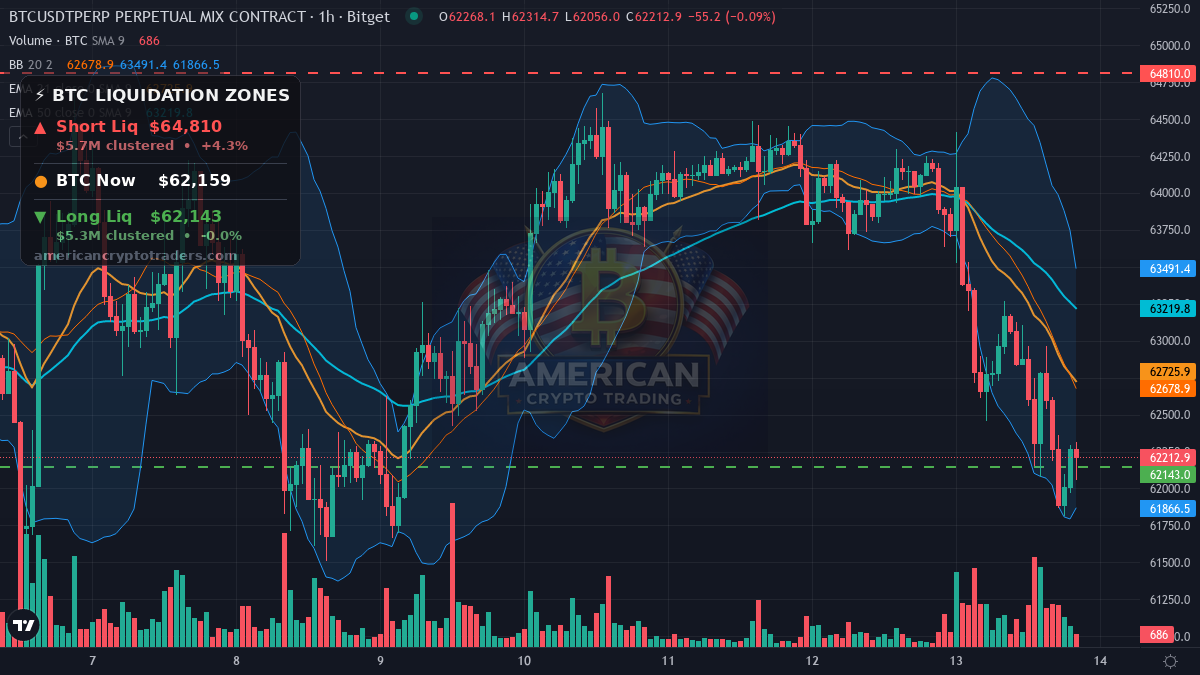
The liquidation data tells a story of a market sitting on a razor’s edge. With Bitcoin last quoted near $62,159, the long liquidation cluster sits at $62,143 — essentially right at current price. Approximately $5.34 million in leveraged long positions would be swept if price dips just marginally from here. That overhang explains why bids have felt thin: the market is treading on top of a long-side trip wire.
On the short side, $5.69 million in short liquidations stack up at $64,810, roughly 4.3% above current price. A sharp recovery rally through that level would force short-covering and could accelerate upside quickly, but getting there requires clearing the geopolitical headlines and stabilizing sentiment first. BTC funding on perpetuals sits at a modest 0.0001, which means the market is not yet heavily net short — leveraged shorts are not piling in aggressively at these levels, but leveraged longs are clearly underwater.
The immediate risk into Asia open is a continuation flush toward and through $62,143. If that level gives, forced liquidations could add momentum to any additional Hormuz-related headlines arriving during overnight hours when liquidity is thinner.
The Macro Picture
The DXY held steady at 101.31, a muted response given the scale of the geopolitical headlines. Gold sat at $4,006.80, essentially unchanged — an interesting data point, because a classic safe-haven flight might have been expected to push gold higher on a Hormuz escalation story. The lack of a strong gold bid suggests markets may not yet be fully pricing a sustained military conflict, keeping the situation fluid and headline-sensitive.
On the stablecoin adoption front, Bolivia is reportedly mulling recognition of USDT as a payment currency amid a domestic dollar shortage, and Hyundai completed a USDT treasury settlement pilot between the U.S. and Mexico. These developments are constructive for the broader crypto ecosystem and speak to the expanding real-world utility of dollar-pegged stablecoins, even if they carry no immediate price impact on BTC or the majors today.
Levels to Watch
The critical near-term level is $62,143, where the long liquidation cluster sits. Asia open price action around this level will set the tone for whether the market stabilizes or enters a second leg lower. Below that, the $61,810 session low is the first structural reference, and a clean break beneath it opens a path toward the $60,000 psychological level.
To the upside, $64,000 — roughly where today’s selloff originated — is the first meaningful recovery target. Clearing $64,810 would trigger the short liquidation cluster and could produce a squeeze toward $65,500 and beyond. London session traders should watch for any de-escalation headlines out of the Middle East as a potential catalyst for a recovery attempt.
Upcoming Catalysts
The macro calendar is relatively quiet for the immediate Asia and London sessions. The dominant catalyst risk is geopolitical: any update on the Strait of Hormuz situation — escalation or de-escalation — is the single most likely overnight price mover. Progress or further deterioration on the Clarity Act’s legislative timeline in Washington could also surface as a secondary headline risk during U.S. morning hours tomorrow.
Sentiment Check
The Fear & Greed Index closed the session at 28, squarely in Fear territory. That reading is consistent with the price action — forced liquidations, weak altcoin structure, and macro headwinds do not produce confident markets. Historically, Fear-zone readings have preceded both continued drawdowns and sharp reversals, so the index alone is not a timing tool.
For broader context on where Bitcoin sits within its longer-term cycle structure, our 28-for-28 monthly candle analysis remains one of the cleaner frameworks for separating cyclical noise from structural trend. Fear at 28 is uncomfortable, but it is not unprecedented within ongoing bull cycles.
Bottom Line
Today’s session was driven by a single, unambiguous macro shock: a geopolitical threat to one of the world’s most critical energy chokepoints. Bitcoin’s 3.08% decline from $64,413 to $62,200, combined with a cluster of double-digit altcoin losses and thin funding rates, paints a picture of a market that is defensively positioned but not yet capitulating. The liquidation map is dangerous at current levels — longs are one bad headline away from a cascade through $62,143.
The honest read here is that this is not a market to be heroic in until the geopolitical situation clarifies. Overnight Asia price action will be the first signal. Watch Hormuz headlines, watch the $62,143 long liquidation floor, and approach any bounce with appropriate skepticism until volume and sentiment confirm a genuine reversal rather than a short-covering blip.
Disclaimer: This recap is for educational and informational purposes only and does not constitute financial advice. Cryptocurrency trading involves substantial risk of loss. Always do your own research. American Crypto Traders and its contributors may hold positions in the assets discussed.
Originally published on American Crypto Traders
This article was syndicated from the American Crypto Traders daily brief. For original analysis and trading signals, visit americancryptotraders.com