
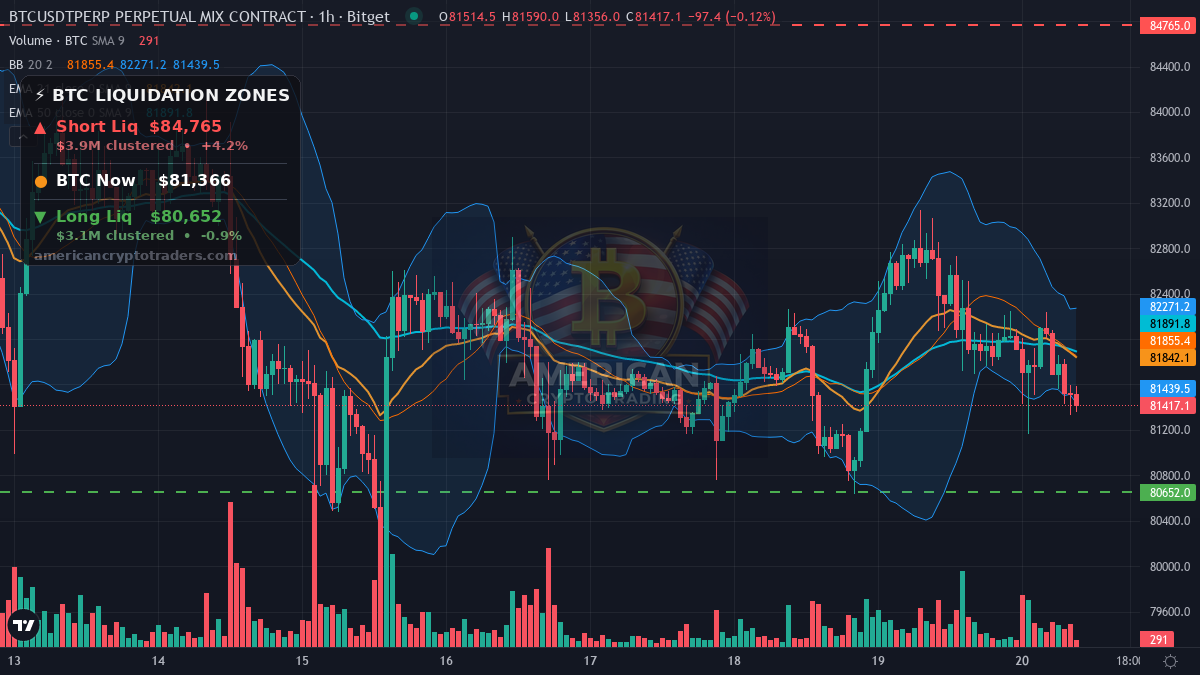
As we gear up for the New York session, Bitcoin currently sits at $81,417, down 1.84% over the past 24 hours after selling off overnight from a high of $83,062, with macro pressure from spiking Treasury yields keeping a lid on what could otherwise have been a constructive tape given the institutional demand story developing beneath the surface.
Bitcoin Market Recap: Yields Clip a Strong Institutional Narrative
The overnight bitcoin market recap tells a classic macro-versus-structure story. On one side, you have some of the most compelling institutional demand data in months — a BlackRock ETF filing, massive single-day inflows, and fresh corporate treasury accumulation. On the other side, the U.S. 10-Year yield punched up to 5.14%, a 0.75% move that is enough to reprice risk assets across the board. When the cost of holding cash risk-free rises that sharply, leveraged crypto longs start to look expensive fast.
The total crypto market cap shed 3.26% over the 24-hour window, dropping to roughly $2.75 trillion. Bitcoin dominance held firm at 59.6%, suggesting that whatever selling occurred, it hit altcoins harder — a classic risk-off rotation within the asset class itself. The low printed at $81,163, just barely holding above the $81K handle, and the question heading into the NY open is whether that level acts as a floor or a launching pad for more downside.
What Moved Markets Overnight
BlackRock filed for a “Buffer” Bitcoin ETF even as its existing IBIT product pulled in $665 million in a single day. The buffer ETF structure — which offers downside protection in exchange for capped upside — is a direct play at institutional allocators who want Bitcoin exposure without the full drawdown risk. The fact that BlackRock is building out a product suite rather than sitting on a single filing signals that demand from traditional finance is structural, not opportunistic. Yet price barely moved, which is worth noting: the market is absorbing extraordinary institutional news and still declining. That divergence matters.
U.S. Bitcoin spot ETFs collectively logged $527 million in net inflows, the biggest single-day showing since September. Spot buying at this scale would normally provide a strong price floor, but the macro headwind from rising yields is acting as an offset. When the 10-Year is at 5.14% and moving, risk premia across equities and crypto reprice almost simultaneously. The inflows are real and verifiable, but they are currently being absorbed by sellers who are using strength — and institutional bid — as an exit.
Strive Asset Management purchased $335 million in Bitcoin after raising $369 million from investors specifically for that purpose. This is the corporate treasury playbook executing in real time. Strive, a firm with ideological alignment to hard-money principles, is accumulating below $82K — a level that, six months ago, many participants would have considered deep value. Corporate treasury buying is slow-moving but persistent, and it tends to reduce the available liquid float over time. The short-term price impact may be muted, but the structural effect compounds quietly.
Altcoin Action
Altcoins were hit harder than Bitcoin overnight, consistent with the dominance reading of 59.6%. Layer-1s bore the brunt of the selling, with NEAR dropping 7.2% to lead the category lower. When macro risk-off sets in and Bitcoin itself is under pressure, layer-1 competitors tend to see disproportionate drawdowns as capital consolidates into the most liquid names.
BTW was the session’s most notable casualty, crashing 27.8% on heavy volume. Sharp single-session moves of that magnitude usually reflect either a project-specific catalyst — an exploit, a team announcement, a liquidity event — or a low-float token experiencing a leverage flush. Without a confirmed catalyst, traders should treat it as a warning about position sizing in smaller names during macro stress periods.
On the brighter side, AKE bucked the trend with a 14.7% gain, joined by PEARL and M at +6.8% each. Individual gainers in a down market often signal either news-driven momentum or short squeezes in thinly traded names. SOL slipped 1.7% to $104.05, holding just above the $103.46 session low. DOGE declined a relatively modest 1.19% to $0.0789, with ETH underperforming the group at -2.28%, trading at $2,383.
Positioning and the Liquidation Map
The liquidation map heading into the NY open presents a relatively tight setup on both sides of current price. On the downside, a cluster of long liquidations sits at $80,652 — roughly 0.9% below where Bitcoin currently trades. A clean breakdown through that level would trigger a cascade of forced long exits and could accelerate a move toward the $80K round number, which carries its own psychological weight.
To the upside, short liquidations stack up at $84,765 — about 4.2% above current price. A push through that level would squeeze the shorts that have been building into this decline and could produce a sharp, fast relief rally. The asymmetry here is notable: there is more fuel above than below in dollar terms, with $3.87 million in short liquidations at $84,765 compared to $3.09 million in long liquidations at $80,652. That does not mean a rally is imminent, but it does mean one would carry more velocity if NY buyers show up with conviction.
Funding rates are mildly positive — BTC at 0.0079% and ETH at 0.0044% — indicating the market is not heavily leveraged long. This is actually a cleaner setup than it might appear: there is no crowded long book waiting to be flushed, which reduces the risk of a catastrophic flush scenario.
The Macro Picture
The dominant macro variable this morning is the U.S. 10-Year yield at 5.14%, up 0.75% — that is a significant single-session move for a rate that is supposed to be among the most stable benchmarks in global finance. When the risk-free rate jumps this aggressively, it raises the discount rate applied to all risk assets and erodes the relative attractiveness of speculative positions. Crypto, as a high-beta, zero-yield asset, feels this more acutely than almost anything else in a portfolio.
The DXY softened slightly to 101.86, down 0.12%, which would normally be a mild tailwind for dollar-denominated assets like Bitcoin. Gold edged down 0.38% to $4,144, suggesting the yield spike is drawing capital away from hard assets broadly. Equities, notably, held up — the S&P 500 futures pointed to a 0.41% gain, which creates an interesting divergence worth watching when NY desks arrive at 9:30 AM ET. If equities open green while crypto stays suppressed, it may indicate sector-specific selling rather than pure macro risk-off.
JPMorgan projecting Bitcoin to outperform U.S. stocks and gold over the next decade adds a longer-duration bullish narrative to the tape, though it functions more as sentiment backdrop than a tradeable near-term catalyst.
Levels to Watch
The first line of defense into the NY open is $81,163 — the overnight session low. Holding that level matters. Below it, $80,652 is the long liquidation trigger and a loss of that opens the door to a test of the psychologically significant $80,000 round number. Traders should have a plan for how they respond if that cascade begins in the first hour of trading.
To the upside, the initial target for any NY-driven recovery is $82,500, then a more meaningful reclaim of $83,000 — the level Bitcoin was trading before the overnight selloff began. A sustained move above $83,000 would shift short-term momentum and begin pressuring the $84,765 short liquidation cluster. Watch volume and the 10-Year yield in tandem: if yields stabilize or pull back as NY trading opens, the probability of a bounce increases meaningfully.
Upcoming Catalysts
There are no scheduled high-impact macro events on the calendar for today’s session that appear in our data set. The dominant catalyst remains the yield environment itself — any Fed commentary or Treasury auction results that move the 10-Year will have an outsized effect on risk appetite. The ETF flow data from today’s session will also be worth watching, as two consecutive large inflow days amid price weakness would strengthen the structural accumulation thesis considerably.
Sentiment Check
The Fear & Greed Index reads 55, labeled Greed — an interesting data point given that prices are declining and altcoins are being hit hard. A greed reading during a down session often reflects lingering optimism from a recent rally rather than genuine conviction, and it can mean there is more sentiment-driven selling to come before the market finds a durable floor. Markets tend to reset sentiment before they reset price. For a longer-term perspective on where Bitcoin tends to be at key monthly inflection points, the 28-for-28 monthly candle analysis remains one of the more compelling historical frameworks on the site.
Bottom Line
The setup heading into the October 20 New York session is one of structural bulls fighting macro headwinds. The institutional demand case — IBIT inflows, the Buffer ETF filing, Strive’s treasury buy — is as strong as it has been in months. But a 10-Year yield at 5.14% is not a minor data point; it is a sustained macro pressure that the market has not fully digested. Bitcoin is currently holding above $81K, but the $80,652 long liquidation level is close enough that NY traders will need to show up with purpose if that support is going to hold. Watch yields, watch volume at the open, and watch whether equity strength translates into crypto follow-through or continues to diverge.
Disclaimer: This recap is for educational and informational purposes only and does not constitute financial advice. Cryptocurrency trading involves substantial risk of loss. Always do your own research. American Crypto Traders and its contributors may hold positions in the assets discussed.
Originally published on American Crypto Traders
This article was syndicated from the American Crypto Traders daily brief. For original analysis and trading signals, visit americancryptotraders.com