
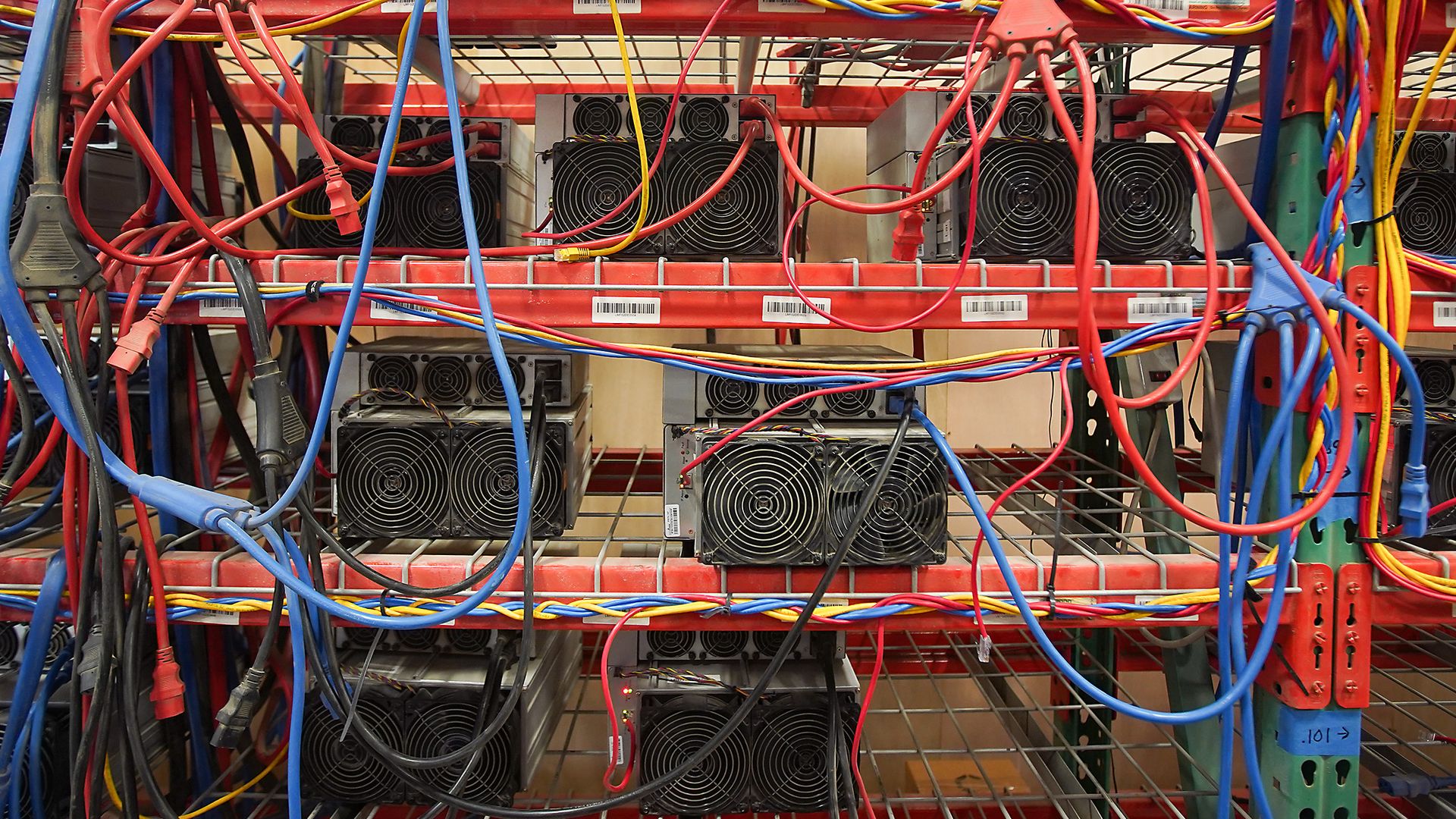
The Texas Public Utility Commission (PUC) is attempting to prevent the release of data pertaining to cryptocurrency mining operations, citing potential risks of terrorist actions if this information becomes public. The PUC initiated a legal challenge in June against Texas Attorney General Ken Paxton after Paxton’s office indicated that certain cryptocurrency mining details would be shared with journalists from news sources, including Straight Arrow News.
Texas has undeniably become a prominent center for cryptocurrency mining. However, the exact scope of these operations and their influence on the state’s power grid remain unclear due to the scarcity of comprehensive data. In June of the current year, a senior official at the Electric Reliability Council of Texas (ERCOT) informed state legislators that cryptocurrency mining could potentially consume approximately 2,600 megawatts of power, roughly equivalent to the electricity demand of Austin on a hotter day. Despite this estimate, precise figures detailing the number of mining facilities in Texas and their impact on grid functionality have not been publicly disclosed.
Texas is experiencing a surge in electricity demand, with ERCOT anticipating nearly double its peak demand by 2030. Bitcoin mining significantly contributes to this increase. The utility provider AEP has recently announced plans to connect an additional 5,000 megawatts of cryptocurrency mining operations to its grid within Texas. This expansion is equivalent to adding the energy load of two more cities the size of Austin.
Why is the Public Utility Commission Filing Suit?
In 2023, the Texas Legislature enacted Senate Bill 1929, which mandates that cryptocurrency facilities with an electrical demand exceeding 75 megawatts must register with the Public Utility Commission by February 2025.
However, access to the data submitted during these registrations, including facility names, locations, ownership details, and energy consumption figures, was denied to reporters upon request. In February, journalists representing Straight Arrow News and The Texas Tribune appealed these denials to the Texas Attorney General’s office.
The Attorney General’s office largely sided with the journalists in a May ruling. Consequently, the Public Utility Commission, whose members are appointed by the Republican Governor Greg Abbott, has filed a lawsuit against Attorney General Ken Paxton.
Download the SAN app today to stay up-to-date with Unbiased. Straight Facts™.
Point phone camera here
“In the wrong hands, this information could be used by terrorists to plan attacks on Texas’s energy grid and critical infrastructure,” the commission’s lawyers stated in a legal document filed on June 27.
Cryptocurrency mining, particularly Bitcoin mining, has become a subject of both economic opportunity and controversy, as Bitcoin miners are drawn to Texas due to its power infrastructure, favorable tax environment, and abundant land. Supporters claim that Bitcoin mining enhances the electrical grid because these mines can swiftly curtail operations when necessary. Conversely, critics contend that the industry exploits lax regulations, increases electricity costs, and negatively impacts the quality of life in communities hosting these facilities.
What is Bitcoin Mining?
Bitcoin mining refers to the energy-intensive process that powers the world’s leading decentralized cryptocurrency. Unlike traditional payment systems managed by banks or governments, Bitcoin functions as a peer-to-peer network where miners compete to validate transactions.
Bitcoin transactions are grouped into “blocks” that require validation through complex cryptographic problems. Mining operations utilize numerous computers to solve these puzzles, generating countless random number combinations until the correct solution is found. This “proof of work” system is intentionally difficult to prevent fraud and maintain network security.
As a reward for maintaining the system’s security, Bitcoin miners receive 3.125 newly created Bitcoins for each validated block—currently valued at over $350,000, based on Bitcoin’s price exceeding $113,000. Miners also collect transaction fees from users who pay extra for expedited processing.
Consequently, the more computing power Bitcoin mines deploy, the greater their potential earnings.
Are Bitcoin Mines ‘Critical Infrastructure?’
In its lawsuit against the Attorney General, the PUC’s legal team asserted that disclosing the location, size, and electrical load details of Bitcoin mines could facilitate terrorist attacks “through manipulation of the volume of available reliable electricity.”
Ellie Breed, Chief Press Officer at the PUC, declined to provide comments on “pending legal matters.”
The lawsuit is a response to the AG’s office ruling issued on May 15.
In the ruling, Texas Assistant Attorney General Blake Brennan stated that the PUC “failed to demonstrate” that the information sought by SAN and Tribune reporters “identifies the technical details of particular vulnerabilities of critical infrastructure to an act of terrorism.” In essence, Brennan argued that the PUC lacked specificity regarding how this information could aid terrorists.
An ERCOT spokesperson provided SAN with a statement outlining some of the grid operator’s monitoring and security measures but did not directly answer questions regarding whether cryptocurrency mines are considered critical infrastructure, or if these facilities have been targeted in any attempted attacks.
What Role Do Bitcoin Mines Play on the Texas Grid?
Most cryptocurrency mines are categorized as a “large flexible load” on the electrical grid because they consume significant amounts of electricity but can also quickly cease operations, making them adaptable.
In a March letter to the Attorney General’s office, the PUC asserted that cryptocurrency mining facilities’ “use of critical infrastructure and massive amounts of electricity can strain and threaten the reliability of the state’s energy grid.”
Bitcoin industry groups argue that their technology reinforces the grid.
“Flexible loads are crucial for grids of the future,” the Texas Blockchain Council states on its website. According to the Texas Blockchain Council, Bitcoin mining provides a financial incentive for increasing energy production, especially renewable energy. However, if prices surge or the grid requires more power for homes, businesses, and essential services, Bitcoin data centers can shut down, creating a buffer that proponents claim enhances grid reliability.
When power utilized by cryptocurrency miners is needed elsewhere, ERCOT can independently reduce the power to part of the cryptocurrency facility, but only if the mine’s owner agrees to relinquish control to the grid operator. The data requested from the PUC by journalists would reveal how many large cryptocurrency mines participate in this ERCOT program, known as demand response.
Daniel Batten, a Bitcoin analyst and climate tech investor, stated in an email to SAN that Bitcoin “plays a vital part of ERCOT’s demand response program, which has helped to stabilize the grid.” Batten, who also serves on the advisory board of the Bitcoin mining company Marathon Digital Holdings, added that Bitcoin mines help to balance frequency fluctuations, protecting against blackouts.
The grid operator also compensates participants in demand response programs, which can be lucrative. During a heatwave in August 2023, ERCOT paid Riot Platforms $31.7 million to shut down its computers, according to CNBC.
Companies may also voluntarily reduce power consumption, contingent on electricity prices and the price of Bitcoin. Most Bitcoin mines enter into contracts to purchase electricity at a fixed rate, allowing them to resell that power to other grid users through ERCOT’s wholesale market. Bitcoin companies typically shut down when they can generate more revenue from reselling power than from mining Bitcoin.
What Do Grid Experts Think?
“We really haven’t been dealing with large controllable loads for that long,” stated Joshua Rhodes, a research associate at the University of Texas at Austin, in an interview with SAN.
Rhodes acknowledged “some credence” to the PUC’s argument due to the increasing importance of these controllable facilities in maintaining the balance of electric supply and demand. However, he favors making information on Bitcoin mining public.
“The more correct information that we have about the system, the more competitive it can be, the more efficient it can be, the better the market can function,” he told SAN.
Ed Hirs, an energy economist and lecturer at the University of Houston, supports the public release of cryptocurrency mining data, labeling the PUC’s lawsuit “a ridiculous spectacle.”
Furthermore, Hirs challenged the notion that Bitcoin strengthens the electrical grid, describing Bitcoin as “the very definition of a parasitic load” because it connects to the grid, increases demand and prices, and then receives payment to shut down through demand response programs.
Both Hirs and Rhodes emphasized that data on power plants, undoubtedly essential grid infrastructure, is publicly available.
Bitcoin in Texas Towns
Jackie Sawicky was residing in Navarro County, Texas, south of Dallas, when Riot Platforms commenced construction of a large Bitcoin mine near her residence. Sawicky told SAN that the public was not given the opportunity to review the plan or provide feedback.
Sawicky also described “utter devastation” in nearby Hood County, where another Bitcoin mine, operated by Marathon Digital Holdings, exists alongside a natural gas power plant. Hood County residents believe that the noise from thousands of fans used to cool the Bitcoin mining computers has led to various health problems.
Unbiased. Straight Facts.TM
Cryptocurrency mining on the Texas grid can draw 2,600 megawatts of electricity, as much as the city of Austin on an above average day.
“In Hood County, there are people who are going deaf, people who are having cardiac issues, there are livestock who are going insane,” Sawicky stated.
SAN contacted Riot Platforms, Marathon Digital Holdings, and other Bitcoin mining companies active in Texas; however, none responded to requests for comment. Lee Bratcher of the Texas Blockchain Council also declined to comment.
The disruptions to health, peace, and quiet, attributed by residents to Bitcoin mining, have heightened calls for transparency and increased regulation.
Sawicky followed the Public Utilities Commission lawsuit with considerable interest.
“It sounds like it’s being written by the Bitcoin mining industry, not an entity that’s supposed to be operating on behalf of the Texas public,” she stated.
The Terrorism Argument
Arguing that public disclosure of information could lead to terrorism is a common tactic.
Joseph Larsen, a lawyer at the Houston-based firm Gregor Wynne Arney, noted that governmental entities frequently employ such arguments. “The burden of proof is low,” Larsen explained in an email to SAN.
“If you’re not careful, the exception to disclosure can swallow the rule, which is disclosure,” said Bill Alshire, an Austin-based lawyer with over 25 years of experience in Texas Public Information Act cases.
While acknowledging that there are some legitimate uses of the terrorism argument, Aleshire suggested that government agencies “think they get more credibility” by invoking national security concerns.
“They misuse the terrorist excuse as just one of the ways they withhold information,” he explained to SAN.
Editor’s Note: Keaton Peters, the author of this article, is mentioned in the lawsuit between the Public Utility Commission of Texas and Texas Attorney General Ken Paxton because he submitted a Texas Public Information Act request seeking data about cryptocurrency mining’s effect on the Texas power grid. Our editors believe the information Peters received regarding the lawsuit is of immediate public interest to our readers.
contributed to this report.