

Why Bitcoin Miners Are Embracing Artificial Intelligence
The Bitcoin network’s 2024 halving event slashed the reward for each mined block to 3.125 BTC, effectively halving the income for Bitcoin miners. This, coupled with escalating electricity prices, the high cost of maintaining specialized equipment, and increased competition, has eroded the profitability of traditional Bitcoin mining. Many firms in the mining sector are now looking for alternative revenue streams to stay afloat.
While Bitcoin mining heavily relies on specialized hardware known as ASICs, Bitcoin mining enterprises often control large data centers with significant power infrastructure. As the demand for AI computing resources explodes, numerous miners are repurposing or upgrading their facilities to include GPUs, which are more suited for AI model training and inference tasks.
Artificial intelligence applications, particularly those involving the training of advanced large language models, powering self-governing systems, and running business-oriented AI tools, require vast amounts of computational horsepower.
With tech companies engaged in a fierce race to acquire high-performance computing infrastructure, Bitcoin mining companies are stepping up to fill the void. By leveraging their existing, energy-intensive data centers and installing GPU arrays, many miners are now offering AI-based cloud computing services or leasing their excess computing capacity. This strategic diversification enables them to generate consistent revenue streams that are not tied to the fluctuating price of Bitcoin (BTC), mitigating the financial risks associated with cryptocurrency volatility.
This pivot towards AI helps offset the financial impact of Bitcoin halving and results in more dependable and lucrative revenue sources.
Did you know? Both AI workloads and Bitcoin mining are exceptionally energy-intensive. By proactively preparing for both applications, miners can lease surplus computing capacity to AI companies, particularly during periods of low crypto prices, converting otherwise stranded power into a steady flow of cash.
Case Study: Core Scientific’s $3.5 Billion Rescue
Core Scientific provides a compelling illustration of how the transition to AI can help a Bitcoin mining business recover from financial distress. After facing challenges and declaring Chapter 11 bankruptcy in late 2022 due to depressed Bitcoin prices and significant debt, the company underwent restructuring and relisted on the Nasdaq stock exchange in early 2024.
In June 2024, Core Scientific signed a substantial 12-year agreement worth $3.5 billion with CoreWeave, an AI cloud services firm. The agreement allows Core Scientific to utilize portions of its infrastructure to support CoreWeave’s advanced computing requirements, moving away from a purely Bitcoin-centric business model to providing AI-based services as well.
Although the firm’s revenue for the first quarter of 2025 decreased to $79.5 million from $179.3 million in the prior year, the new AI strategy boosted investor confidence. The company’s stock value rose following the announcement of the CoreWeave deal, showing market approval for the company’s change in direction.
By mid-2025, CoreWeave resumed talks to buy Core Scientific, following a previous unsuccessful offer of $1 billion the year prior. This renewed interest underscores how the company’s focus on AI lessened the impact of the Bitcoin halving and established Core Scientific as a significant player in the expanding AI computing sector.
Hut 8’s AI Venture: A Secondary Income Stream
Hut 8 has incorporated AI as an additional revenue source while still emphasizing Bitcoin mining as its main focus. Their business strategy blends stability and expansion potential through a five-year agreement including fixed payments and profit-sharing, guaranteeing consistent revenue with prospects for additional income based on customer success.
In September 2024, the company launched Highrise AI, a subsidiary that delivers GPU-as-a-Service, making use of over 1,000 Nvidia H100 chips—specialized hardware perfect for training and deploying cutting-edge AI models. This move signalled Hut 8’s official entry into the high-performance computing (HPC) market.
Even with the AI venture, Hut 8 remains committed to Bitcoin mining. In the first quarter of 2025, they mined 167 BTC, a decrease from 716 BTC in the same timeframe in 2024, primarily due to the 2024 Bitcoin halving. The company continues to invest in its mining infrastructure, bolstered by its significant Bitcoin holdings of 10,273 BTC, placing it ninth among corporate Bitcoin holders globally.
For Hut 8, AI functions as a supplementary strategy, diversifying income while preserving Bitcoin mining as a core element of their long-term strategy.

Hybrid Models: The Rise of Hive and Iren
As the returns from Bitcoin mining diminish, hybrid business strategies blending Bitcoin mining and AI computing are gaining traction. Companies like Hive and Iren are demonstrating the possibility of increasing AI revenue without abandoning their Bitcoin roots by diversifying revenue streams while optimizing existing infrastructure.
Hive Digital Technologies
Formerly known as Hive Blockchain, the firm rebranded in mid-2023 to reflect its wider ambitions in high-performance computing. Hive invested $30 million to deploy Nvidia-powered GPU clusters, marking a significant shift toward AI workloads.
This investment quickly bore fruit. In fiscal year 2025, Hive’s revenue from AI and HPC hosting tripled to $10.1 million, representing nearly 9% of its total revenue. Looking forward, Hive has set an ambitious goal of $100 million in AI revenue by 2026, indicating a firm commitment to growing its hybrid business model.
Iren (Iris Energy)
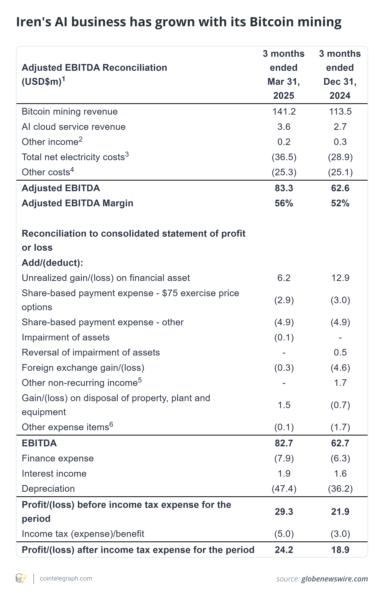
Australian mining group Iren initiated its AI endeavors in early 2024 with only 248 GPUs, but by mid-2025, it had expanded to over 4,300 units. The company’s hybrid model is already yielding positive results, with mining 1,514 BTC in Q3 FY2025, and earning $3.6 million from AI cloud services. To bolster this expansion, Iren is constructing AI-focused data centers in Texas and British Columbia.
However, the company encounters challenges: a class-action lawsuit filed in October 2024 alleges misleading investors about the operational readiness of its Texas site, potentially overshadowing its otherwise promising growth.
Leading Bitcoin Miners Preparing for AI: Riot Platforms and MARA Holdings
While some Bitcoin miners are already generating revenue from AI operations, others are establishing the foundations for potential AI ventures. Riot Platforms and MARA Holdings, prominent firms in the Bitcoin mining sector, are strategically planning for the integration of AI, while still prioritizing their core Bitcoin mining operations.
Riot Platforms
Looking into AI possibilities, Riot Platforms has initiated assessments to potentially convert 600 megawatts of capacity at its Corsicana, Texas, site into high-performance computing (HPC) infrastructure. Even though Riot has not yet secured substantial AI-related contracts, its Corsicana site, spanning 355 acres, has the capacity to support up to 1 gigawatt of computing resources, creating a significant competitive edge.
From a financial viewpoint, Riot maintains a solid foundation through its Bitcoin mining activities, having mined 1,530 BTC and earned $142.9 million in mining revenue during the first quarter of 2025. The company also holds 19,225 BTC (as of July 17, 2025), marking one of the largest corporate Bitcoin holdings globally.
MARA Holdings
MARA commands the most substantial Bitcoin reserve among mining companies, possessing 50,000 BTC, which is second only to MicroStrategy among publicly traded companies. Its AI approach is centered on edge computing, incorporating the advancement of its MARA 2PIC700 immersion cooling system, engineered to manage demanding computational tasks.
Despite the availability of this infrastructure, MARA’s AI initiatives have not resulted in major contracts or consistent revenue yet. For the time being, venturing into AI remains a forward-looking strategy with potential for future development.
Did you know? Bitcoin mining uses ASICs, while AI relies on GPUs like Nvidia’s H100s. Some miners are now retrofitting their data centers with GPUs to cater to AI clients, forming dual-use infrastructure that supports both blockchain and AI demands.
An Exception: Canaan’s Retreat from AI
While many Bitcoin mining companies are exploring AI to diversify their revenue streams, Canaan has taken a different route.
In July 2025, the company shut down its AI chip division, withdrawing from the high-performance computing sector. This decision underscores a renewed focus on its principal strength: the design of application-specific integrated circuits (ASICs) for Bitcoin mining.
Instead of pursuing the burgeoning AI market, Canaan is advancing its mining hardware to maintain a competitive advantage. Still, it holds just 2.1% of the global ASIC market, significantly trailing prominent competitors such as Bitmain and MicroBT.
By giving priority to mining-focused hardware and bolstering its presence in markets such as North America, Canaan is executing a distinct strategy while others are shifting toward AI. The long-term effectiveness of this strategy remains to be seen.
Did you know? AI companies are under increasing pressure to operate sustainably. Bitcoin miners who already utilize renewable energy resources, such as hydropower or solar, can appeal to AI clients seeking to meet sustainability objectives via clean colocation deals.
Key Risks and Considerations for Miners Entering the AI Market
As Bitcoin mining firms increasingly shift towards AI, this transition presents both significant opportunities and noteworthy risks. Miners must carefully evaluate the following:
- Infrastructure Costs vs. Returns: Shifting from ASIC-based mining to GPU-based AI systems entails substantial upfront costs. Miners need to ensure that potential long-term revenues compensate for these significant investments.
- Client Stability: AI customers, particularly nascent startups, may lack consistent funding or long-term financial reliability. Miners must thoroughly assess clients to avoid payment defaults or service disruptions.
- Power Supply Reliability: AI operations require continuous and considerable energy consumption. Miners must secure stable, long-term power agreements and carefully monitor local grid capacity to prevent outages or sudden price increases.
- Cooling and Thermal Management: AI processors, like Nvidia H100s, generate substantial heat. Insufficient cooling systems can result in equipment failures and decreased efficiency.
- Regulatory Compliance: Hosting AI workloads can involve complex regulations related to data privacy, intellectual property, international data hosting, energy consumption, water usage, and carbon emissions. Miners must be ready to navigate these legal complexities.
- Market Competition: As more miners join the AI colocation market, pricing is likely to decline. Early participants should establish competitive advantages, like strategic locations, cheap energy resources, or large-scale operations.
- Resource Strain: Expanding into AI while maintaining mining operations can strain financial and management resources.