
The future of large-scale Bitcoin mining operations is in jeopardy, according to Bit Digital’s CEO, Sam Tabar. While Bitcoin itself will endure, he predicts the commercial mining industry faces extinction.
Tabar told Magazine that the existing business model for “Bitcoin mining is unsustainable and will fail within two years.” He suggests the profit margins will simply disappear, making it an unviable endeavor.
“The mining industry cannot withstand another halving event, particularly if sovereign entities commence Bitcoin mining operations.”
Bit Digital, which originated as a car-sharing platform in China back in 2015, shifted its focus to Bitcoin mining after regulatory changes in China’s P2P lending sector in 2018. Recently, in June, the company revealed plans to cease its Bitcoin mining activities in the United States, Canada, and Iceland, reallocating those resources towards building up their Ethereum holdings.
“After some time, we concluded – and I believe other mining companies are also starting to realize – that it’s a really problematic line of business,” he commented.
Tabar pointed out that the block reward halving which reduced mining rewards in 2024 “was devastating” and believes the upcoming halving predicted for April 2028 will effectively kill off much of the remaining mining industry because their income will be cut in half yet again. He also expects that sovereign nations will start aggressively “mining Bitcoin to add to their national reserves” as its price potentially reaches $250,000.
“National governments have an unfair advantage, with little to no expenses for energy, in contrast to commercial Bitcoin mining operations.”


Many countries around the globe utilize state-owned assets for power generation, particularly within the top electricity-producing nations such as China, India, Russia, and Brazil.
Bhutan has already invested its access to hydropower in Bitcoin, amassing a hoard currently worth $1.4 Billion.
Ethiopia is another example, now contributing around 5% of the entire Bitcoin hashrate. This is due to their state-owned Ethiopia Electric Power company.
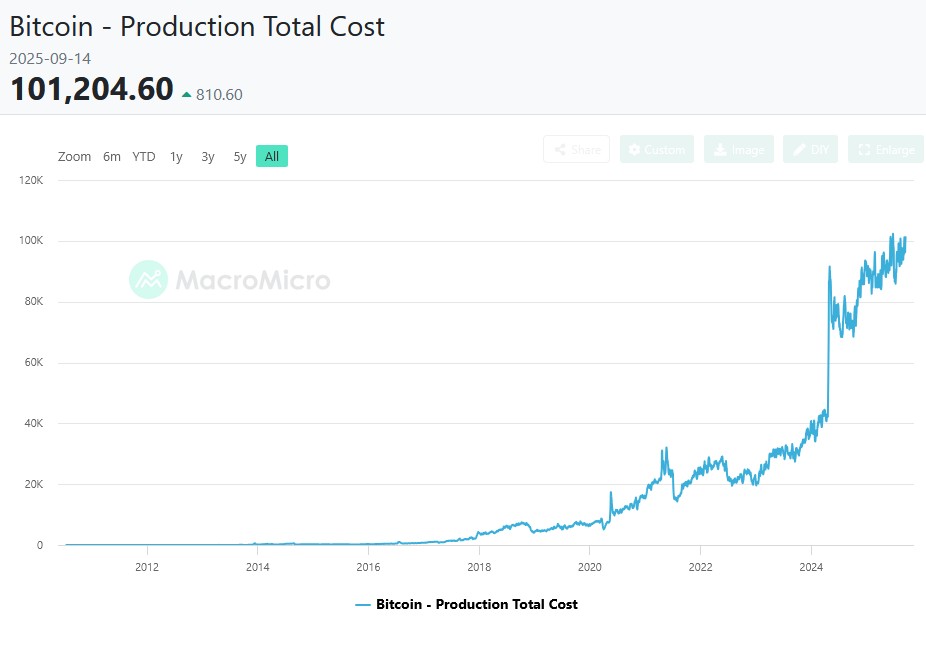
Reports from Al Jazeera say that their Bitcoin production cost is only around $20,000 per coin because they use surplus hydropower, which netted them $220 million in the last year. In contrast, estimates for the commercial industry reveal much higher costs, with MacroMicro placing the average production cost of 1 Bitcoin at over $100,000.
NEW: Al Jazeera reports the all in cost of of mining one Bitcoin in 🇪🇹 Ethiopia is only $20,000 due to abundant hydropower 😮
— Bitcoin News (@BitcoinNewsCom) September 12, 2025
Tabar states that the increase of national countries entering the Bitcoin mining space will push the Bitcoin hashrate up “astronomically”. Because of this, he believes that there is no possible way that either public or private Bitcoin mining firms will be able to make it through another halving and the “hasrate going up the fucking roof” if sovereign entities also join in.
He suggests that this scenario makes the long-running discussion surrounding Bitcoin’s future security budget somewhat unimportant. Tabar comments “I don’t think it will be an issue” because nation-states are coming in to take over.
Tabar maintains that he had anticipated and accurately forecast China’s ban on Bitcoin mining – successfully moving his mining equipment out of the country – in addition to the rise in popularity of crypto treasury firms, so you should put your trust in his predictions for the future.
Differing Perspectives on Bitcoin Mining’s Prospects
Of course, not everyone agrees. Mati Greenspan, the founder of Quantum Economics, founded Quantum Expeditions in 2023 to mine Bitcoin using sustainable, affordable energy sources. He believes that affordable energy is available if you do some searching.
“National governments do not have free energy access. The energy sources they use require capital, development and labor,” he asserts, further stating:
“Quantum Expeditions can use energy at no cost. Hundreds of billions of cubic feet of natural gas are burned every year by the oil and gas companies in Texas. They are happy to give it to us, and fund our operations.”
Bitcoin mining expert General Kenobi also concedes that the Bitcoin mining industry will likely have major changes, especially with power companies dominating as a method to both stabilize the grid and generate income.

“I believe that power grid companies will create Bitcoin mining divisions,” he said, explaining that mining rigs will be easily turned on when excess energy is available and easily shut off at peak times.
“Each grid operator will have Bitcoin miners because of its effective method for grid balancing. It is less complicated than forcing disconnections,” he stated. Kenobi also believes it might have prevented Spain’s electric grid failure earlier this year.
Read also
Michael Saylor Also Thinks That Bitcoin Mining Is A Rough Business
Reportedly, another well-known Bitcoiner, Michael Saylor, the head of Strategy, agrees that it is a difficult business. Tabar had a talk with him at the HC Wainwright conference just a few months ago.
Tabar reported that Saylor sympathized with his Bitcoin mining concerns and was in agreement that “the Bitcoin mining industry is a difficult place to be.”

“Why not shut down your Bitcoin mining business, and follow what we are doing?” Saylor inquired, suggesting to “become just like MSTR. Accumulate Bitcoin, store it on your balance sheet, and repeat.”
“My response was that I prefer to do this with Ethereum.”
The tone changed at that point, although Tabar felt as if Bitcoin was too saturated and Ethereum was better as an investment.
“There is no Ethereum halving, so you don’t need to buy expensive equipment constantly. There is also no need to shop for low energy costs either. It is much better and easier.”
Bit Digital has since gained traction, and is now the fourth largest ETH treasury, with 120,300 Ether in their reserves, which is valued at over $500 million.
Part 2, ‘7 reasons why Bitcoin mining is a terrible business idea’ will be published tomorrow.
Subscribe
The most engaging reads in blockchain. Delivered once a
week.


Andrew Fenton
Andrew Fenton is a journalist and editor with more than 25 years experience, who has been covering cryptocurrency since 2018. He spent a decade working for News Corp Australia, first as a film journalist with The Advertiser in Adelaide, then as Deputy Editor and entertainment writer in Melbourne for the nationally syndicated entertainment lift-outs Hit and Switched on, published in the Herald-Sun, Daily Telegraph and Courier Mail.
His work saw him cover the Oscars and Golden Globes and interview some of the world’s biggest stars including Leonardo DiCaprio, Cameron Diaz, Jackie Chan, Robin Williams, Gerard Butler, Metallica and Pearl Jam.
Prior to that he worked as a journalist with Melbourne Weekly Magazine and The Melbourne Times where he won FCN Best Feature Story twice. His freelance work has been published by CNN International, Independent Reserve, Escape and Adventure.com.
He holds a degree in Journalism from RMIT and a Bachelor of Letters from the University of Melbourne. His portfolio includes ETH, BTC, VET, SNX, LINK, AAVE, UNI, AUCTION, SKY, TRAC, RUNE, ATOM, OP, NEAR, FET and he has an Infinex Patron and COIN shares.