
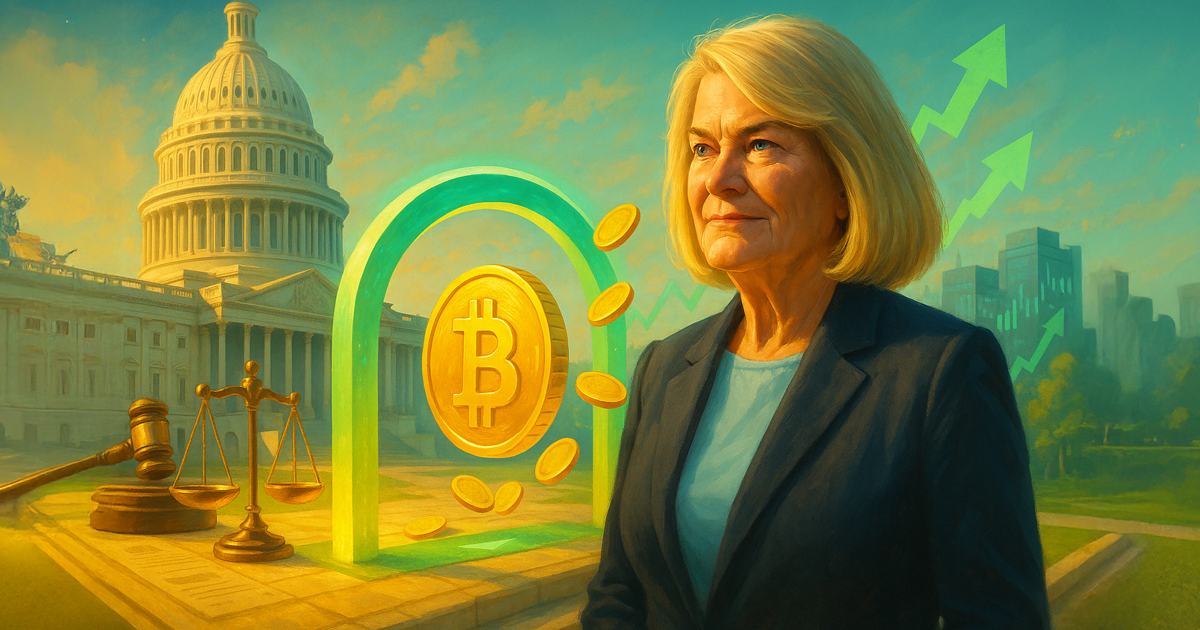

On Capitol Hill, Senator
Cynthia Lummis
is championing a plan to help
Bitcoin
become a more widely used form of currency.
The Wyoming Republican is spearheading the creation of new legislation aimed at achieving what years of advocacy have not: making the everyday use of Bitcoin more realistic.
Her proposed tax relief for minor crypto transactions would let individuals spend a certain amount of Bitcoin without needing to report capital gains.
Lummis
announced
on October 9th that this provision would be part of a more comprehensive framework for digital asset taxation that she is developing. She encouraged her constituents to reach out to their representatives to show support for the initiative.
This seemingly small change could potentially transform Bitcoin from an investment option to a viable everyday currency. This would be a return to
Satoshi Nakamoto’s
original concept of Bitcoin as a decentralized, peer-to-peer form of money that can be exchanged easily between users.
What is a de minimis tax exemption?
In the language of tax laws,
de minimis
means something is “too insignificant to be concerned about.” The principle goes back to the Tariff Act of 1930, which excused importers from paying charges on goods of minimal value.
When applied to crypto, this rule would exempt users from needing to calculate gains each time they make small BTC purchases, a complex procedure that has long made Bitcoin payments unfeasible in the US.
Lummis initially tried to
introduce this legislation back in June.
The suggested bill would make transactions under $300, with a yearly cap of $5,000, tax-free. While it would exclude assets sold for cash or utilized in business operations, it would still cover the majority of everyday spending.
However, this proposal has encountered considerable disagreement from detractors such as
Senator Elizabeth Warren,
a notable critic of the crypto industry.
Warren has claimed that crypto holders have failed to pay as much as $50 billion in taxes annually, and that this new legislation would only exacerbate that issue.
In that context, she
stated:
“I support regulations that are appropriately tailored, but I believe we should stick to the principle we have used in Congress for decades: the same basic transaction and risks should be subject to the same rules. This should apply to crypto just as it does to any other financial product.”
How will this impact Bitcoin?
A well-defined de minimis rule would simplify tax-related matters and also potentially redefine how Bitcoin is used within the economy.
For everyday consumers, this translates to easier payments. Purchasing coffee, movie tickets, or groceries with Bitcoin would no longer necessitate calculating capital gains or tracking the cost basis. Wallet applications could introduce a special “everyday mode” for smaller purchases, while payment processors such as
Strike
and BitPay could promote a new kind of tax-free micro-spending that feels as seamless as using a debit card.
This change in behavior could have broader effects on the market. As more individuals spend and convert smaller amounts of BTC, trading activity would become more consistent, tightening bid-ask spreads and lowering intraday volatility. This effect might not lead to extreme price changes, but it would give the market a more stable rhythm, at least within the US.
The advantages are equally apparent for companies that are experimenting with crypto rewards or payroll.
A simple tax threshold would let companies manage Bitcoin stipends or loyalty points as routine costs instead of complex taxable events. With better clarity, accounting platforms could automate compliance, permitting businesses to
integrate BTC practically
without assuming complete treasury risks.
In Washington, the PR would be favorable. Lawmakers would get to highlight a pro-innovation initiative that has minimal financial impact, while also showing openness to a more adaptable digital economy.
The end result is a policy that modernizes taxation without generating controversy and pushes Bitcoin closer to its initial objective: being a form of money that is actually used.
Additionally, a de minimis exemption sends a signal that the US government recognizes Bitcoin as a medium of exchange, rather than just a risky investment. This could nudge payment giants like Visa and PayPal to increase their integrations and pressure other regions, such as the UK, to follow suit.