
According to Senator Cynthia Lummis, the establishment of a US Strategic Bitcoin Reserve could be initiated “at any time.”
This statement has intensified discussions in Washington regarding the potential timeline for the Treasury Department to launch such a plan, possibly even preceding the finalization of relevant legislation by Congress.
Sponsored
Sponsored
While Congress is still reviewing several proposed bills, Senator Lummis’s remarks suggest that the Treasury Department might already possess the authority – or at least sufficient political support – to commence preparations for infrastructure and resource allocation, even before formal legislative approval is secured.
“Navigating the legislative process can be slow, and we’re still striving towards its completion. However, thanks to initiatives under President Trump, acquiring funds for a Strategic Bitcoin Reserve can proceed immediately,” Lummis shared on the X platform.
Based on an executive order from March during Donald Trump’s presidency, the Treasury currently oversees approximately 200,000 BTC. This quantity, valued at roughly $17 billion as of mid-March, serves as the foundation for the envisioned reserve. White House advisor David Sacks has indicated that the program operates in a “budget-neutral” manner, utilizing seized assets rather than relying on taxpayer funds.
The executive order also created two distinct accounts: the Strategic Bitcoin Reserve specifically for BTC holdings that are not intended for sale, and a Digital Asset Stockpile designed for other types of confiscated digital tokens. Both accounts are managed under the Treasury’s purview without incurring costs.
President Trump described Bitcoin as “an innovative asset employing ledger technology” that benefits individuals globally. He presented the strategic reserve as a mechanism to lessen national debt and reinforce America’s leadership in the financial sector.
The House’s appropriations bill for 2026, identified as H.R. 5166, instructs the Treasury to conduct a comprehensive study within 90 days focusing on the custody, cybersecurity measures, and accounting practices related to the Strategic Bitcoin Reserve. Additionally, it mandates a confidential briefing coordinated by the NSA, allocates more funds to the Office of Terrorism and Financial Intelligence to assess AI-driven sanctions tools, and prohibits the Treasury from using appropriated funds to develop a central bank digital currency.
Although the bill does not authorize any new purchases of Bitcoin, it does position Bitcoin as a focal point within the wider fiscal policy conversation for the first time.
Sponsored
Sponsored
Economic Models and Market Outlook
Legal experts at Vitallaw have indicated that the executive order effectively designates the Treasury as a “digital Fort Knox.” This framework consolidates all seized BTC under federal control and enforces rigorous key management protocols, multi-signature security systems, and cross-agency oversight to ensure operational consistency across different administrations.
Financial firm VanEck has estimated that accumulating one million BTC by 2029 could potentially offset 18% of the US national debt by 2049. This projection equates to about $21 trillion in reserve value against a projected $116 trillion national debt, based on an assumed annual price increase of 25%.
Senator Lummis contends that establishing such a reserve would reinforce America’s standing as a leader in both finance and technology on the world stage.
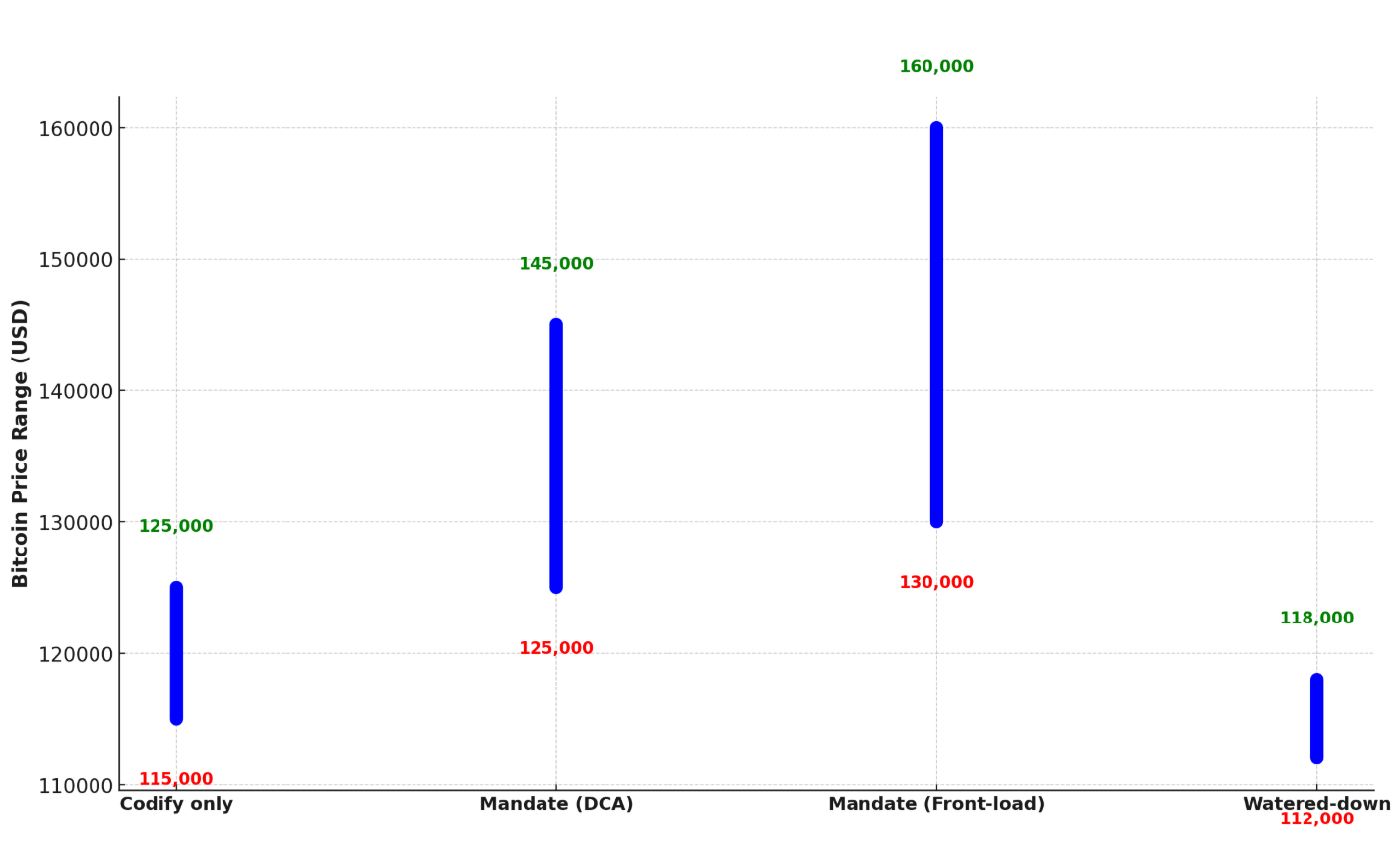
BeInCrypto’s analysis suggests that if Congress approves the reserve without mandating compulsory purchases, the price of Bitcoin could potentially range from $115,000 to $125,000. However, if the mandate includes purchasing 200,000 BTC annually, prices could be driven higher, potentially reaching between $130,000 and $160,000, due to supply limitations.
CoinShares asserts that allocating Bitcoin as a sovereign reserve asset could serve as a hedge against inflation, diversify reserve holdings, and demonstrate technological foresight. The firm also highlights early initiatives at the state level, such as New Hampshire’s HB 302 and Arizona’s proposed “crypto reserve,” as evidence of increasing policy interest.
Conversely, Chainalysis cautions that simultaneous accumulation by multiple nations could create liquidity challenges in the Bitcoin market. Economist David Krause characterizes the reserve as a “high-risk experiment in financial symbolism,” raising concerns about blurring the distinction between responsible fiscal management and speculative investment.
Currently, a single tweet from a senator has transformed a previously theoretical fiscal concept into an immediate political challenge. The central question now is whether Washington can effectively manage a digital reserve without creating instability in the very market it seeks to lead.