

On August 21, Bitcoin’s price surged sharply, surpassing $76,000 for the first time since late May. This increase was bolstered by institutional investments and improved liquidity conditions in the United States.
Summary
- Bitcoin crossed the $75,000 threshold for the first time since late May, experiencing a robust 18% rise.
- On August 20, U.S. spot Bitcoin ETFs attracted $606 million, continuing a trend of two consecutive days of inflows.
- The daily Awesome Oscillator for Bitcoin turned positive, while the Chande Momentum Oscillator hit a high of 91.13.
- Starting in September, the Treasury will increase long-dated debt buybacks to at least $4 billion per operation.
- The support range between $70,000 and $72,000 now serves as a buffer against potential deep retracement.
According to data from crypto.news, BTC is trading around $76,291, marking a nearly 9% gain in 24 hours and a total increase of roughly 19% over the past week. This rally has seen BTC rise by over $11,000 in just two days.
This upward trend initiated after the price rebounded from the $62,000-$63,000 zone, breaking past the resistance at around $65,000. Following this, it exceeded the $70,000 mark, paused around $72,000, and then moved beyond $75,000.
Bitcoin breaks free from weeks of stagnant trading
For approximately six weeks, Bitcoin fluctuated within a narrow range and struggled to surpass the $65,000 barrier, which encouraged traders to adopt bearish positions at the upper limits.
The shift in momentum occurred on Wednesday as BTC quickly surged past multiple resistance levels. The rapid rise was fueled by forced short covering, as traders bought BTC to liquidate their leveraged short positions.
As previously noted, nearly $3 billion in positions were liquidated following BTC’s rise above $70,000, predominantly from short positions, based on analyst data from CoinGlass.
These liquidations contributed to the speed of the rally, but do not solely account for its direction. The inflows from spot demand and U.S. ETFs also rose as BTC climbed.
ETF inflows underscore institutional interest
According to SoSoValue data, U.S. spot Bitcoin ETFs recorded around $606 million in net inflows on August 20, following approximately $517 million on August 19.
The two-day total exceeded $1.1 billion in combined net purchases, which suggests that institutional investors were indeed part of the breakout rather than leaving the movement solely to derivative traders making up for short positions.
In addition, spot Ether ETFs drew in about $221 million on August 20, while XRP and Solana products attracted approximately $13 million and $15 million, respectively.
Analysts have cautioned that continued demand from ETFs and spot markets will be critical for Bitcoin to hold steady above the $70,000 mark. Short covering can create temporary buying pressure, but once bearish positions are closed, that pressure fades.
Future ETF inflow reports will be closely monitored. Sustained inflows into the following week would affirm that institutions are increasing their exposure following the breakout, but a rapid decline could leave the advance reliant on momentum-driven traders.
U.S. Treasury moves enhance liquidity environment
On August 19, the U.S. Treasury Department announced it would at least double the maximum liquidity support buybacks for long-dated government securities.
This will raise the maximum from $2 billion to at least $4 billion per operation, starting September 9 and continuing through November 4, as noted in the department’s official statement.
Following this announcement, long-term Treasury yields decreased, and the U.S. dollar weakened. Lower bond yields can heighten the appeal of more volatile assets since returns on government securities are less attractive.
It’s important to clarify that these buybacks do not serve as direct stimulus for Bitcoin. The Treasury specified that the program aims to improve liquidity in long-dated bond markets and does not create central bank funds or directly invest in cryptocurrencies.
Further adding to market sentiment, President Donald Trump urged Congress to enact a “fair version” of the Digital Asset Market Clarity Act during an event involving crypto executives and federal regulators on August 19.
He also broached the potential for expanding U.S. Bitcoin holdings; however, no specific purchase, funding methods, or timelines have been disclosed, leaving any acquisition uncertain.
Bitcoin price exhibiting signs of overheated momentum
The chart for BTC/USDT indicates Bitcoin is currently trading well above its previous consolidation range of $60,000 to $66,000, with a volume of approximately 13,610 BTC—higher than many recent trading sessions, reinforcing the breakout.
The Awesome Oscillator is currently near 3,448, indicating a robust positive momentum, while the Chande Momentum Oscillator has reached about 91.13. This elevated reading signifies strong buying pressure but also suggests that Bitcoin may be temporarily on an overheated path following its swift increase.
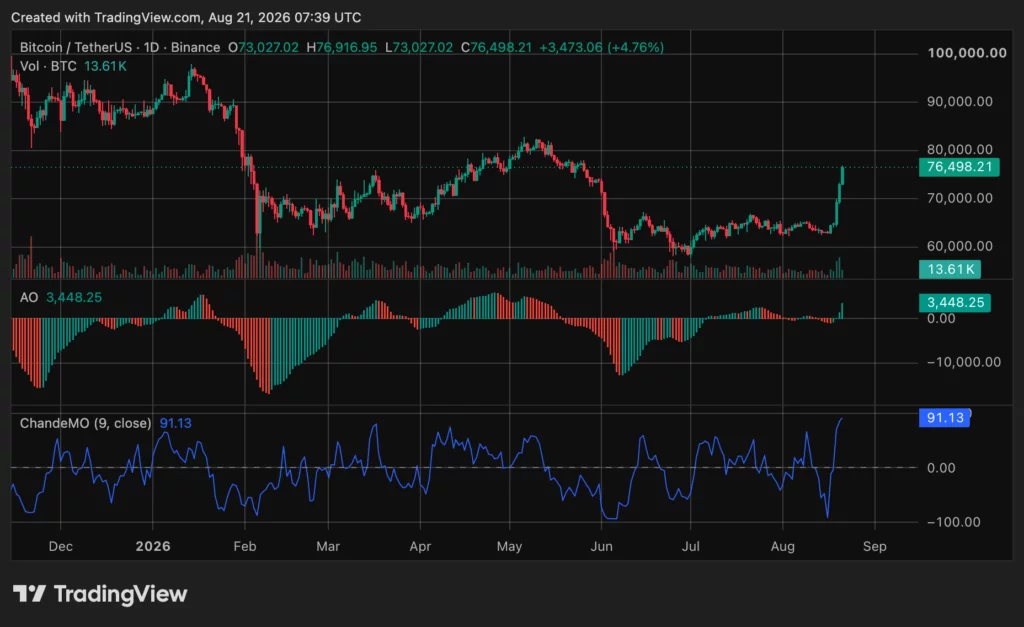
The breakthrough has put the $65,000 to $67,000 area on the radar as a potential deeper retest zone. The immediate support level has shifted to between $70,000 and $72,000.
Maintaining above this range would uphold the current bullish trend, while the next significant resistance is anticipated between $80,000 and $82,000, where Bitcoin previously encountered selling pressure.
A weekly close exceeding $75,000 would confirm stronger bullish momentum, compared to an intraday surge. Conversely, failing to maintain above $70,000 could lead to a significant pullback following an 18% rise in two days.
Disclosure: This article does not constitute investment advice. The information and materials provided on this page are intended solely for educational purposes.