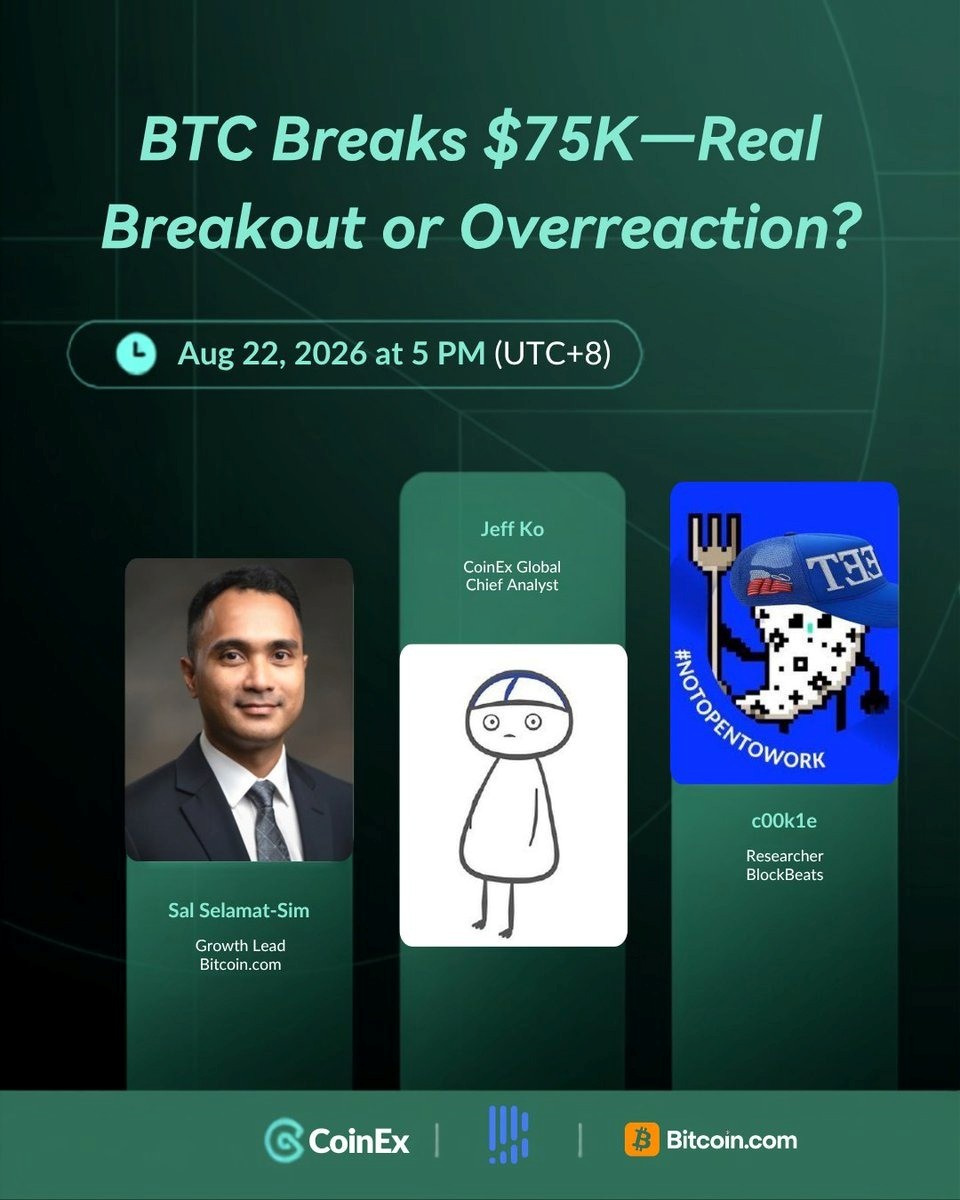
Analysts Jeff Ko from CoinEx, c00k1e (Cookie) from BlockBeats, and Sal Selamat-Sim from Bitcoin.com discuss the factors influencing Bitcoin’s recent surge, the indicators that may validate its longevity, and the implications for the larger crypto landscape.
HONG KONG, Aug. 25, 2026 (GLOBE NEWSWIRE) — Bitcoin has surged past $80,000, marking its peak in about three months and signaling a rapid shift in market sentiment.
Just days prior, Bitcoin had eclipsed $75,000 after remaining in the $60,000–$66,000 range for nearly two months. The market was already engaging in discussions about whether this surge was the onset of a significant breakthrough or a temporary reaction to short-lived factors.
This discussion was central to an X Spaces event on August 22, featuring CoinEx Chief Analyst Jeff Ko; BlockBeats Researcher c00k1e (Cookie); and Sal Selamat-Sim, Growth Lead at Bitcoin.com.
Following the break above $80,000, the discourse gained even more traction.
The panel explored three primary topics: the catalysts behind Bitcoin’s surge, what would denote its sustainability, and how this momentum might impact liquidity and opportunities within the broader crypto ecosystem.
Macro Factors, ETF Interest, and Short Selling Drove the Surge
The panelists widely agreed that the rally in Bitcoin wasn’t due to a singular cause.
Jeff Ko pinpointed changes in U.S. Treasury policies as a major macro driver influencing this trend. Increased purchases and buybacks of long-term Treasuries exerted downward pressure on long-term yields and the U.S. dollar, fostering a more favorable atmosphere for alternative assets and risk markets.
This macroeconomic backdrop maintained its importance as Bitcoin’s price climbed above $80,000, with continued dollar weakness and worries about currency devaluation further bolstering demand for Bitcoin and other alternative investments.
However, Jeff reiterated that the rally wasn’t merely a consequence of one news item.
Bitcoin had spent a considerable duration in the $60,000–$66,000 range while bearish positions continued to accumulate. As sentiment flipped, the overcrowded short positions emerged as a crucial source of upward momentum.
During the event, Jeff highlighted that around $2.7 billion in short positions were liquidated during the initial surge, which accelerated the rally as leveraged bearish traders were forced to exit.
Cookie pointed to the influx of Bitcoin ETFs as another significant driver of support.
He noted that spot Bitcoin ETFs had seen close to $1.6 billion in net inflows over a span of four trading days, indicating sustained institutional and ETF interest even prior to the price acceleration.
From Cookie’s perspective, these inflows hinted that Bitcoin may have already completed a critical phase of adjustment before the breakout.
Sal Selamat-Sim also emphasized market positioning as a key aspect. With many traders anticipating further declines, the shift in momentum created the opportunity for a more rapid and pronounced price adjustment.
Overall, the panel suggested that Bitcoin’s breakout was influenced by a combination of three major factors:
a more favorable macro scenario, ongoing ETF interest, and a market heavily positioned for further declines.
From $75K to $80K: The Crucial Question Remains Whether Bitcoin Can Establish a New Base
Bitcoin’s rise above $80,000 strengthens the short-term momentum narrative, but the panel stressed that price alone isn’t sufficient to confirm a lasting trend.
Jeff posited that the healthiest confirmation might come from something more subdued: stability.
“For me, the ultimate confirmation might be Bitcoin returning to a state of monotony,” he remarked.
Rather than an immediate acceleration through successive price points, Jeff suggested a healthier market scenario would involve the asset solidifying a new trading range and allowing spot demand to accumulate beneath the movement.
During the discussion, he identified the $72,000–$75,000 zone as a critical area to monitor.
If this range, which has previously served as resistance, can now provide support after Bitcoin’s ascent above $80,000, it would offer stronger evidence of a significant structural shift in the market.
Jeff also pointed out that the source of demand is key.
“I prefer to witness the spot market lead before leverage follows.”
A breakout driven by spot buying and sustained ETF interest would create a sturdier foundation than one fueled primarily by derivatives and speculative leverage.
In contrast, a rapid rise in open interest and funding rates without a corresponding growth in spot demand could suggest a rebuilding of speculative excess.
Both Cookie and Sal underscored the importance of time frames.
While Bitcoin’s rise above $80,000 strengthens momentum, sharp short-term volatility could still occur following such a rapid advance.
The pivotal question is no longer merely whether Bitcoin can break resistance, but whether the market can transform the breakout into a solid support structure.
What Could Bitcoin’s Strength Signify for Altcoins?
Bitcoin’s ongoing rally has revitalized hopes that liquidity may eventually transition into the broader crypto landscape.
The panel, however, warned against assuming that the current market cycle will mimic the patterns from 2021.
Sal pointed out that the current crypto market is considerably more fragmented.
Capital is traversing a diverse array of ecosystems, themes, and asset categories, ranging from meme coins to nascent blockchain networks, infrastructure initiatives, and platform-specific prospects.
Therefore, the next phase may be characterized less by a widespread “altseason” and more by targeted movements into specific sectors and themes.
Cookie contended that Bitcoin continues to absorb a substantial portion of market liquidity.
Although BTC remains in a robust and notably volatile trend, broader shifts towards altcoins may require additional time.
Jeff conveyed a similar sentiment.
When Bitcoin is on a rapid upward trajectory, capital tends to concentrate in this dominant asset. Once Bitcoin enters a period of greater stability, investors may begin seeking higher-risk opportunities elsewhere.
Two indicators, therefore, could gain heightened importance:
Bitcoin dominance and ETH/BTC performance.
A sustained decline in Bitcoin dominance may indicate that liquidity is shifting towards the wider crypto market.
Meanwhile, a stronger ETH/BTC performance could suggest renewed excitement for notable altcoins.
Jeff also highlighted regulatory changes as potential long-term catalysts.
Progress surrounding frameworks such as the CLARITY Act could be particularly pivotal for altcoins, reducing ambiguity around asset classification and facilitating broader market participation.
The panel’s consensus was that Bitcoin’s strength alone doesn’t guarantee a sweeping market rally.
Instead, opportunities are expected to emerge selectively across narratives, ecosystems, and projects that can maintain ongoing liquidity.
Key Market Indicators to Monitor Following Bitcoin’s Surge Above $80K
With Bitcoin now hovering above $80,000, the forthcoming phase will increasingly rely on the quality of the demand that supports this movement.
Several indicators will be significant to track.
ETF Flows
Continuous net inflows into spot Bitcoin ETFs would indicate that institutional and longer-term demand remains robust.
Spot Market Demand
A rally led by spot buying would signify healthier market participation than one primarily driven by derivatives.
Jeff’s preference for the “spot market to lead” remains particularly relevant following such a swift price change.
$72K–$75K Support Zone
The previous resistance zone is an essential structural reference point.
If buyers continue to uphold this area during any pullbacks, it would bolster the argument that Bitcoin has established a higher base in the market.
Open Interest and Funding Rates
Rapid growth in leveraged positions without corresponding spot demand could reflect increasing correction risks.
The recent rally already demonstrated how quickly crowded leveraged positions can be unwound.
$70K and the 21-Week Moving Average
Jeff also noted the $70,000 level and the 21-week moving average as significant reference points.
A sustained weekly decline below these markers could undermine the breakout pattern and suggest that Bitcoin might require more time to consolidate.
For those who missed the initial rally, Jeff cautioned against overextending leverage.
“There’s no need for leverage to support a bullish perspective after the market has shown its effect on leveraged positions.”
This message holds particular relevance following Bitcoin’s rise above $80,000: increased momentum does not negate volatility risks.
A More Discerning Crypto Market May Be Evolving
Bitcoin’s rise beyond the $80,000 mark and its return to a three-month high represent a significant shift in short-term market dynamics.
However, the breakout itself is just one aspect of the narrative.
The sustainability of this rally will hinge on the strength of spot and ETF demand, whether leverage remains controlled, and whether prior resistance levels can transform into lasting support.
Moreover, the conversation among CoinEx, BlockBeats, and Bitcoin.com pointed to a broader transformation occurring within the crypto market.
The traditional sequence—where Bitcoin rallies initially and liquidity subsequently diffuses across nearly all altcoins—may be becoming less predictable.
Instead, future opportunities are likely to rely more on specific themes, ecosystems, regulatory frameworks, and the capacity of individual assets to draw sustained interest.
Therefore, for market participants, the next phase may involve less focus on Bitcoin’s headline price and more on:
where liquidity is moving, the nature of the demand propelling the market, and which sectors are beginning to attract sustained involvement.
The August 22 discussion united insights from CoinEx, BlockBeats, and Bitcoin.com at a crucial juncture for the market.
Bitcoin’s subsequent surge above $80,000 has heightened the relevance of the questions raised during the discussion: can the breakout evolve into a stable trend, when may liquidity begin to flow more broadly, and will the next phase of crypto be characterized by a comprehensive rally or a more discerning search for opportunities?
Contact:
CoinEx
pr@coinex.com
Disclaimer: This sponsored content is provided by the content provider and does not necessarily reflect the views of this media platform or its publisher. The information is shared for general informational purposes only and should not be considered financial, investment, or trading advice. Cryptocurrency and mining-related activities carry risks, including the potential loss of capital, and readers are encouraged to conduct their own research and seek professional advice where appropriate. Speculate only with funds that you can afford to lose. The media platform and publisher assume no responsibility for any losses or claims arising from reliance on this content. GlobeNewswire does not endorse any content on this page.
Legal Disclaimer: This article is provided on an “as-is” basis, without warranties or representations of any kind, express or implied. The media platform assumes no responsibility or liability for the accuracy, content, completeness, legality, or reliability of the information presented. Any complaints, claims, or copyright concerns related to this article should be directed to the content provider mentioned above.
A photo accompanying this announcement is available at https://www.globenewswire.com/NewsRoom/AttachmentNg/12b1f888-86b5-4a6c-97e7-d45d6c9ff8e5