
Businesses holding Bitcoin (BTC) as a core asset are encountering difficulties. Their perceived market value, compared to the actual Bitcoin they possess, is shrinking. This is happening due to reduced price fluctuations and a significant drop in their Bitcoin acquisition rate.
Specifically, the collective volume of Bitcoin purchased monthly by these entities has plummeted by 97% since November of last year. This substantial decrease signifies a much more careful and reserved approach to the market in recent months. However, fresh analysis from CryptoQuant indicates that a swift change in operational tactics may be necessary.
Reduced Bitcoin Fluctuations Put Pressure on Bitcoin Holding Companies
Typically, firms holding Bitcoin trade at a higher value than their Bitcoin holdings alone would suggest. This “premium” exists because investors anticipate these companies can increase their Bitcoin reserves, profit from market instability, and function as a secure method of exposure to the leading digital currency. The market net asset value (mNAV), which assesses a company’s stock price relative to the net asset value (NAV) of its Bitcoin, usually stays above 1.
Nevertheless, Julio Moreno, Head of Research at CryptoQuant, notes that Bitcoin’s annualized volatility has sunk to its lowest levels in years. This reduction is removing a crucial factor that drove the premium. With fewer instances to capitalize on rapid price shifts, these Bitcoin-holding companies find it harder to validate valuations exceeding their actual Bitcoin reserves.
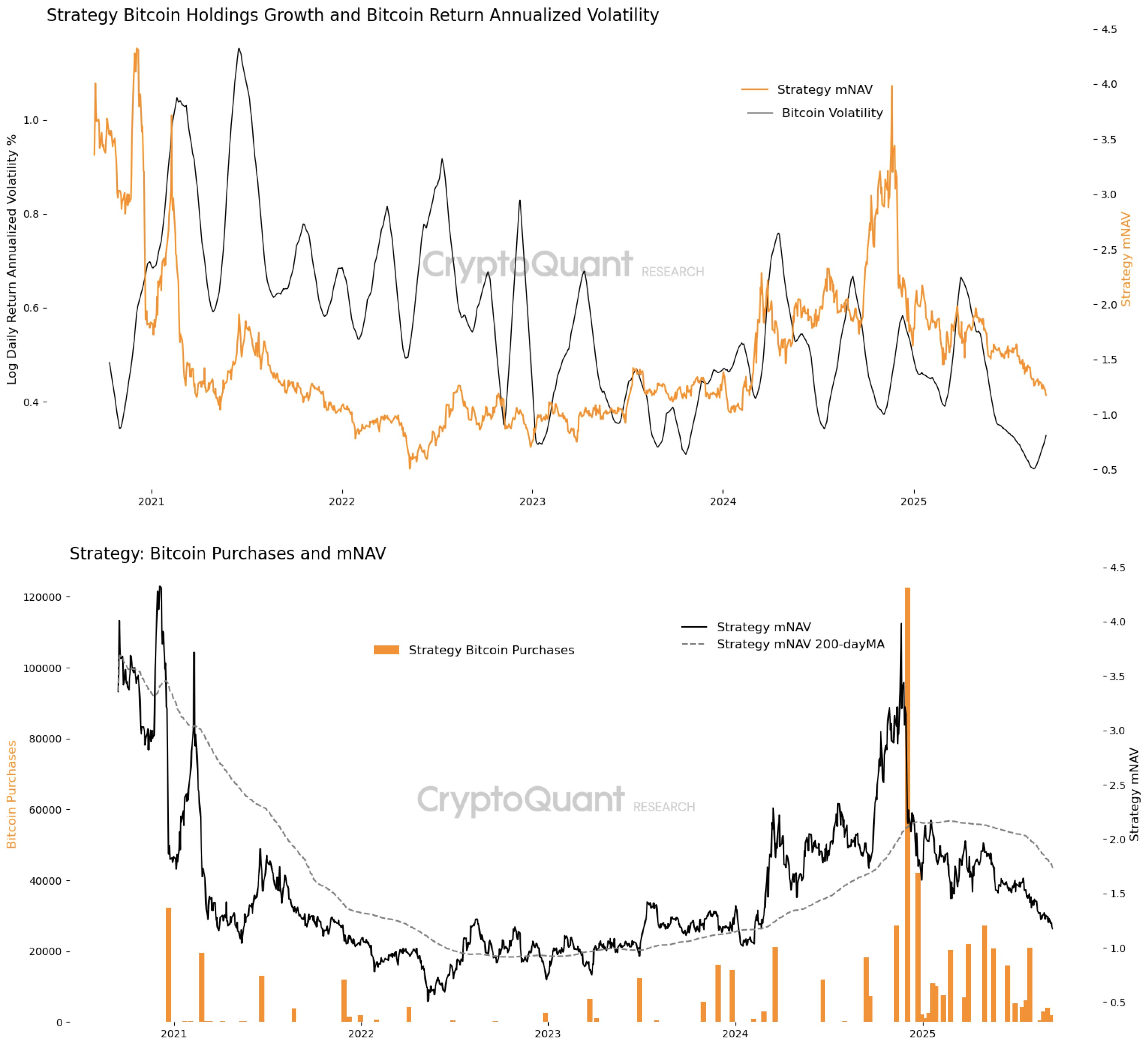
Reviewing market information for Strategy, a significant corporate holder of BTC, demonstrates that spikes in market instability have, at times, boosted the mNAV value above 2.0. Most prominently, this occurred in early 2021 and again in the middle of 2024. During these periods, companies holding substantial Bitcoin were able to leverage this market volatility, securing funding through stock or debt offerings at favorable rates and reinvesting those funds into rapid Bitcoin acquisitions.
At the present moment, however, volatility has compressed significantly, dropping below 0.4 log daily return annualized, marking its lowest point since 2020. This stabilized volatility trend has coincided with a gradual decrease in mNAV, which has fallen back towards 1.25. This tightening premium implies that investors no longer perceive Bitcoin holding companies as offering significantly greater advantages compared to simply holding Bitcoin directly.
Diminished Demand Exacerbates the Challenges for Bitcoin Treasuries
Without the driving force of significant price changes, Bitcoin treasury firms are finding it difficult to expand their assets in a manner that supports a premium market valuation. Despite occasional periods of increased purchasing activity in late 2024 and early 2025, overall activity has remained subdued.
Consequently, Strategy’s mNAV has demonstrated a downward trend since the start of 2025, even though the value of Bitcoin itself has remained comparatively high in relation to previous years. The data points to a correlation: when Bitcoin holding firms engage in aggressive purchasing, investor confidence increases, pushing the mNAV higher and fostering a cycle of premium stock issuance followed by Bitcoin accumulation.
Julio Moreno suggests that for the mNAV premium to be sustained, both an increase in Bitcoin volatility and renewed demand fueled by large-scale purchasing activity are urgently needed. Until these factors materialize, these firms may face escalating challenges in justifying valuations above the net asset value of their Bitcoin. This situation may lead investors to prioritize direct Bitcoin ownership as a means of generating returns instead of relying on corporate investment strategies.
As of the latest update, Bitcoin is trading at $115,810, reflecting an increase of 4.72% over the past week.
Disclaimer: Provided for informational purposes only. Past performance is not a predictor of future performance.