

- A suggested alteration to Bitcoin, termed ‘Post Quantum Transition and Legacy Signature Deactivation,’ lays out a gradual approach to phase out Bitcoin’s original digital signature methods before the emergence of quantum computers that could potentially compromise them.
- The gradual network update would be executed in three distinct phases and might effectively lock up over 1 million BTC associated with initial Bitcoin mining activities—possibly including Satoshi Nakamoto’s holdings, valued at over $100 billion.
- The authors caution that delaying this necessary upgrade magnifies the overall vulnerability of the Bitcoin system, and that a quantum computing advance could facilitate undetected theft of cryptocurrency, thereby undermining faith in the Bitcoin system.
A freshly presented Bitcoin enhancement strategy could fundamentally transform the security of older Bitcoin holdings.
This draft, titled ‘Post Quantum Transition and Legacy Signature Deactivation,’ introduces a strategic process for systematically removing Bitcoin’s initial security protocols before quantum computing technology can render them ineffective.
This plan was developed by a team of cybersecurity specialists and blockchain developers, counting Jameson Lopp and Christian Papathanasiou among them. It emerges against a backdrop of increasing anxiety that advanced quantum computers, with the capability of compromising Bitcoin’s cryptographic protections, may be operational by the close of the decade.
Further Reading: US CPI Increase Causes Tariff-Related Market Changes and Instability in Crypto
The Quantum Risk
The proposal addresses the quantum computing challenge as an inevitable technological development. It suggests that technology capable of breaking Bitcoin’s method of encryption could be available by 2030, possibly sooner, citing findings from a McKinsey study.
A successful quantum attack on Bitcoin could provoke substantial financial chaos and damage across the digital currency ecosystem. Besides its effect on value, the capacity of Bitcoin miners to ensure network safety could be critically undermined.
Jameson Lopp, Christian Papathanasiou
In essence, the adjustment to the system would unfold across three significant stages, as illustrated below:
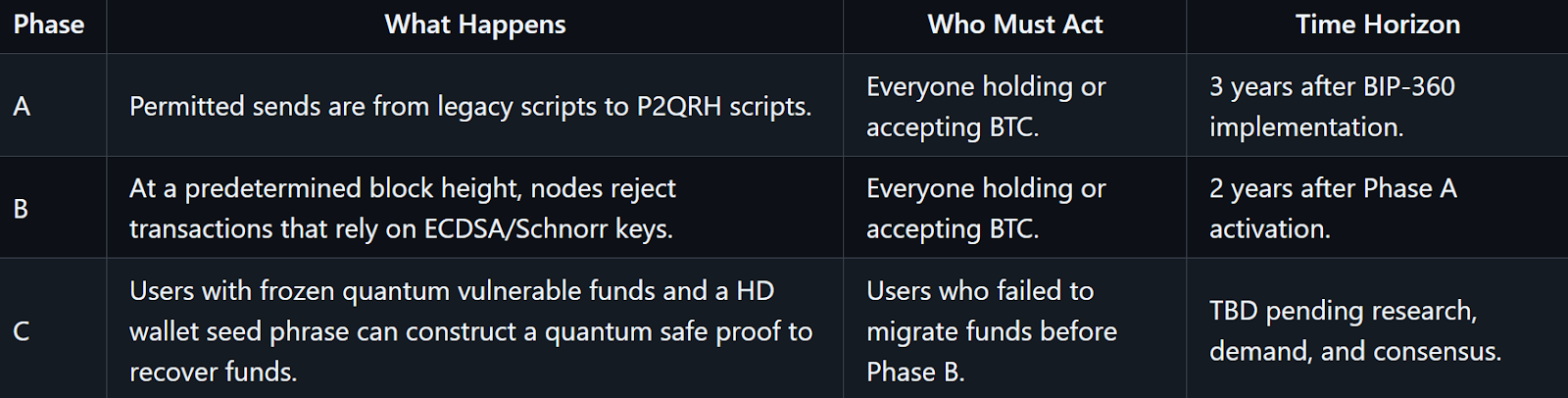
The draft emphasizes that any postponement will only increase the difficulty and potential dangers. “The longer we delay the transition, the more complex coordination becomes,” the development group noted. Furthermore, should a breakthrough in quantum computing occur prior to the completion of the transition, malicious actors could secretly extract funds, leading to market disruption and a collapse of confidence in Bitcoin.
The implications are substantial for everyone involved. Should it be implemented, the update would effectively freeze more than 1 million BTC connected to initial mining efforts, widely attributed to Satoshi Nakamoto. This stockpile alone has a valuation exceeding US$100 billion (AU$153 billion) and has remained untouched since Bitcoin’s inception.
Currently, the proposal remains in its initial drafting phase and lacks a formal Bitcoin Improvement Proposal designation. Nonetheless, it signifies a pivotal stride in solidifying Bitcoin’s defenses against what might become the most critical cryptographic challenge in its history.
Further Reading: Crypto Week Delayed: US Legislative Body Pauses Vote on Key Stablecoin Legislation