


Bitcoin
is currently exhibiting signs of weakening, often a precursor to significant price fluctuations.
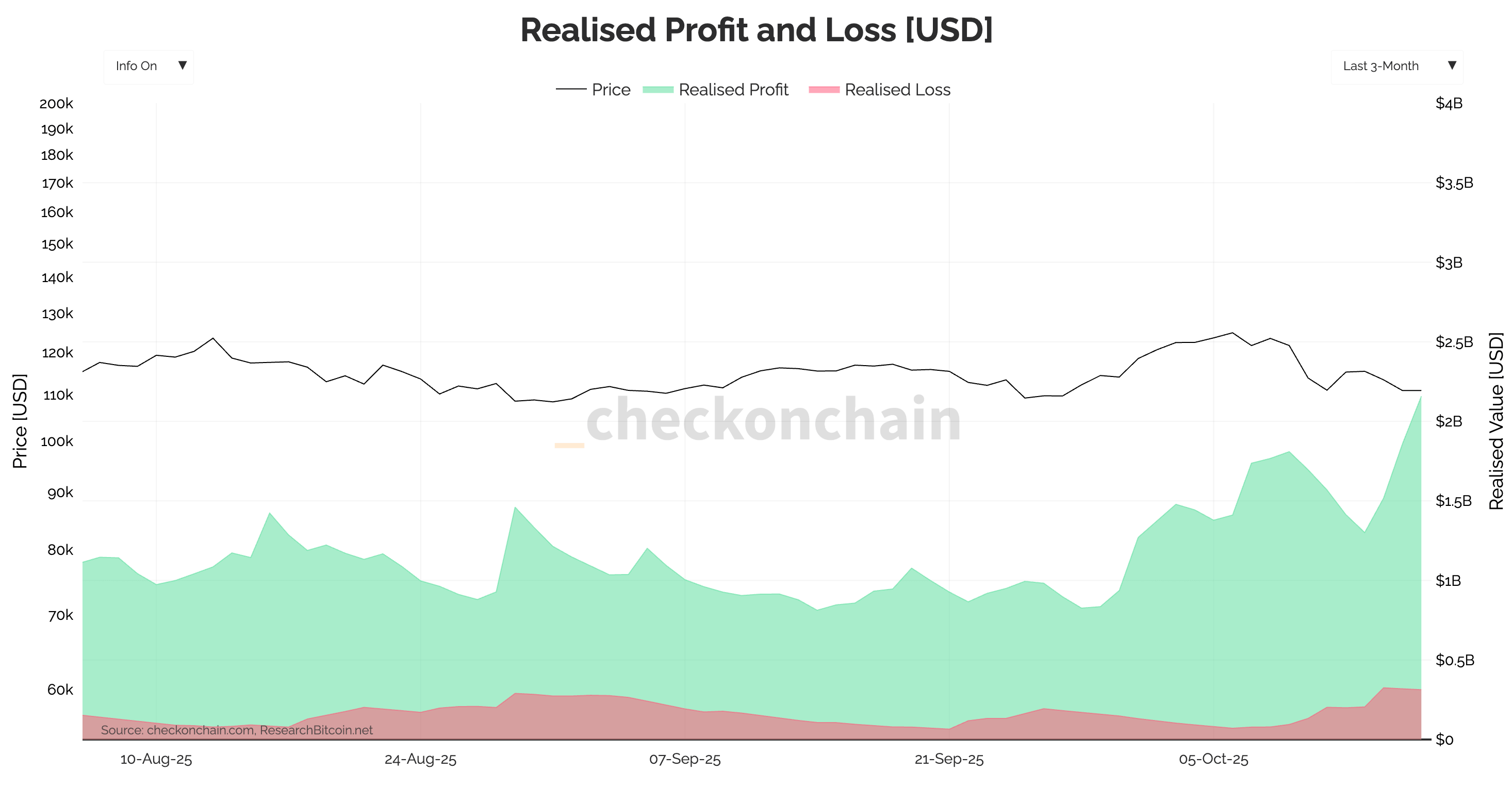
On October 15th, a substantial $1.8 billion in profits were realized by traders. This marked one of the largest profit-taking days observed since the summer months began.
Concurrently, around $430 million in losses materialized on the same day, confirming market sentiment after the weekend’s price decline. The prior upward thrust is waning, leading many investors to reduce their exposure.
Checkonchain)
Currently, Bitcoin’s price hovers around $110,000, reflecting a nearly 10% drop since the start of October. This decline is primarily attributed to rapid selling by investors who initially bought in early 2025 and have held their positions since.
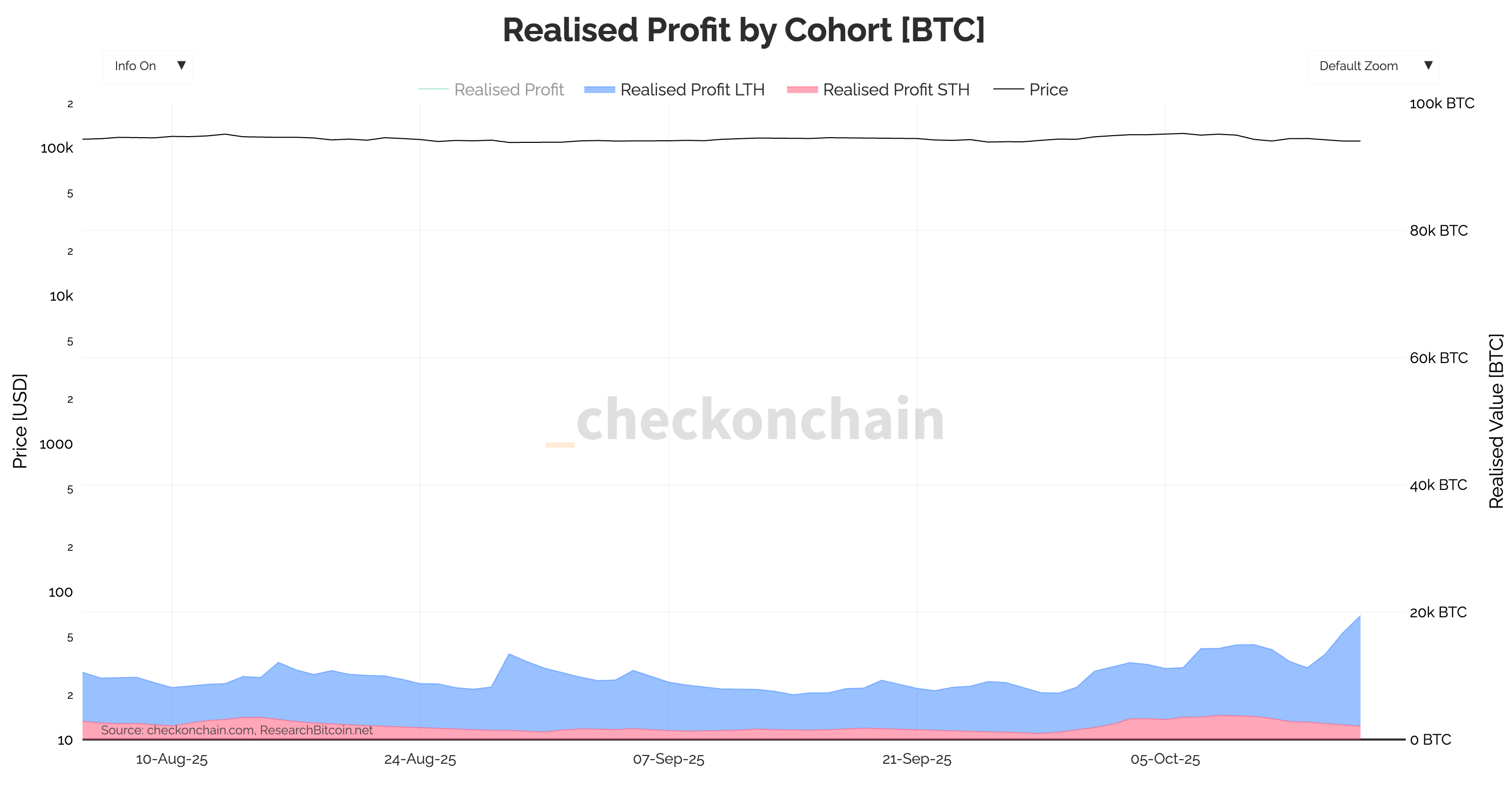
Long-term holders, defined as those holding coins for over three months, accounted for the majority of the selling activity, realizing over six times more profit compared to short-term holders.
Given that long-term holders remain significantly profitable even after last week’s dip, their actions suggest a de-risking strategy rather than panic selling. They appear to be securing profits amidst the price softness instead of anticipating a price rebound.
Checkonchain)
Some level of profit realization is common after periods of price consolidation. Occasional billion-dollar profit-taking days can be considered healthy market rotation. However, when these selling patterns persist, as seen throughout the month, they point toward a weakening underlying trend rather than simple distribution.
Realized losses are also on the rise. While still within a moderate range, the increase in losses alongside profit-taking suggests that the de-risking behavior is extending beyond short-term holders to a wider range of market participants.
This trend could be infectious, particularly since half of Bitcoin’s short-term investors are currently seeing paper losses. Checkonchain data indicates that unrealized losses now represent approximately 2% of the overall market capitalization, a figure that is growing quickly.
A further price decrease below $100,000 might easily increase that to 5%, triggering widespread market nervousness.
Historically, only during significant bear markets has the supply in a loss position reached levels exceeding 30%. The market is approaching this critical level.
If buyers
succeed in defending
the $100,000 level, Bitcoin can re-establish a short-term cost basis and regain positive momentum.
Failing to maintain $100,000 could break the cost basis for recent buyers and push the entire short-term supply into a loss position. While this would not necessarily signal the end of the cycle, it could prolong the correction, with potential targets in the $80,000 range, representing a roughly 35% decline from the all-time high.
At the moment, Bitcoin is showing remarkable stability, considering the extent of selling pressure. However, blockchain data signals a clear weakening of investor confidence.
The bulls are still trying to maintain support, but each price drop makes it increasingly difficult to distinguish buying the dip from catching a falling knife.