

Key Points to Note
The quantity of Bitcoin experiencing losses during this cycle is approximately 9%, significantly lower than the 25% observed in previous downturns. Could this imply that recent sales are driven more by profit-taking rather than widespread panic?
Market sentiment remains divided regarding whether Bitcoin [BTC] has reached its lowest point or not.
Current market behavior suggests a potential for three consecutive days of higher closing prices to begin September, a trend not seen since the beginning of August. This earlier period saw Bitcoin briefly touch $113,000 before climbing to $124,000 within two weeks.
If this trend continues, the Short-Term Holder Net Unrealized Profit/Loss (STH NUPL) may stay above the red “capitulation” zone. This would contrast with last week’s dip below $110,000, which corresponded with $943 million in realized losses, the highest since April.
Here’s what makes this situation particularly noteworthy.
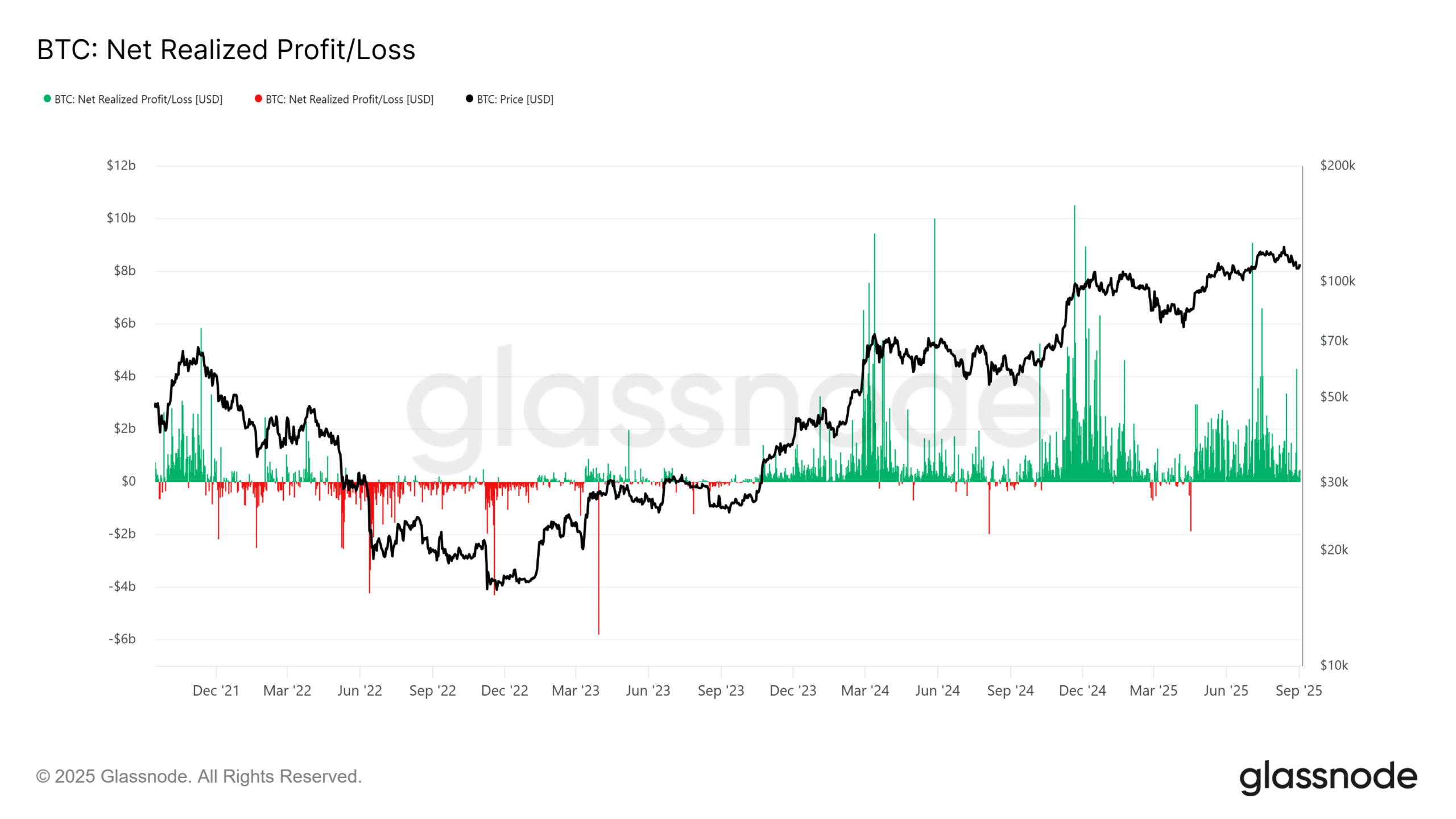
Despite the recent price drop, Bitcoin’s Net Realized Profit/Loss (NRPL) remained positive. In fact, it surged to its highest level in a month, reaching $4.2 billion in net gains, unlike the usual behavior seen during bear markets.
For instance, in 2022, Bitcoin experienced a 63% decline by year’s end, causing the NRPL to turn negative as investors sold at a loss. This divergence suggests that confidence in Bitcoin remains strong.
Bitcoin’s Limited Loss Supply Suggests Stability
When the average purchase price of sellers exceeds the current Bitcoin price, it is generally seen as a positive indicator.
Conversely, if investors facing losses begin selling, it can trigger widespread panic, limiting any potential recovery as future faith diminishes. Current analysis indicates that Bitcoin’s structure appears to be trending positively at the time of this writing.
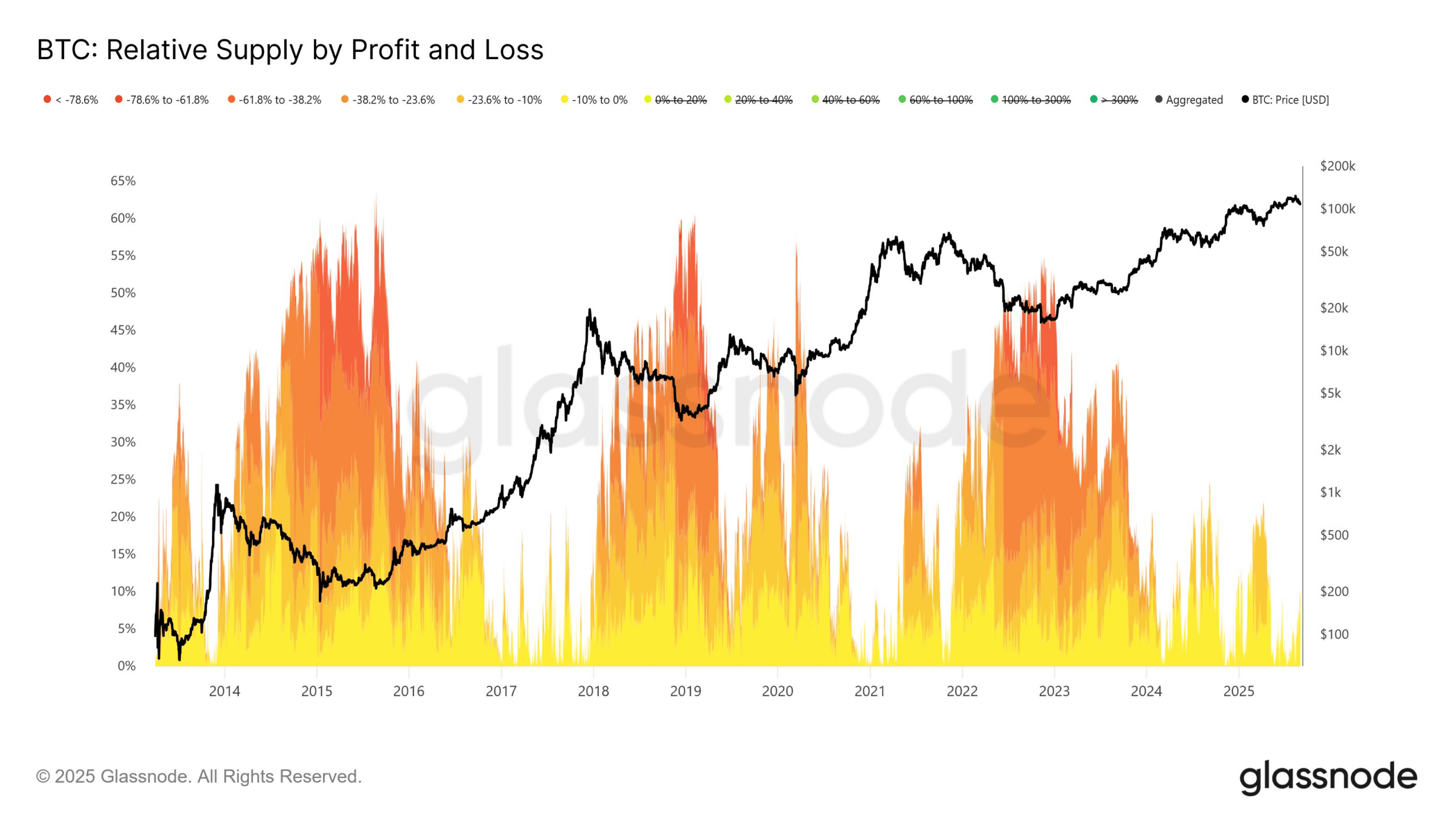
Consider this statistic: At $110,000, only 9% of Bitcoin’s total supply was in a loss position, representing up to 10% in unrealized losses. In comparison, the market bottom during this cycle saw more than 25% of the supply underwater, with losses reaching 23%.
Source: Glassnode
In short, Bitcoin holders are not selling due to fear at the moment.
In contrast, during severe bear markets, more than half of the total Bitcoin supply experiences losses, reaching up to 78%. Currently, most Bitcoin holdings are profitable, with the Net Realized Profit/Loss (NRPL) still showing gains of $4.2 billion.
This shows that the rally conviction has remained strong. Instead of selling at a loss, Bitcoin investors are securing profits. Therefore, the recent 11% price decline might represent a natural correction, rather than complete market collapse.