


The cryptocurrency market has kicked off the week with a significant boost, fueled by a confluence of positive economic indicators.
Data from CryptoSlate shows that Bitcoin experienced a surge, hitting a high of over $116,000 before settling around $115,587 at the time of this report. This represents the highest price point in recent weeks, bringing it closer to its all-time high.
Ethereum mirrored Bitcoin’s upward trend, approaching $4,200, while Solana surpassed the $200 mark. Other prominent digital currencies, including BNB, Cardano, Chainlink, and Hyperliquid, also witnessed noteworthy gains during this period.
This widespread rally signals a resurgence of positive market sentiment following a period of stagnation and consolidation among major alternative cryptocurrencies.
Factors Driving Bitcoin’s Price Increase
Analysis of blockchain data suggests that this price surge is not solely based on speculation.
Insights from Glassnode reveal that the cumulative volume delta (CVD) for both spot and futures markets has stabilized for the first time since the sell-off on October 10th. This indicates a decrease in aggressive selling pressure after nearly two weeks of market correction.
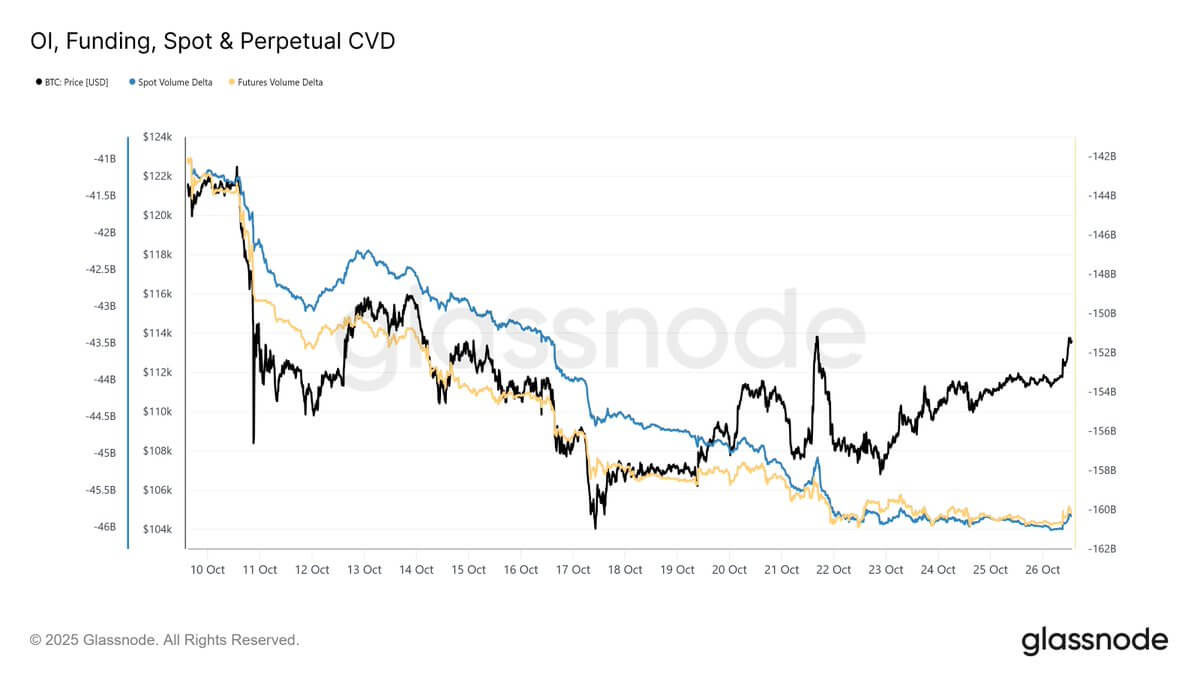
Furthermore, funding rates are holding below the 0.01% neutral level, suggesting that traders are not excessively overleveraged. Funding rates briefly turned negative at various points over the last couple of weeks, reflecting a cautious market gradually recovering from recent instability.
Short-term option skews also point to highly negative market sentiment prior to the price uptrend, which is frequently a precursor to sharp market reversals.
Positive Macroeconomic Factors Influencing Bitcoin
Timothy Misir, Head of Research at BRN, shared with CryptoSlate that macroeconomic developments were instrumental in Bitcoin’s current rise.
He indicated that news regarding progress towards a US–China trade agreement, along with indications of a more accommodating stance from the Federal Reserve, have reduced risk premiums and promoted capital flow into the cryptocurrency market.
Misir explained that the resulting market movement is now “highly sensitive to headlines,” where positive news triggers disproportionate gains and any policy reversals could quickly reverse these advances.
Misir also highlighted that the recent rally triggered substantial liquidations within the derivatives market.
Figures from Coinglass reveal that approximately $365 million in short positions were eliminated in just a few hours, impacting over 100,000 traders. Bitcoin short positions accounted for roughly $174 million of these losses.
In summary, Misir said that the combination of improved macroeconomic conditions and forced short covering created a “short, sharp risk-on leg.”
Importantly, institutional investors, especially ETFs, corporate treasuries, and medium-sized whales, absorbed selling pressure and helped sustain the rally. However, he advised caution, emphasizing that market structure remains susceptible to volatility based on news headlines due to options and futures positioning.
Misir concluded with this guidance:
“Consider any move above $116,000 as a potential point of increased activity (and any drop below $108,500 as a signal to potentially sell).”
As of 10:21 am UTC on Oct. 27, 2025, Bitcoin is the top-ranked cryptocurrency by market capitalization, and its price has increased by 2.64% in the last 24 hours. Bitcoin’s market capitalization stands at $2.3 trillion, with a 24-hour trading volume of $59.32 billion. Learn more about Bitcoin ›
As of 10:21 am UTC on Oct. 27, 2025, the total cryptocurrency market valuation is $3.89 trillion, with a 24-hour trading volume of $163.31 billion. Bitcoin’s dominance is currently at 59.18%. Learn more about the crypto market ›