

Important Points
Why is Bitcoin increasing in value when the economic news isn’t good?
Bitcoin’s price has risen by 5.41% this month. This is mainly because people expect interest rates to be lowered due to a struggling job market, not because of strong economic performance.
Does this mean a true bull market has begun?
The U.S. economy is unstable, the government shutdown adds to the uncertainty, and excessive optimism creates high volatility, making it a bumpy ride for Bitcoin traders.
Assets considered riskier are performing well based purely on “anticipation.” The total value of the cryptocurrency market has surged by approximately $250 billion in less than three days, with major cryptocurrencies surpassing important resistance levels, boosting a risk-on attitude.
However, looking at the bigger picture, the negative macroeconomic factors haven’t disappeared.
The U.S. economy is facing increased uncertainty after the government shutdown. ADP, a payroll processing company, reports that U.S. businesses reduced 32,000 jobs in September, bringing the total private employment down to 134.526 million.
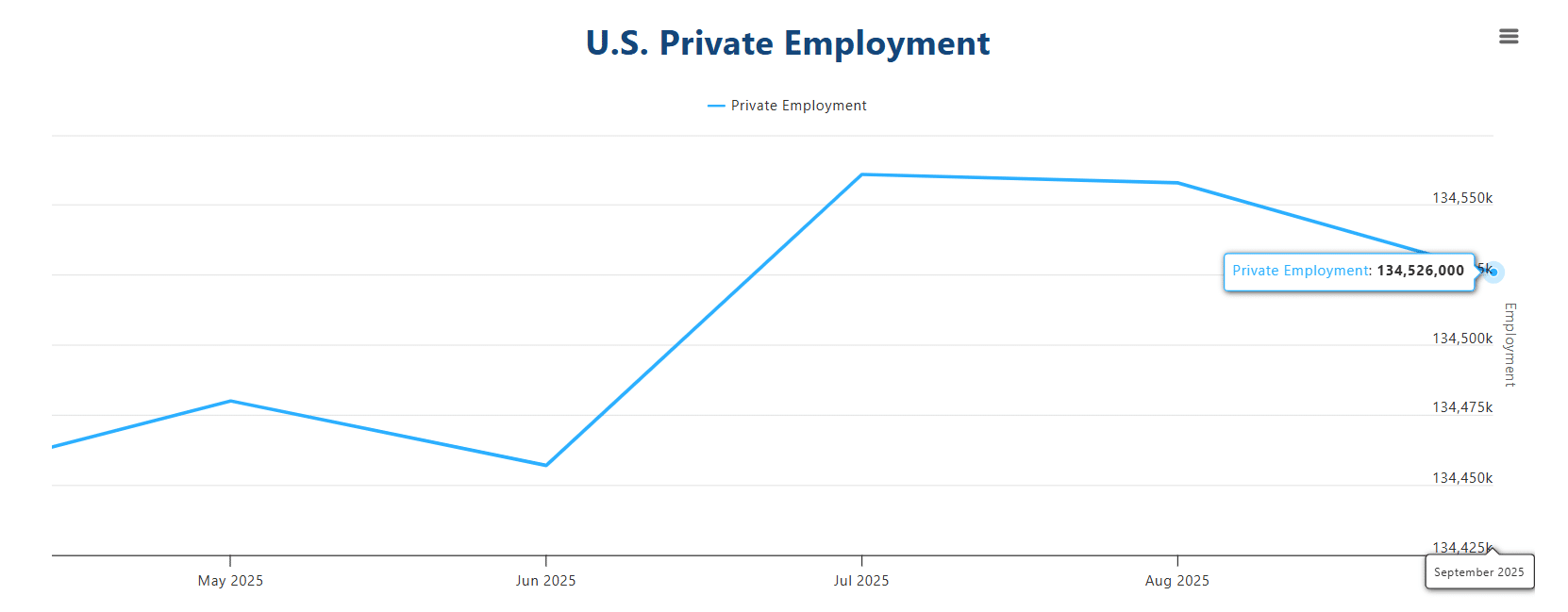
Simply put, the job market in the United States is weakening.
Challenger, Gray & Christmas, a global outplacement firm, announced that U.S. employers planned to cut 202,118 jobs in the third quarter, marking the highest number for a third quarter since 2020, when 497,215 job cuts were recorded.
Based on this information, traders are shifting towards riskier investments, “anticipating” that a weaker economy will lead to another interest rate cut. But does this contradict the idea that Bitcoin [BTC] is moving solely based on “unrealistic optimism”?
Government Shutdown Hides Important Economic Indicators
The government shutdown is making it difficult for markets to navigate.
The suspension of operations at vital agencies, like the Bureau of Labor Statistics (BLS), has created a significant information gap for risk assets. With the BLS not operating, key U.S. economic data is delayed.
This includes the monthly jobs report, originally scheduled for October 3rd, as well as other important inflation data, such as the Consumer Price Index (CPI) and Producer Price Index (PPI), expected around the middle of October.
Source: Polymarket
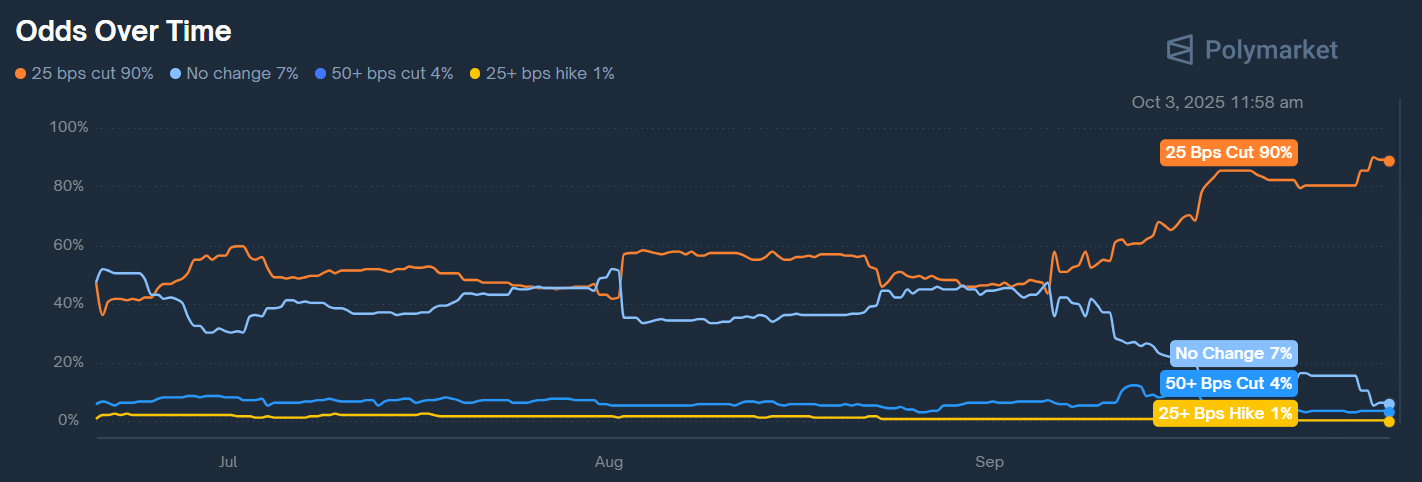
Notably, this uncertainty has increased the probability of an October rate cut to 90%.
As a result, Bitcoin is up 5.41% this month. However, this increase isn’t based on concrete data but on bullish “expectations” of rate cuts fueled by a weakening job market, obscuring the true state of the U.S. economy.
Institutional Bitcoin Investment Bets Heavily on the Economic Paradox
The Kobeissi Letter described the U.S. economic situation as “broken.”
“We are 26 days away from the next Federal Reserve meeting, and tomorrow’s delayed jobs report will be the last one before their next meeting.”
It further stated:
“So, the Federal Reserve is reducing rates amidst rising inflation due to a weak job market, but we can no longer receive CRUCIAL job market data. And, even when we do receive the data, it is revised downwards twice before it’s considered “accurate.” The system is faulty.”
In simple terms, the market is “blindly” anticipating a rate cut based on a weak job market while largely disregarding inflation. As an example, U.S. inflation rose to 2.9% in August, the highest level in seven months.
However, due to the government shutdown, inflation data is not a priority. For Bitcoin, the situation is very favorable, with large investors increasing their positions. Notably, $1.3 billion has flowed into BTC ETFs, supporting this paradox.
But does this truly signal a bull market? The U.S. economy is still surrounded by uncertainty, volatility remains high, and Bitcoin’s momentum is driven by overly optimistic sentiment, making the trading experience erratic.