

Key Points:
-
Escalating bond returns signal rising anxieties surrounding fiscal soundness and inflation, prompting some investors to re-evaluate the U.S. Treasury’s standing as a secure investment haven.
-
Bitcoin defies typical risk assessments, increasing possibly *because* of deteriorating macroeconomic conditions rather than in spite of them.
Bitcoin (BTC) has reached record levels even with a concerning global economic climate. Bond yields are climbing in both the U.S. and Japan, global economic expansion is slowing, and U.S. consumer sentiment is nearing historical lows.
Ironically, the very economic conditions that once put downward pressure on Bitcoin’s value are now propelling its ascent. This shift reflects a significant change in how investors perceive risk and where they seek safe harbor for their assets. At the heart of this change is the U.S. debt situation and the increasing Treasury yields, which were previously regarded as the safest investments available.
Why U.S. Treasury Yields Matter
When U.S. government bond yields increase, the expense of managing the country’s national debt rises substantially. This is a crucial issue, considering that U.S. debt has now exceeded $36.8 trillion, with interest payments predicted to total $952 billion in 2025.
Former U.S. President Donald Trump frequently emphasized the importance of lower yields as a major economic goal. However, achieving this may be more challenging than anticipated, as the two most effective methods rely on actions from the U.S. Federal Reserve. Reducing interest rates would result in lower yields for newly issued bonds, making existing, higher-yielding bonds more attractive. This would drive up their prices and lower their effective yield. Quantitative easing (QE), where the Fed purchases significant quantities of bonds in the open market, is another approach. This increases demand and lowers yields.
Currently, the Federal Reserve is hesitant to implement either strategy, exercising caution to avoid reigniting inflation, particularly amidst the ongoing trade tensions. Even if Trump were to find a legally acceptable method to influence Fed Chair Jerome Powell, it could backfire by damaging investor confidence and creating the opposite effect of what was intended.
Investors react negatively to political interference with the foundations of the U.S. and global economies, and their confidence levels are already low. Traditionally, investors seek the safety of government bonds during times of instability. However, the reverse is now occurring. Investors are avoiding Treasurys, suggesting the challenges within the U.S. economy are too considerable to overlook. The recent downgrade of the U.S. government’s AAA credit rating serves as a strong indicator of this.
Rising Yields in the U.S. and Japan Cause Concern
On May 22nd, the yield on the U.S. 30-year bond reached 5.15%, the highest figure since October 2023, and prior to that, a level not witnessed since July 2007. The 10-year yield is currently at 4.48%, the 5-year yield at 4%, and the 2-year yield at 3.92%.
For the first time since October 2021, the U.S. 5-Year to 30-Year bond spread has risen to 1.00%. This indicates that markets are factoring in stronger economic growth, sustained inflation, and an environment of “higher for longer” interest rates.
Related: Bitcoin price hit a new all-time high and data shows BTC bulls aren’t done yet
Adding to these challenges is Japan, the largest foreign holder of U.S. Treasurys. Japanese investors currently hold $1.13 trillion in U.S. government debt, $350 billion more than China. For years, Japanese institutions have borrowed money at low rates domestically to invest in U.S. bonds and stocks – a strategy known as the carry trade.
This trend might be coming to an end. In March 2024, the Bank of Japan began increasing interest rates from -0.1% to the current 0.5%. Since April, the Japanese 30-year bond yield has increased by 100 basis points, reaching a record high of 3.1%. The 20-year bond yields have risen to 2.53%, a level not observed since 1999.
On May 19th, Prime Minister Shigeru Ishiba even cautioned the country’s parliament that the government’s heavily indebted position was “worse than Greece” – a remarkable statement for a nation with a 260% debt-to-GDP ratio.
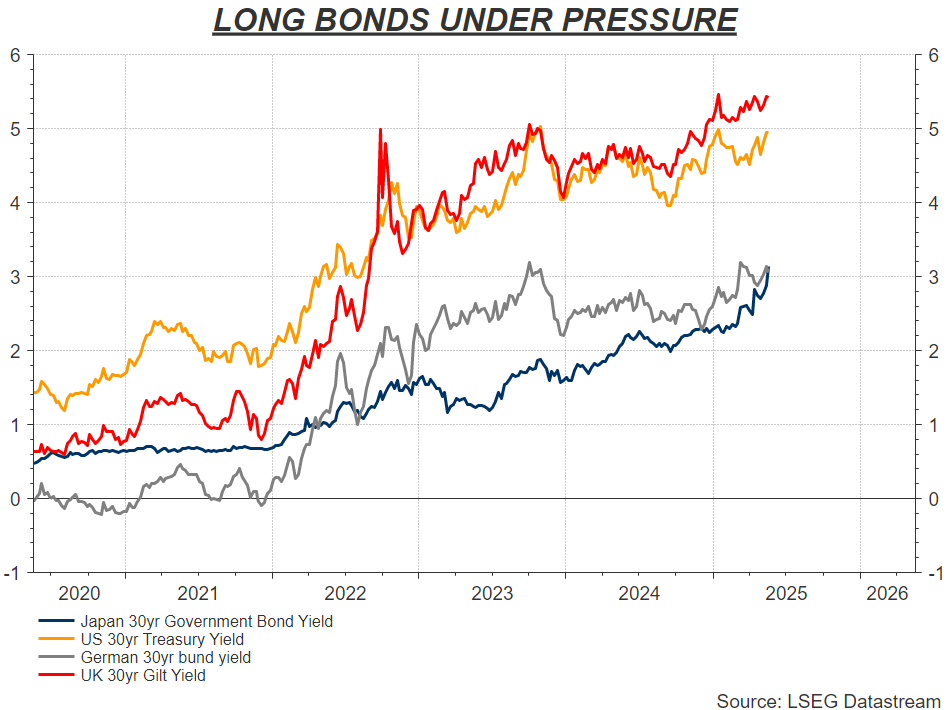
Interestingly, the surge in long-term Japanese bonds was not mirrored in shorter-term maturities. The 10-year bond yield is 1.53%, and the 5-year bond yield is just 1%. As Reuters pointed out, this implies a strategic adjustment by major Japanese pension funds and insurance companies as the Bank of Japan “normalizes” interest rates. These institutions might now be reassessing both duration risk and foreign bond exposure, which could create problems for U.S. Treasurys if (or when) they begin to reduce their holdings.
Will Bond Volatility Keep Influencing Bitcoin’s Price?
As the U.S. continues down its debt path, and Japan might be starting its own, the global economy is far from recovering, which could be a favorable signal for Bitcoin.
Traditionally, increasing bond yields would negatively impact riskier assets. However, stocks and Bitcoin are continuing to rise. This divergence suggests that investors may be moving away from conventional strategies. When confidence in the established financial system declines, assets outside of it, such as stocks and Bitcoin, become more appealing, even if they are traditionally considered riskier investments.
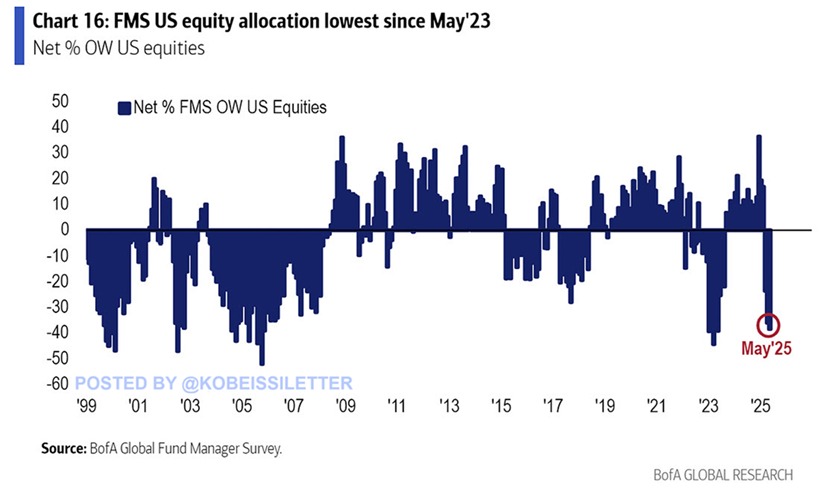
Furthermore, an increasing number of institutional investors are choosing Bitcoin over U.S. stocks. According to The Kobeissi Letter, net 38% of institutional investors were underweight U.S. equities in early May, the lowest percentage since May 2023, according to BofA.
Meanwhile, according to CoinGlass, total inflows into spot Bitcoin ETFs are continuing to grow, with assets under management now exceeding $104 billion, a record high. This surge suggests that institutional capital is beginning to recognize Bitcoin not only as a high-performing asset, but also as a politically independent store of value, similar to gold. In an era of increasing instability in fiat debt-based economies, Bitcoin is emerging as a credible alternative, providing a monetary system built on predictability and decentralization. With a market capitalization still considerably below gold’s $22 trillion or even the $5.5 trillion in base dollars (excluding debt), Bitcoin remains notably undervalued.
Interestingly, the current situation supports both of Bitcoin’s previously contrasting narratives: it is acting as both a high-yield, risk-on asset and a secure, safe-haven store of value. In a world where traditional models are failing, Bitcoin’s dual role may no longer be an anomaly, but instead, a sign of things to come.
This content is for informational purposes only and should not be considered investment advice. All investments carry risk, and readers should conduct their own thorough research before making any investment decisions.