
Unveiling Bitcoin Trend Analysis Through ChatGPT’s Lens
ChatGPT, a sophisticated AI model crafted by OpenAI, is powered by the GPT-4 architecture. It excels at producing text that closely mirrors human conversation across diverse subject areas, drawing upon a vast reservoir of knowledge encompassing textual data, literature, programming code, and online resources.
While ChatGPT doesn’t offer real-time access to current Bitcoin BTCUSD price information or up-to-the-minute market charts, it still provides significant value for traders. By providing it with relevant information—historical price points, indicators of market sentiment, and technical measurements—ChatGPT becomes a valuable analytical resource.
It aids in structuring projections of Bitcoin prices, pinpointing emerging patterns, and even emulating crypto trading approaches when supplied with appropriate datasets.
This is where ChatGPT’s analytical potential for Bitcoin truly shines. Its strength lies in comprehending context: synthesizing historical data, technical indicators, and the prevailing market mood to promote well-informed decision-making.
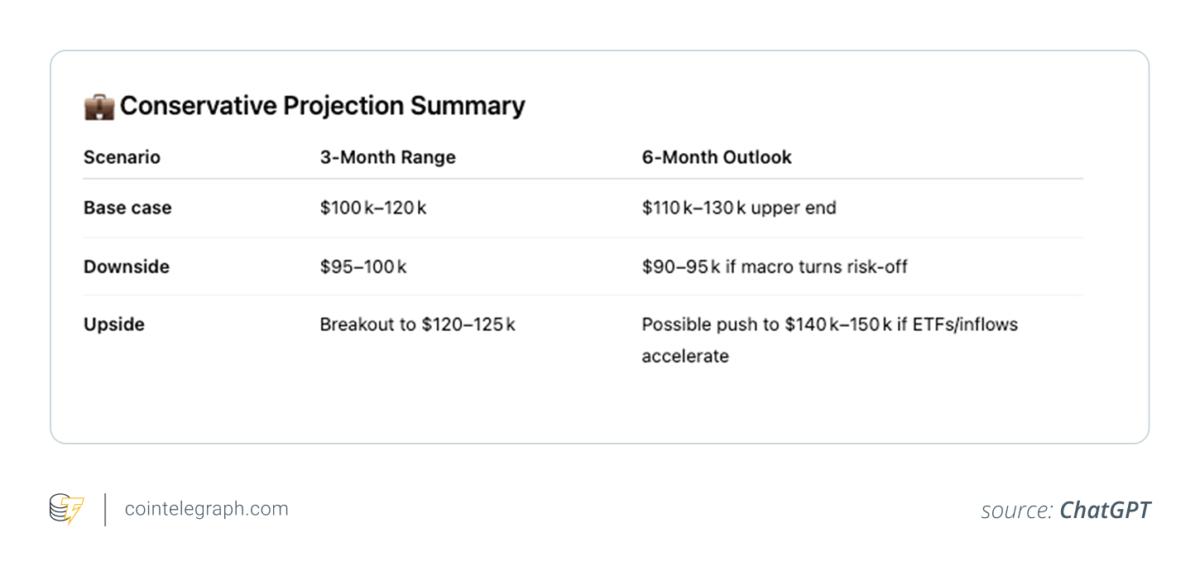
Fun Fact: Projections estimate that by 2025, roughly 77% of consumer electronics will incorporate some form of artificial intelligence.
Leveraging AI to Forecast Bitcoin’s Trajectory
Specifically, how do traders use AI, and ChatGPT, to make predictions about Bitcoin?
Many start by providing it with structured instructions, including market sentiment, on-chain data, and key technical analysis figures.
For example, forecasting crypto trends with GPT might begin by examining news headlines, public opinion from X, discussions on Reddit, or insights from industry experts. This process allows ChatGPT to determine whether the prevailing outlook is optimistic or pessimistic, which is a crucial element in a market where Bitcoin’s volatile behavior often mirrors changes in prevailing sentiment.
By receiving technical indicators such as the Relative Strength Index (RSI), Moving Average Convergence Divergence (MACD), moving averages, or trading volume, ChatGPT’s financial analysis capabilities can contextualize them using established historical relationships. As an illustration, if the RSI surpasses 70 and trading volume escalates rapidly, ChatGPT could identify the market as overbought – a typical sign of a likely pullback based on past Bitcoin price behavior.
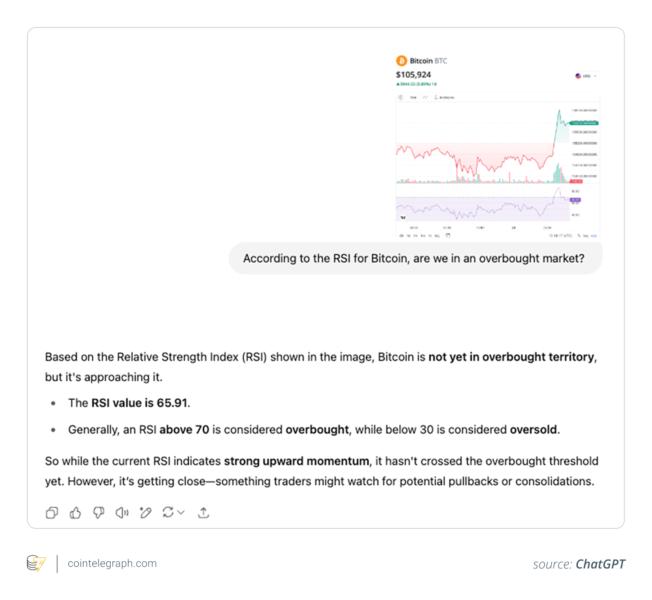
Adding on-chain analysis – like the actions of large Bitcoin holders, trends in hash rate, and movements of cryptocurrency into and out of exchanges – paints a more complete picture. ChatGPT assists in understanding such data, indicating potential phases of accumulation or distribution, particularly when integrated with external analytical platforms such as TradingView or LunarCrush.
From Automated Scripts to AI-Driven Systems: The Evolution of Bitcoin Trading with ChatGPT
Some sophisticated traders are designing AI-powered Bitcoin trading strategies that merge ChatGPT with APIs or visual dashboards.
These arrangements enable ChatGPT to extract information from multiple sources – including social sentiment APIs, technical indicators, and trading signals – which it uses to build testable models or even functional code for automated trading bots and comprehensive AI trading agents.
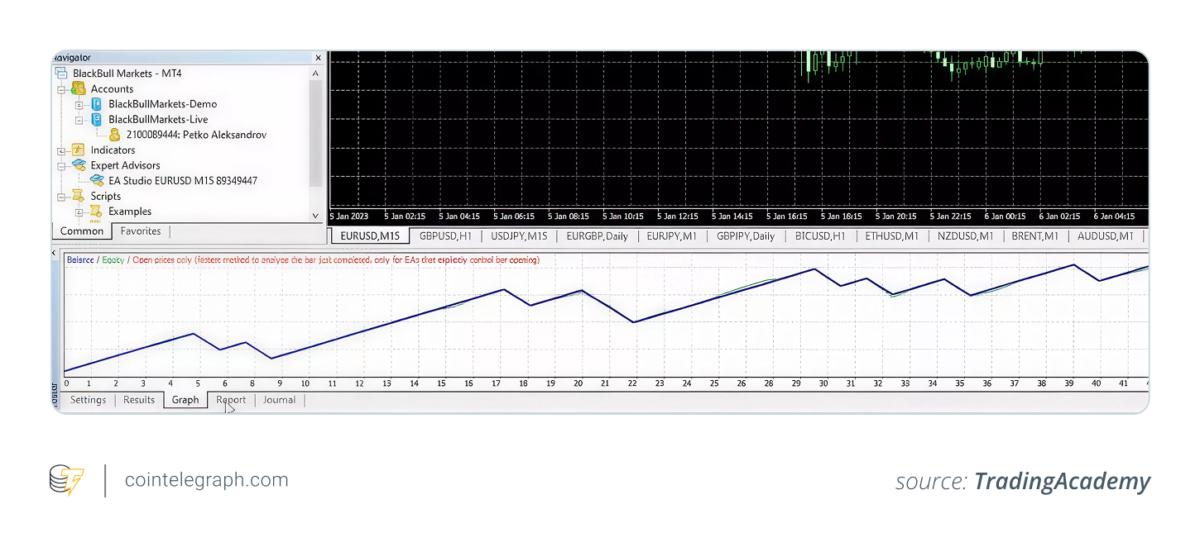
In this framework, the trader functions as the architect, while ChatGPT acts as the data synthesizer, merging varied pieces of information into practical, actionable insights.
This type of workflow represents the leading edge of AI in cryptocurrency, where the distinction between traditional trading bots and AI rests on the question of adaptability. While traditional bots adhere strictly to pre-programmed rules, ChatGPT can refine its strategies to adapt to evolving market conditions.
Insights from Research: ChatGPT’s Impact on Crypto Trading
Numerous studies suggest that AI – and even AI systems improved by ChatGPT – can achieve better results than both manual methods and standard machine learning models when it comes to predicting movements in crypto prices.
A peer-reviewed research paper published in *Frontiers in Artificial Intelligence* compared the performance of various predictive models for Bitcoin covering the period from 2018 to 2024.
A machine learning model for Bitcoin prices employing a neural ensemble strategy produced an outstanding 1,640% return, vastly exceeding the 305% return achieved by standard machine learning models and the 223% generated by a simple buy-and-hold strategy.
After accounting for a cost of 1% per transaction, the net return remained above 1,580%, showing the clear advantage of dynamic, AI-driven strategies.
Transformer-based architectures (similar to the design of GPT), which combine on-chain data analysis with Bitcoin market sentiment extracted from social media, have also outperformed traditional models with regard to both return rates and managing risk. These systems minimize potential losses by anticipating fluctuations using real-time assessments of sentiment and technical signals.
However, it’s important to understand that these results are not solely attributable to ChatGPT. Rather, they show the potential of employing ChatGPT to generate actionable insights into crypto trading when incorporated into a wider system that features live data feeds, logical prompting, and post-analysis validation.
Real-World Application: How Traders Utilize Machine Learning and AI for Bitcoin Price Predictions
The most compelling examples of how ChatGPT can provide valuable insights into crypto trading arise from the real-world configurations used by active traders.
As an example, a case study documented on TradingView utilized OpenAI’s GPT-based “o3 Pro” model to evaluate the Sui (SUI) token. This system analyzed 38 real-time metrics – encompassing technical measurements, Binance order book activity, on-chain usage data, and social media sentiment – to deliver a structured and current forecast. It noted instances of breakout compression occurring near key support and resistance levels, offering a valuable AI-driven perspective on the crypto market.
These setups are becoming increasingly common. Traders input screenshots of candlestick charts, data from indicators like the RSI or Bollinger Bands, and API-delivered datasets from platforms such as LunarCrush or TradingView. ChatGPT-powered trading bots utilizing these data flows can then produce buy/sell recommendations, develop PineScript strategies, or even formulate MQL5 code tailored to specific needs (the programming language used to build customized trading algorithms for MetaTrader 5).
Some communities now maintain collections of prompts that guide users through nine separate workflows, ranging from strategy development and backtesting to maintaining trade logs or identifying false breakouts across multiple time frames.
By blending human intuition with AI-driven tools designed for traders, these integrated environments demonstrate that effectively predicting Bitcoin prices with AI is not about fully automating the process but, rather, about achieving deeper and faster synthesis of data and sentiment.
Another Fun Fact: AI models such as ChatGPT organize meaning across as many as 66 dimensions, creating conceptual “maps” of ideas that mirror how the human brain organizes related concepts. This explains why it understands that an “apple” is more closely related to “fruit” than to a “laptop,” even though both may appear in your shopping cart.
The Limits of ChatGPT in Bitcoin Price Prediction
Despite its capabilities, ChatGPT’s analytical potential regarding Bitcoin is fundamentally limited by its design.
Due to its lack of direct access to real-time data streams, ChatGPT is unable to offer instantaneous market calls or react to immediate, volatile price fluctuations. Bitcoin market sentiment, order book information, macro-economic news – these are not streamed directly into the model. Instead, all insights are dependent on the user’s ability to input structured data from external resources.
This restriction also means that ChatGPT cannot reliably identify instances of market manipulation. Sophisticated schemes involving spoofing, wash trading, or flash crashes often occur too rapidly and subtly for a text-based model to detect, particularly without live on-chain analytics or real-time data feeds.
Another documented issue is overconfidence. In several reported cases, users have noted that ChatGPT will initially resist making predictions until prompted with exhaustive instructions; however, once it responds, it may provide outputs that sound authoritative but have not been tested or verified. This can lead to fabricated insights, which, although seemingly credible, present a risk if acted upon without question.
Finally, wider research from both BCG and Harvard Business School cautions against placing excessive reliance on generative AI. When completing high-stakes tasks requiring strategic judgment, users of GPT-4 sometimes performed 23% worse than control groups – a cautionary lesson for crypto traders who may be considering replacing their own judgment with automation.
Bitcoin Price Prediction: ChatGPT as a Tool, Not a Fortune Teller
Is ChatGPT able to forecast Bitcoin’s next move? Not on its own. However, it can help you develop into a more effective analyst.
With properly structured instructions and high-quality inputs, ChatGPT can identify patterns, interpret sentiment, decode technical signals, and accelerate the development of trading strategies. It serves as a bridge between intuition and data, but it does not eliminate the need for human oversight.
In the ongoing discussion about trading bots versus AI, ChatGPT is not a replacement for bots; instead, it helps you create smarter ones. It won’t provide definite answers, but it can deliver structured and easily understandable perspectives, particularly when used in combination with traditional crypto technical analysis techniques.
When navigating the volatility of today’s markets, ChatGPT’s financial tools are best viewed as components of a broader toolkit – where AI assists in understanding complexity but does not bear responsibility alone.