

Key Highlights
How Strategy Employs Bitcoin
Strategy has introduced credit offerings totaling $4 billion, including Stretch, which provides fixed yields as high as 12%, all backed by their Bitcoin holdings.
Factors Driving Institutional Interest
Bitcoin ETFs have accumulated over $150 billion in assets, while corporate treasuries now hold more than 1 million BTC. This has fostered cautious optimism regarding the widespread, enduring adoption of Bitcoin.
Michael Saylor is leading the charge in redefining the function of Bitcoin within the broader financial ecosystem.
As Executive Chairman of Strategy (formerly MicroStrategy), Saylor believes the company’s innovative “digital credit” tools mark a fundamental evolution, transforming Bitcoin [BTC] from simply a store of value subject to market fluctuations into a bedrock for a credit-based system generating returns.
In 2025, Strategy unveiled four credit products with a total value of $4 billion. Stretch, a preferred stock, is central to this initiative, aiming to deliver a steady income stream secured entirely by Bitcoin reserves.
Speaking to Bloomberg, Saylor elaborated:
“We’re mitigating Bitcoin’s inherent volatility and risk … turning it into a digital asset that can generate capital, and then offering a fixed yield—for example, 10% in U.S. dollars.”
Strategy’s $4 Billion Investment in Credit
Traditionally, credit systems were founded on gold reserves. Governments and businesses issued debt instruments supported by tangible assets.
Saylor asserts that Bitcoin is now taking on this role, offering instruments designed to yield up to 12% and boasting significant over-collateralization.
“The standout application within the Bitcoin realm is credit supported by Bitcoin. Had we simply been an ETF, we wouldn’t have the capacity to create these credit instruments. This form of credit is a groundbreaking asset class.”
Strategy’s vision is to establish Bitcoin as digital capital, serving as collateral to design and market structured yield-generating products.
He differentiated between Bitcoin’s role as capital and everyday payment methods, suggesting that stablecoins such as Tether [USDT] and Circle’s [USDC] are better suited for routine transactions.
Corporations Accumulate Bitcoin for Their Treasuries
Bitcoin has emerged as a notable investment vehicle for corporations, as they look to enhance their digital treasury strategies.
According to CoinGecko data, 120 corporations currently incorporate Bitcoin as part of their treasury holdings, collectively possessing 1.51 million BTC – approximately 7.19% of the total circulating supply – with a total valuation of $171 billion.
Strategy possesses almost half of this total share, with 3.047%. However, publicly traded companies collectively added 415,000 BTC to their treasuries in 2025, already surpassing the 325,000 BTC acquired in 2024.
This significant growth coincided with improvements in regulatory certainty, highlighted by the proposed BITCOIN Act, designed to establish guidelines for the utilization of digital assets.

Source: CoinGecko
Companies are also exploring other digital assets as part of their diversification efforts.
Ethereum [ETH], which is the second-largest cryptocurrency in terms of market capitalization, represents $15.8 billion of treasury holdings. Binance Coin [BNB], the token for BNB Chain, is also progressively being included in these corporate portfolios.
ETFs Fuel Institutional Interest
Institutional investors are similarly broadening their investment portfolios through Bitcoin ETFs.
Data provided by SoSoValue reveals that U.S.-based Bitcoin ETFs held $150.41 billion worth of BTC as of September 29th, reporting a daily net inflow of $521.95 million.
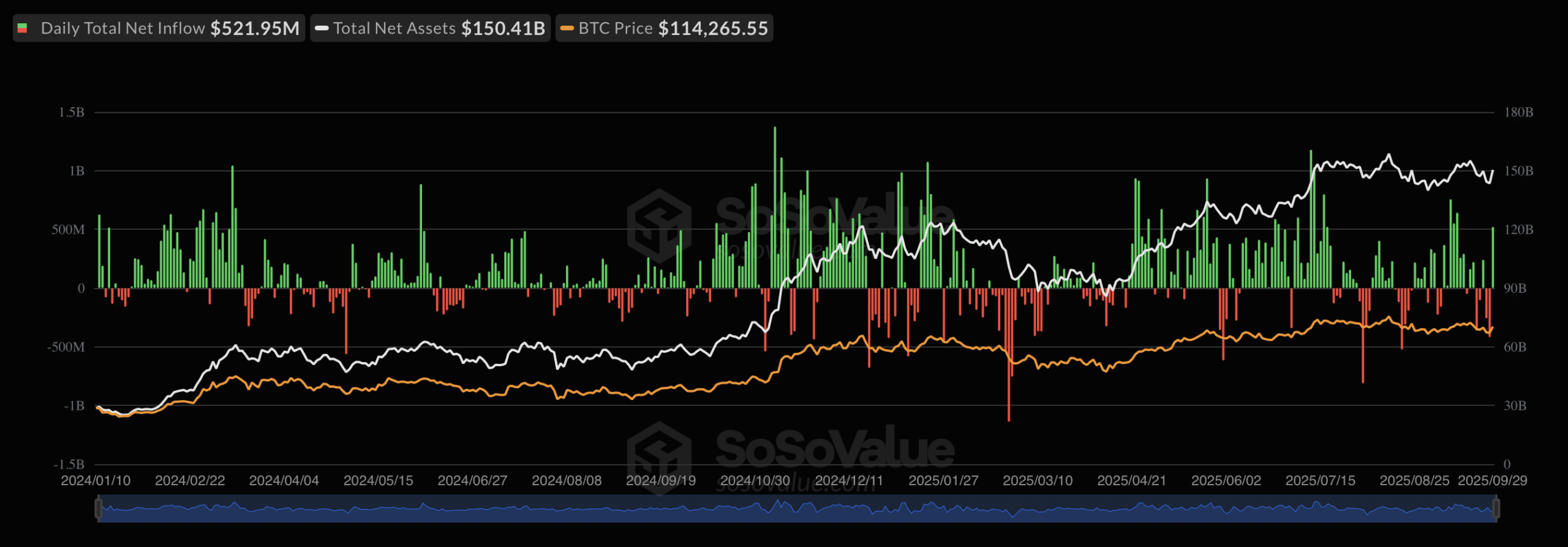
Source: SoSoValue
Analysts predict that continued price strength will be crucial to maintaining this positive trajectory in the long term.
James Madden, Trading Director at Deus X Pay, stated that “ongoing accumulation by both long-term holders and digital asset managers” is supporting the current upward trend of Bitcoin.
He further suggested that a less restrictive (dovish) policy from the Federal Reserve could stimulate further demand.