

Insights from Glassnode, a firm specializing in on-chain analysis, suggest Bitcoin (BTC) may encounter increased downward pressure following a recent drop below a significant price threshold. Additional indicators also hint at the potential for a more substantial market correction, with market sentiment showing signs of weakness after the Federal Open Market Committee (FOMC) meeting.
However, a number of market observers suggest that the approaching month of October, often referred to as “Uptober,” might bring positive momentum for Bitcoin. This digital asset could benefit from typical seasonal patterns, which might help stabilize its price movement and reignite optimism among investors.
Reasons Behind a Potential Further Bitcoin Price Decline
Sponsored
Glassnode’s latest analysis indicates that Bitcoin is demonstrating potential signs of market fatigue following the Federal Reserve’s rate adjustment last week, an event which temporarily drove the price up to $117,000.
“Bitcoin appears to be entering a correction phase, mirroring a classic ‘buy the rumor, sell the news’ scenario,” according to Glassnode.
Furthermore, underlying data suggests areas of weakness. The analysis noted that long-term holders (LTHs) have realized considerable profits recently, selling off approximately 3.4 million BTC worth of their holdings.
This volume of sales exceeds that of previous market cycles. Glassnode pointed out that, historically, such extensive distribution by long-term holders has often coincided with market peaks.
“Unlike previous cycles, this one has featured three distinct surges over several months. The Realized Profit/Loss Ratio indicates that cyclical highs occur each time profit-taking exceeds 90% of the coins in circulation. Given that we’ve recently moved away from the third such peak, the likelihood of a period of price consolidation increases,” analysts explained.
Sponsored
Simultaneously, a decline in new demand is intensifying the downward pressure. Net inflows into ETFs have plummeted from 2,600 BTC daily to nearly zero, coinciding with increased selling by long-term holders.
“ETF inflows have, until now, offset LTH sales; however, the margin for error is small. Around the time of the FOMC meeting, LTH distribution increased sharply to 122k BTC per month, while ETF net inflows (7D-SMA) fell from 2.6k BTC per day to almost nothing. This combination of increased selling pressure and diminishing institutional demand has created a vulnerable situation that has laid the groundwork for market weakness,” the analysis stated.
Furthermore, spot markets exhibited signs of strain, with trading volumes surging during the sell-off that followed the FOMC announcement. Futures markets also saw significant deleveraging, with open interest declining by billions of dollars.
Options markets have also become more defensive, with an increase in demand for put options and a rise in skew, reflecting increased caution among traders. Glassnode emphasized the importance of the $111,800 level, representing the cost basis for short-term holders.
“Given the pressure in both spot and futures markets, the $111k cost basis for short-term holders is the critical level to maintain to avoid a deeper correction,” the firm stressed.
Sponsored
Now that Bitcoin has fallen below the cost basis, the likelihood of further price decreases has increased considerably. Analyst Quinten Francois suggested that the short-term outlook isn’t particularly bullish, but the market may move sideways rather than immediately entering a bearish decline.
“BTC has dropped below both the $111.8k support and the uptrend support, closing the day below these crucial levels. I believe we’re in a no-trade zone, and it’s time to observe the direction it takes. It may move sideways, with liquidity flowing into alternative cryptocurrencies since the Bitcoin Dominance (BTC.D) is still strongly bearish,” Francois noted.
Could “Uptober” Rescue Bitcoin? Historical Data Shows Potential for Significant Gains
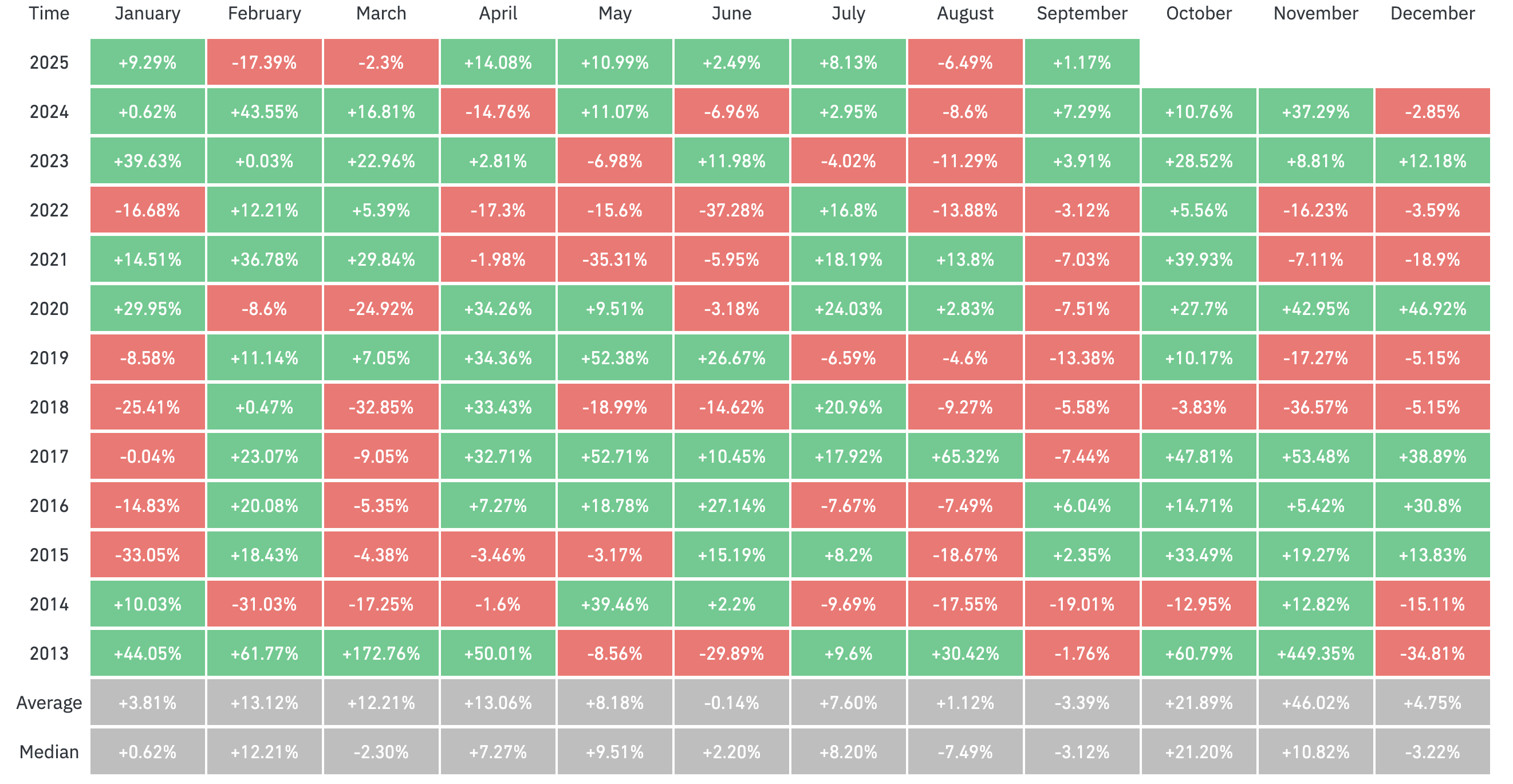
Despite these challenges, historical seasonal trends offer a potentially positive outlook. October, often called “Uptober” in the crypto community, has historically been a favorable month for Bitcoin. Data sourced from Coinglass reveals that BTC has achieved an average return of 21.89% during this month.
Sponsored
Furthermore, analyst Darkfost pointed out that, over the past 16 years, Bitcoin has only recorded losses in October on four occasions.
“If you had invested in BTC on October 1st, you would have realized profits 12 times since 2009, with a peak monthly return of 213% in 2010. More recently, since 2020, a simple investment in BTC on October 1st would have produced returns of between 7.5% and 30.5% within the month. Consequently, it is difficult to dismiss seasonality in BTC altogether, although this could be influenced by broader seasonal trends across all financial markets,” he posted.
This historical performance has fueled market expectations of a potential rally in the coming month.
As Bitcoin trades below critical support levels, the next few weeks will determine whether it will live up to the promises of “Uptober” or whether the current market correction will persist.