

Key Insights
Bitcoin’s market value relative to realized value (MVRV) falling below its 365-day simple moving average (SMA365) suggests underlying weakness, even with positive macroeconomic forecasts. Concurrently, an increase in Open Interest coupled with a slight bias toward long positions hints at the possibility of a price surge.
Since the middle of 2024, the MVRV ratio for Bitcoin (BTC) has been acting strangely, dropping below its SMA365 several times, which is unusual for a bull market.
Typically, a healthy bull market sees the MVRV consistently above the SMA365, indicating that long-term holders are generally profitable.
However, the recent weakness in the MVRV raises concerns about how sustainable Bitcoin’s current upward trend really is.
Although potential interest rate cuts by the Federal Reserve later in 2025 might provide macroeconomic tailwinds, the on-chain data presents a picture of increasing instability.
This discrepancy highlights the importance of seeing Bitcoin regain ground above the SMA365 to confirm its strength before the year concludes.
Divergence in On-Chain and Centralized Exchange Volume Raises Liquidity Questions
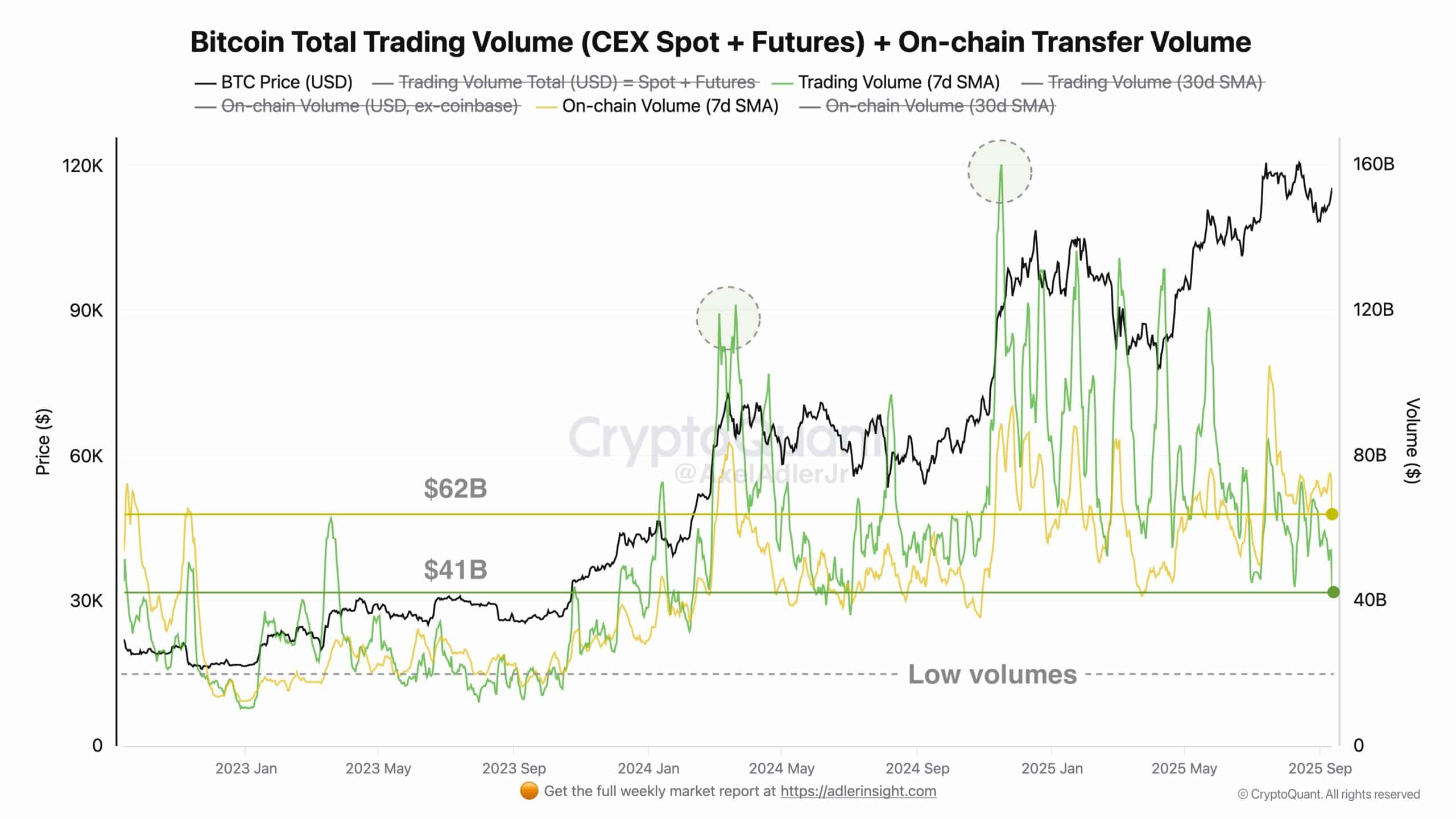
Trading volume patterns are showing a distinct difference between activity on the blockchain and activity on exchanges. Recently, on-chain volumes have jumped to $62 billion, which is significantly higher than the $41 billion seen across spot and futures trading on centralized exchanges.
While this suggests a healthy level of activity within the Bitcoin network, the broader trend indicates that volumes have been decreasing while prices have been increasing.
This type of negative divergence is often a sign of limited liquidity, which can make price rallies more susceptible to sudden pullbacks. Historically, strong bull markets have needed rising volume to sustain them.
As a result, this current imbalance leads to questions about whether Bitcoin can maintain its upward momentum without more participation from traders on centralized exchanges.
Source: X
Puell Multiple Indicates Strain on Miners
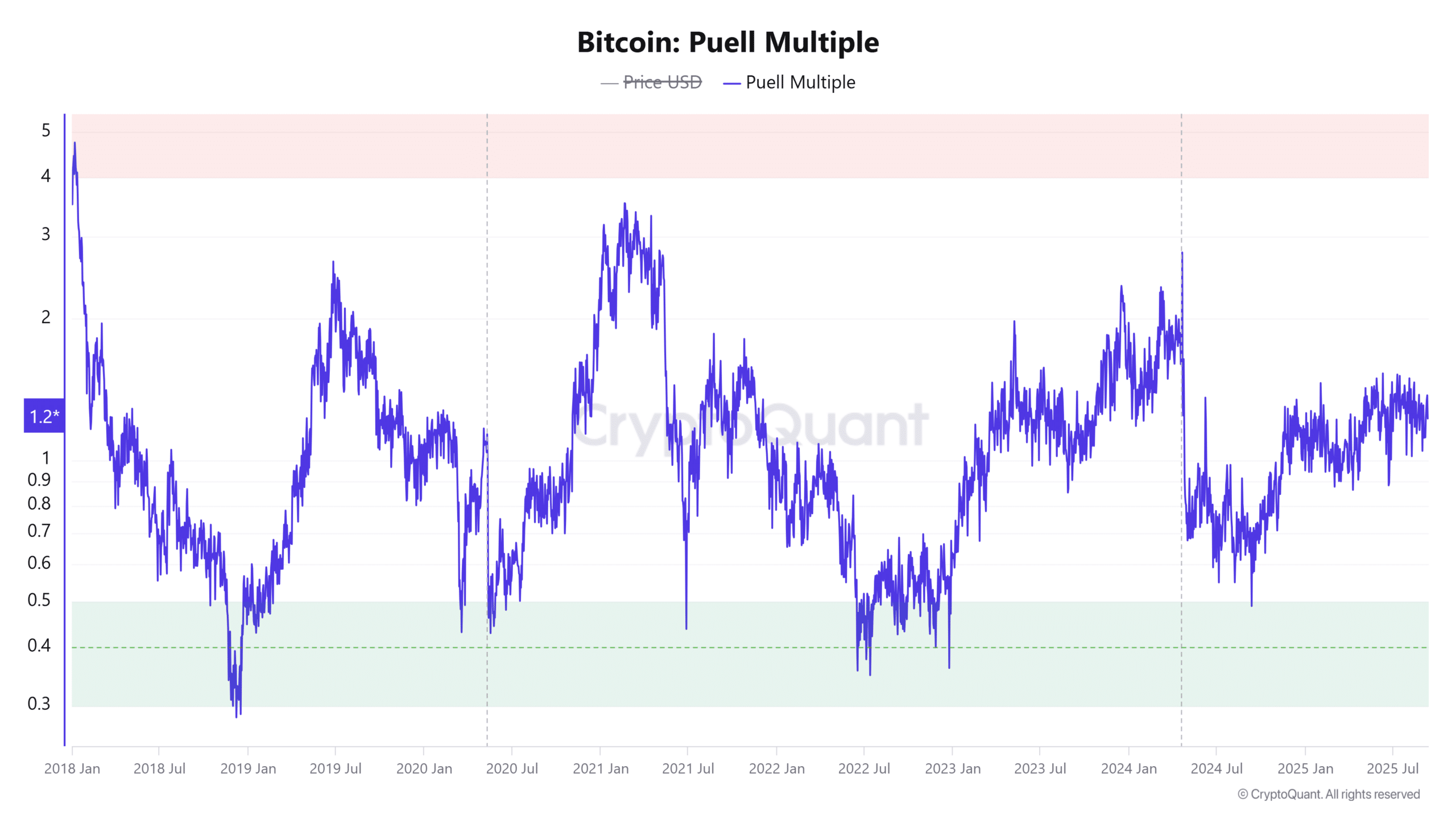
At the time of this report, the Puell Multiple has fallen approximately 15% to around 1.22, reflecting a reduction in miner revenue compared to historical averages.
This indicator typically highlights periods when miners are facing profitability challenges, which can often lead to increased selling pressure.
The recent decline suggests that miners may be selling off some of their holdings to cover their operating expenses, which could potentially create downward pressure on Bitcoin’s price.
However, a value above 1.0 still falls within a neutral range, suggesting that while miners are experiencing stress, it is not yet at a critical level.
Therefore, while miners are contributing to selling in the short term, the Puell Multiple does not currently indicate that Bitcoin is entering a full-blown capitulation phase.
Source: CryptoQuant
Increased Open Interest Signals Potential Volatility
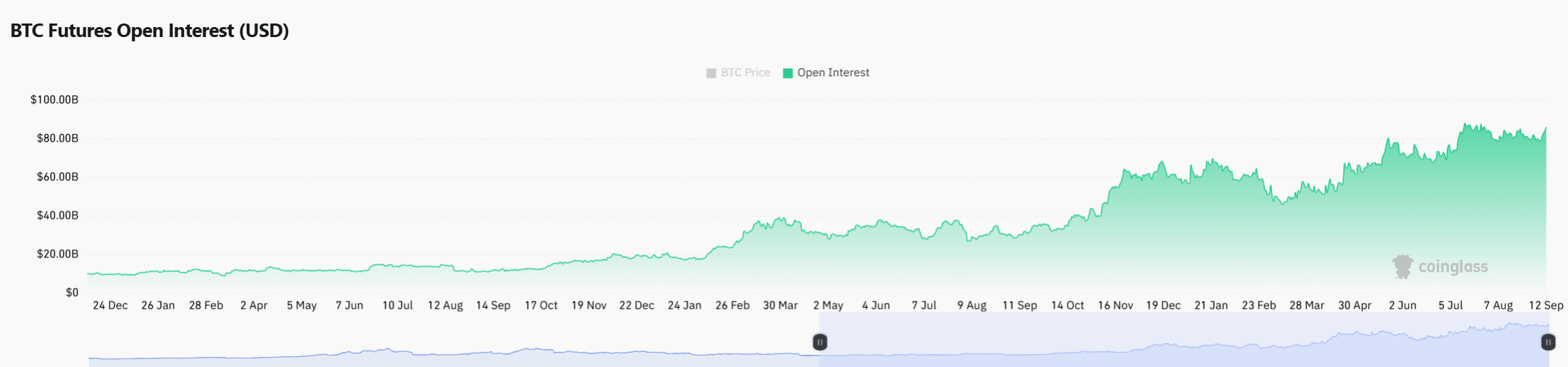
Activity in the futures market clearly demonstrates increased speculation, as Open Interest (OI) has risen by 2.50% to $86.05 billion, as of this writing.
This increase indicates a surge in leveraged positions, suggesting that traders are preparing for larger price fluctuations.
With long positions holding a slight majority at 53.23%, there is a modestly positive sentiment, although not overwhelmingly so.
Importantly, elevated OI often precedes increased volatility, as bulls and bears battle to defend key price levels.
However, should momentum falter, widespread liquidations could exacerbate downward price movements, reinforcing the ambiguous picture painted by the combined on-chain and derivatives data.
Source: CoinGlass
Can Bitcoin Navigate These Conflicting Signals?
Bitcoin has the potential to overcome the current mixed signals, but only if trading volumes increase and the MVRV can climb back above its SMA365 in the near future.
Despite concerns about miner stress and liquidity, the rise in Open Interest and supportive macroeconomic policies offer a slightly positive outlook for continued growth.
Consequently, the current market situation suggests that another breakout is more likely than a prolonged period of consolidation, assuming buyers can successfully defend crucial price levels.