

As global markets experienced turbulence this week, resulting in forced liquidations and margin calls impacting highly leveraged positions, seasoned investors are adjusting their strategies. Newly implemented tariffs announced by the U.S. government and a weaker-than-expected jobs report in America have triggered concerns in international markets. The S&P 500 saw a 1.6% decrease in a single day, and Bitcoin, characteristically, mirrored the downturn in risk appetite.
During periods of market volatility, a broader perspective can be beneficial. Over the past two years, Bitcoin has consistently outperformed all other major assets by a significant margin.
Bitcoin’s Two-Year Performance Compared to Key Assets
Between July 2023 and July 2025, Bitcoin skyrocketed by an impressive 301.7%, more than quadrupling its value and solidifying its position as the top-performing major asset. According to insights from ecoinometrics analysis:
“Bitcoin is experiencing another dip, but the overall trend remains unchanged. This consistent performance has been observed for the past two years; Bitcoin has been a frontrunner.”
Bitcoin’s gains considerably surpass those of traditional stock market investments. The S&P 500, a key U.S. stock benchmark, posted a more conservative return of 38% over the same two-year period. Despite a robust stock market and numerous record highs for large-cap stocks, the index failed to match Bitcoin’s impressive growth.
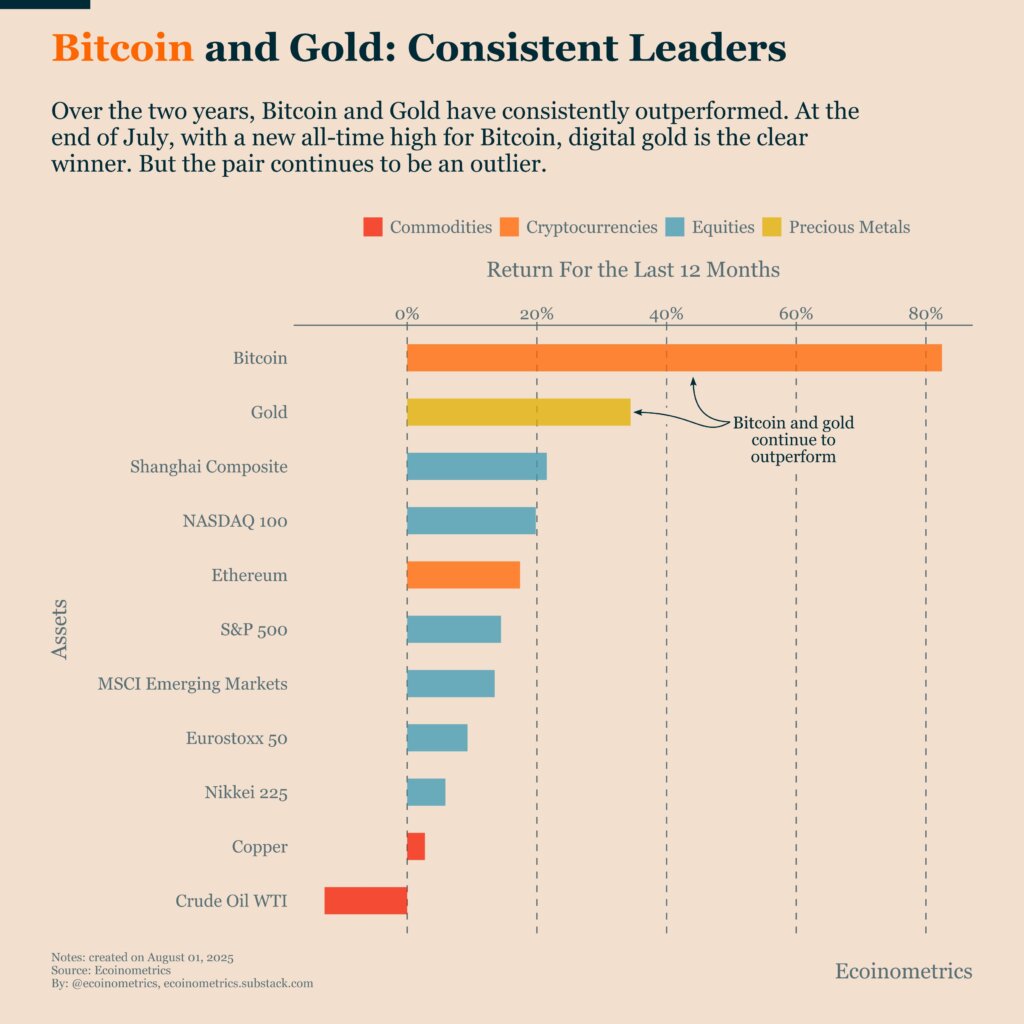
Gold, which benefited from increasing inflation and geopolitical instability, experienced a respectable 69.8% increase over the past two years. However, it still fell short of Bitcoin’s returns, validating the perspective of many Bitcoin advocates assertion: there isn’t a close alternative. As Adam Back remarked:
“There isn’t a true second best; the only runner-up consists of companies holding significant treasury reserves.”
Even when considering Ethereum, the second largest cryptocurrency, it reinforces Back’s argument. ETH realized a roughly 56% increase over the preceding 24 months.

Trailing behind the major assets is crude oil, which demonstrated minimal growth over the past two years, with returns fluctuating before ultimately remaining flat by the summer of 2025.
The Driving Forces Behind Bitcoin’s Dominance
The recent market downturn can be attributed more to macroeconomic uncertainties, trade tariffs, and employment concerns than to any fundamental change in Bitcoin’s intrinsic value. Bitcoin’s price fluctuations tend to correlate with broader market anxiety during periods of risk aversion. Yet, for the past two years, Bitcoin has successfully weathered market corrections and established itself as a leader in asset growth.
Its predictable issuance schedule, decentralized structure, and growing acceptance among both individual and institutional investors have supported its sustained growth.
While Ethereum remains a strong competitor, it has not surpassed BTC in performance. Gold’s role as a reliable inflation hedge has yielded significantly lower returns. Crude oil continues to face challenges due to evolving energy trends and macroeconomic pressures, lacking the performance and excitement seen in digital and financial assets.
Bitcoin’s temporary price declines may appear substantial, but these fluctuations are part of its nature. The data clearly demonstrates that since mid-2023, BTC has significantly outperformed gold, U.S. stocks, Ethereum, and crude oil. As ecoinometrics suggests, when in doubt, adopt a long-term perspective:
“It may not be necessary to overreact to movements that appear to be driven more by market sentiment than by underlying fundamentals.”