
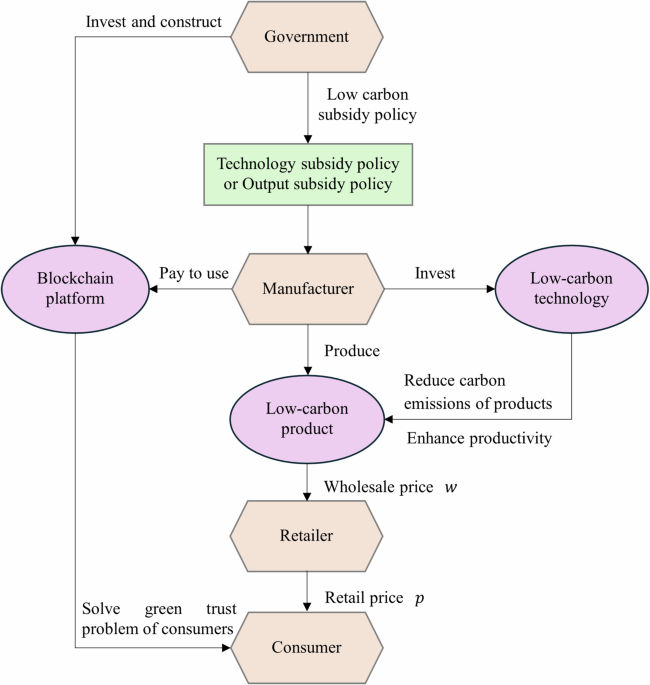
A stable equilibrium results from the government’s choice between a technology-specific subsidy program (TSP) and an output-specific subsidy program (OSP), contingent on whether the manufacturer uses blockchain technology (BT). This equilibrium forms the basis for further investigation into: (1) how the cost of carbon emission reduction (CER) investment, consumer preference for low-carbon (LC) goods, and level of consumer trust in green claims affect equilibrium; and (2) a comparison of TSP and OSP under conditions where the manufacturer either utilizes or forgoes BT, as well as a comparative analysis of the two subsidy models exclusively when the manufacturer employs BT.
<p>Let <span class="mathjax-tex">\(M=\left\{A,B\right\}\)</span>, and <span class="mathjax-tex">\(N=\left\{A,B,C,D\right\}\)</span> denote specific sets. Key findings are summarized below; detailed proofs can be found in the Appendix.</p>
<h3 class="c-article__sub-heading" id="Sec30">Sensitivity Analysis</h3>
<p>This segment focuses on how changes in three factors—the low-carbon technology (LCT) investment cost coefficient (<i>k</i>), consumer low-carbon preference coefficient (<i>β</i>), and the level of consumer confidence in green claims (<i>λ</i>)—influence equilibrium variables. These variables include carbon emission reduction rate, demand volume, prices at both the wholesale and retail levels, and profit margins for both manufacturers and retailers.</p>
<p><b>Proposition 1</b>. An increasing LCT investment cost coefficient (<i>k</i>) correlates with: <span class="mathjax-tex">\(\frac{\partial {r}^{N* }}{\partial k} < 0\)</span>, <span class="mathjax-tex">\(\frac{\partial {q}^{N* }}{\partial k} < 0\)</span>, <span class="mathjax-tex">\(\frac{\partial {p}^{N* }}{\partial k} < 0\)</span>, <span class="mathjax-tex">\(\frac{\partial {w}^{N* }}{\partial k} < 0\)</span>, <span class="mathjax-tex">\(\frac{\partial {\pi }_{m}^{N* }}{\partial k} < 0\)</span>, and <span class="mathjax-tex">\(\frac{\partial {\pi }_{r}^{N* }}{\partial k} < 0\)</span>.</p>
<p>Proposition 1 indicates that, regardless of whether a manufacturer adopts blockchain technology, a higher LCT investment cost coefficient corresponds to reductions in carbon emission reduction rates, consumer demand, wholesale and retail pricing, and profits for manufacturers and retailers across both the technology-specific and output-specific subsidy programs. An elevation in this coefficient suggests diminished LCT investment efficiency, weakening carbon emission reduction impact. Faced with a perceived drop in the level of emission reduction achieved by the product, retailers are motivated to decrease their retail prices to sustain demand. This reduction in demand has ripple effects across the supply chain and to the consumer, compelling manufacturers to reduce their wholesale prices due to worries about accumulating unsold inventory. The primary factor impacting diminished retailer profits is reduced demand, while lower demand, reduced wholesale prices, and elevated LCT investment expenses collectively contribute to decreased manufacturer earnings.</p>
<p>These observations suggest that either lessening LCT investment costs or improving its effectiveness will likely boost the product's low-carbon attributes. Data indicates that technology constitutes about 30% of the overall factors influencing an enterprise's capability to reduce emissions (Song et al., <a data-track="click" data-track-action="reference anchor" data-track-label="link" data-test="citation-ref" aria-label="Reference 2023" title="Song YZ, Li Y, Liu TS (2023) Carbon asset remolding and potential benefit measurement of machinery products in the light of lean production and low-carbon investment. Technol Forecast Soc Chang 186.
https://doi.org/10.1016/j.techfore.2022.122166
" href="http://www.nature.com/articles/s41599-025-05590-5#ref-CR81" id="ref-link-section-d143957012e6002">2023</a>). Therefore, there should be incentives for companies to invest in research and development to improve LCT, increase its efficiency, and benefit from emission reductions. Advances in technology and the benefits of scale lead to lower costs for emission reductions and greater investment in renewable energy. For example, the International Renewable Energy Agency (IRENA) reported that global renewable energy capacity reached 3,372 GW by the end of 2022 due to technological advancements, a year-over-year rise of 9.6%, with solar energy capacity rising by 22% (191 GW) (EP, 2023).</p>
<p><b>Proposition 2</b>. An increasing low-carbon preference coefficient (<i>β</i>) correlates with: <span class="mathjax-tex">\(\frac{\partial {r}^{N* }}{\partial \beta } > 0\)</span>, <span class="mathjax-tex">\(\frac{\partial {q}^{N* }}{\partial \beta } > 0\)</span>, <span class="mathjax-tex">\(\frac{\partial {p}^{N* }}{\partial \beta } > 0\)</span>, <span class="mathjax-tex">\(\frac{\partial {w}^{N* }}{\partial \beta } > 0\)</span>, <span class="mathjax-tex">\(\frac{\partial {\pi }_{m}^{N* }}{\partial \beta } > 0\)</span>, <span class="mathjax-tex">\(\frac{\partial {\pi }_{r}^{N* }}{\partial \beta } > 0\)</span>.</p>
<p>Proposition 2 implies that growing consumer inclination towards low-carbon products enhances carbon emission reduction rates, increases demand, drives up wholesale and retail prices, and boosts profits for manufacturers and retailers under both technology and output-specific subsidy programs, irrespective of blockchain adoption. An augmented low-carbon preference coefficient heightens consumer awareness of the low-carbon product attributes, promoting escalated investment in LCT, as heightened market demand leads to a stronger return on investment. Concurrently, elevated demand encourages firms to invest more capital in low-carbon technology, establishing a circular dynamic within the low-carbon supply chain. Moreover, an intensified consumer preference for low-carbon products allows businesses to elevate the prices of such items since they often transfer some of their LCT investment-related costs to the end consumer.</p>
<p>These findings affirm that cultivating a robust consumer preference for low-carbon products stimulates LCT investment and increases profitability. Simultaneously, firms elevate the cost of preferred low-carbon offerings, underscoring the economic advantages of lowering carbon output. Aside from advertising and other forms of publicity, governmental bodies might consider implementing incentive systems that foster low-carbon behavioral awareness among consumers. For example, Tencent and the Shenzhen Municipal Bureau of Ecological Environment, in conjunction with other organizations, developed a collaborative platform that recognizes and incentivizes environmentally responsible conduct through the creation of citizen carbon emission reduction mechanisms (CNR News, <a data-track="click" data-track-action="reference anchor" data-track-label="link" data-test="citation-ref" aria-label="Reference 2022" title="China National Radio (CNR) News (2022) Shenzhen Ecological Environment Bureau and Tencent completed the first personal carbon inclusive emission reduction transaction carbon reduction 12 kg can be exchanged for travel vouchers.
https://baijiahao.baidu.com/s?id=1752011596453091408&wfr=spider&for=pc
. Accessed 12 Dec 2022" href="http://www.nature.com/articles/s41599-025-05590-5#ref-CR19" id="ref-link-section-d143957012e6346">2022</a>). Designed with traits of being "recordable, measurable, profitable, and recognized", the scheme establishes a positive feedback cycle merging economic rewards with governmental support. Such programs aid in nurturing a widening group of consumers who strongly prefer low-carbon options, which, consequently, enhances the low-carbon marketplace.</p>
<p><b>Proposition 3</b>. An increasing green trust factor (<i>λ</i>) correlates with: <span class="mathjax-tex">\(\frac{\partial {r}^{M* }}{\partial \lambda } > 0\)</span>, <span class="mathjax-tex">\(\frac{\partial {q}^{M* }}{\partial \lambda } > 0\)</span>, <span class="mathjax-tex">\(\frac{\partial {p}^{M* }}{\partial \lambda } > 0\)</span>, <span class="mathjax-tex">\(\frac{\partial {w}^{M* }}{\partial \lambda } > 0\)</span>, <span class="mathjax-tex">\(\frac{\partial {\pi }_{m}^{M* }}{\partial \lambda } > 0\)</span>, and <span class="mathjax-tex">\(\frac{\partial {\pi }_{r}^{M* }}{\partial \lambda } > 0\)</span>.</p>
<p>Proposition 3 demonstrates that a boost in the green trust factor contributes to amplified carbon reduction rates, heightened demand, increasing wholesale and retail costs, and greater profits for both manufacturers and retailers, particularly without blockchain technology, across both forms of subsidy programs. A rise in consumer trust suggests consumers are more confident in a firm's low-carbon claims, irrespective of whether these assurances stem from blockchain verification or conventional marketing activities. This enhanced level of faith prompts companies with lower emission reduction to spend more aggressively on LCT, with the assumption that consumer reaction would be positive. Core influences on demand comprise of levels of trust in green marketing and amounts of decrease in emissions. As green trust elevates, more consumers who prefer low-carbon products typically remove their reservations related to information and buy from the manufacturers, enhancing demand. Subsequently, producers increase wholesale prices, which prompts retailers to alter their retail charges accordingly. Ultimately, gains across all members of the supply chain are elevated.</p>
<p>These insights suggest that promoting green trust considerably strengthens manufacturers’ drive to diminish their carbon emissions and augment LCT investment without using blockchain. Absent blockchain technology, governments may promote consumer trust in LCT and green products by employing certification processes and public relations campaigns. A notable example is the “Energy Star” initiative, collaboratively managed by the U.S. Department of Energy (DOE) and the Environmental Protection Agency (EPA), which boosts consumer faith in energy-efficient products using its labelling system. By pushing businesses to innovate their products and adopt leading-edge technologies to adhere to the energy-efficiency standards, the project acknowledges the best 25% energy-efficient products with the Blue Energy Star seal (GBA, <a data-track="click" data-track-action="reference anchor" data-track-label="link" data-test="citation-ref" aria-label="Reference 2017" title="Green Building Advisor (GBA) (2017) Energy Star brings significant benefits to America: why put it at risk?
https://m.etiketa4.com/article/energy-star-delivers-big-for-america-why-put-it-at-risk
. Accessed 20 Apr 2017" href="http://www.nature.com/articles/s41599-025-05590-5#ref-CR35" id="ref-link-section-d143957012e6689">2017</a>). This boost in consumer green trust not only catalyzes LCT investment, but also heightens firm profitability through enhanced market position. Furthermore, significant levels of green trust enables producers to more effectively transfer their LCT investment costs to the consumer, fostering low-carbon market advancement.</p>
<h3 class="c-article__sub-heading" id="Sec31">Comparative Analysis</h3>
<p>Propositions 4 through 7 are used to evaluate the equilibrium results from two subsidy programs in scenarios where blockchain is not used, whereas results 8 through 11 carry out corresponding evaluations when blockchain technology is put into practice.</p>
<p><b>Proposition 4</b>. By evaluating carbon emission reduction equilibrium percentages across both technology and output-specific subsidy schemes without blockchain integration, it is observable that: for conditions where <span class="mathjax-tex">\(0 < \mu < {\bar{\mu }}_{1}\)</span>, <span class="mathjax-tex">\({r}^{A* } > {r}^{B* }\)</span>; under circumstances where <span class="mathjax-tex">\(\mu > {\bar{\mu }}_{1}\)</span>, <span class="mathjax-tex">\({r}^{B* } > {r}^{A* }\)</span> (as visualized in Fig. <a data-track="click" data-track-label="link" data-track-action="figure anchor" href="http://www.nature.com/articles/s41599-025-05590-5#Fig2">2</a>).</p>
<div class="c-article-section__figure js-c-reading-companion-figures-item" data-test="figure" data-container-section="figure" id="figure-2" data-title="Fig. 2">
<figure>
<figcaption><b id="Fig2" class="c-article-section__figure-caption" data-test="figure-caption-text">Fig. 2</b></figcaption>
<div class="c-article-section__figure-content">
<div class="c-article-section__figure-item"><a class="c-article-section__figure-link" data-test="img-link" data-track="click" data-track-label="image" data-track-action="view figure" href="https://www.nature.com/articles/s41599-025-05590-5/figures/2" rel="nofollow">
<picture>
<source type="image/webp" >
<img aria-describedby="Fig2" src="https://media.springernature.com/lw685/springer-static/image/art%3A10.1057%2Fs41599-025-05590-5/MediaObjects/41599_2025_5590_Fig2_HTML.png" alt="figure 2" loading="lazy" width="685" height="562">
</picture>
</a></div>
<div class="c-article-section__figure-description" data-test="bottom-caption" id="figure-2-desc">
<p>Relationship between the size of CER rate <i>r</i> for models A and B.</p>
</div>
</div>
</figure>
</div>
<p>This evaluation shows that technology-specific subsidy programs are advantageous at maximizing an organizations CER rate in circumstances with low per-unit producer subsidy amounts (<span class="mathjax-tex">\(0 < \mu < {\bar{\mu }}_{1}\)</span>). In this framework, output-specific subsidy schemes produce a much lower aggregate amount of support for manufacturers, thereby decreasing the motive to allocate resources to low-carbon technologies. Opposingly, under elevated per-unit costs amounts (<span class="mathjax-tex">\(\mu > {\bar{\mu }}_{1}\)</span>), the OSP promotes a stronger CER rate. In this case, the output-specific program offers a considerably higher overall payout for producers, bolstering their incentive to allocate resources toward LCT.</p>
<p>These conclusions showcase that maximizing a firm's low-carbon technology investments relies upon the volume of the government's per-unit payouts. Assuming the amount per unit is low (high), producers can choose to allocate funds under the TSP (OSP).</p>
<p><b>Proposition 5</b>. Based on the evaluation of both the wholesale and retail equilibrium costs with technology-specific subsidy schemes and output-specific subsidy schemes, neglecting blockchain, it is plausible to draw the conclusions: <span class="mathjax-tex">\({w}^{A* } > {w}^{B* }\)</span>, and <span class="mathjax-tex">\({p}^{A* } > {p}^{B* }\)</span>.</p>
<p>Evaluation 5 highlights that both prices at the wholesale level and the retail level increase under the technology-specific subsidy scheme. This can be attributed to the reality that payouts under technology-specific subsidies are heavily tied to an entity's carbon emission reduction rate, in contrast to an output-specific program that is dependent on the amount of low-carbon offerings generated by those who invest in low-carbon practices. Said more plainly, payout allocations are driven based on overall demand levels; the greater the market, the greater the production, thereby, increasing government payout volumes. Due to this reality, producers benefit by cutting prices at the wholesale level, thereby strengthening overall market needs, enhancing total government payout volume. Also, manufacturers under the technology-specific subsidy model earn revenue from allocating resources towards low-carbon technologies, providing them an opportunity to reallocate these costs to consumers. Consequently, producers typically increase their wholesale pricing under technology-specific scenarios.</p>
<p>These data imply that, neglected blockchain integration, technological subsidy programs typically escalate both costs at the wholesale and consumer levels. The reasoning of this effect can be traced back to technological investment programs enabling producers to prioritize resources in leading-edge engineering that add value. To secure payback volume for these operations, it is common to secure top rates for commodities. The opposite holds true under outputs subsidy platforms that strengthen the market base. Due to these dynamics, market competition elevates to limit entities from charging top pricing for products. For instance, government entities in Germany allocated great payouts to BMW, focused in high-value applications namely in battery management operations, intelligent driving support systems, and automotive online functions (CAAM, <a data-track="click" data-track-action="reference anchor" data-track-label="link" data-test="citation-ref" aria-label="Reference 2024" title="China Association of Automobile Manufacturers (CAAM) (2024) The German government plans to subsidize research and development of electric car batteries.
http://www.caam.org.cn/item/tags-jee%25252525252525252525252520p%D7%D4%D3%C9%B9%E2/chn/9/cate_106/con_5222066.html
. Accessed 20 Mar 2019" href="http://www.nature.com/articles/s41599-025-05590-5#ref-CR17" id="ref-link-section-d143957012e7131">2024</a>). Such incentives enable BMW to begin offering the i8 plug-in model and it cost significantly higher versus other vehicle models due to it being a leading commodity. Extremely high commodity pricing can discourage potential customer purchases. Therefore, unless Blockchain implementation is put into effect, the governing entities need to implement an output-subsidy strategy to check pricing in order to protect potential customers.</p>
<p><b>Proposition 6</b>. After carrying out market evaluation across a technology-specific subsidy, an output-specific subsidy, neglecting Blockchain, inferences can be drawn under two categories: when <span class="mathjax-tex">\(0 < \mu < {\bar{\mu }}_{2}\)</span>, <span class="mathjax-tex">\({q}^{A* } > {q}^{B* }\)</span>; and where <span class="mathjax-tex">\(\mu > {\bar{\mu }}_{2}\)</span>, <span class="mathjax-tex">\({q}^{B* } > {q}^{A* }\)</span> (as portrayed in the diagram in Fig. <a data-track="click" data-track-label="link" data-track-action="figure anchor" href="http://www.nature.com/articles/s41599-025-05590-5#Fig3">3</a>).</p>
<div class="c-article-section__figure js-c-reading-companion-figures-item" data-test="figure" data-container-section="figure" id="figure-3" data-title="Fig. 3">
<figure>
<figcaption><b id="Fig3" class="c-article-section__figure-caption" data-test="figure-caption-text">Fig. 3</b></figcaption>
<div class="c-article-section__figure-content">
<div class="c-article-section__figure-item"><a class="c-article-section__figure-link" data-test="img-link" data-track="click" data-track-label="image" data-track-action="view figure" href="https://www.nature.com/articles/s41599-025-05590-5/figures/3" rel="nofollow">
<picture>
<source type="image/webp" >
<img aria-describedby="Fig3" src="https://media.springernature.com/lw685/springer-static/image/art%3A10.1057%2Fs41599-025-05590-5/MediaObjects/41599_2025_5590_Fig3_HTML.png" alt="figure 3" loading="lazy" width="685" height="567">
</picture>
</a></div>
<div class="c-article-section__figure-description" data-test="bottom-caption" id="figure-3-desc">
<p>Relationship between the size of demand <i>q</i> for models A and B.</p>
</div>
</div>
</figure>
</div>
<p>Proposition 6 demonstrates under unit subsidy amounts (<span class="mathjax-tex">\(0 < \mu < {\bar{\mu }}_{2}\)</span>), the technology-specific subsidies are more effective in creating greater demand as compared to output-specific. The opposite dynamic holds true, that increased government subsidy volumes (<span class="mathjax-tex">\(\mu > {\bar{\mu }}_{2}\)</span>), enable stronger stimulus in demand. Lacking block-chain utilization, carbon emissions reduction becomes critical for influencing consumption. Based on proposition 4, under low subsidy payments, companies are highly incentivized to allocate significant assets toward lower carbon practices. On the opposing, should subsidy payment volumes increase, entities are pushed to allocate greater production in low carbon activities enhancing market demand.</p>
<p>These findings determine volumes from subsidy funds not only shift manufacturer focus towards low carbon activities but also impacts quantity volume requirements from a carbon emissions reduction view. In the scenario where resource allocation to lower carbon processes escalates in total volume with minor efficiency improvement gains, customer awareness in green activities must elevate, and, is typically superior to carbon emission reduction contributions. Provided this scenario, companies can elevate their marketing profile of green products thereby improving customer procurement requirements.</p>
<p><b>Proposition 7</b>. Under a comparison of profitability from entities in a technology-specific and output-specific environment, without Block-chain, two implications can occur, specifically, when <span class="mathjax-tex">\(0 < \mu < {\bar{\mu }}_{3}\)</span>, <span class="mathjax-tex">\({\pi }_{m}^{A* } > {\pi }_{m}^{B* }\)</span>; and when <span class="mathjax-tex">\(\mu > {\bar{\mu }}_{3}\)</span>, <span class="mathjax-tex">\({\pi }_{m}^{B* } > {\pi }_{m}^{A* }\)</span> (shown in Fig. <a data-track="click" data-track-label="link" data-track-action="figure anchor" href="http://www.nature.com/articles/s41599-025-05590-5#Fig4">4</a>). As well, at conditions where <span class="mathjax-tex">\(0 < \mu < {\bar{\mu }}_{4}\)</span>, <span class="mathjax-tex">\({\pi }_{r}^{A* } > {\pi }_{r}^{B* }\)</span>; and where <span class="mathjax-tex">\(\mu > {\bar{\mu }}_{4}\)</span>, <span class="mathjax-tex">\({\pi }_{r}^{B* } > {\pi }_{r}^{A* }\)</span> (shown in Fig. <a data-track="click" data-track-label="link" data-track-action="figure anchor" href="http://www.nature.com/articles/s41599-025-05590-5#Fig5">5</a>).</p>
<div class="c-article-section__figure js-c-reading-companion-figures-item" data-test="figure" data-container-section="figure" id="figure-4" data-title="Fig. 4">
<figure>
<figcaption><b id="Fig4" class="c-article-section__figure-caption" data-test="figure-caption-text">Fig. 4</b></figcaption>
<div class="c-article-section__figure-content">
<div class="c-article-section__figure-item"><a class="c-article-section__figure-link" data-test="img-link" data-track="click" data-track-label="image" data-track-action="view figure" href="https://www.nature.com/articles/s41599-025-05590-5/figures/4" rel="nofollow">
<picture>
<source type="image/webp" >
<img aria-describedby="Fig4" src="https://media.springernature.com/lw685/springer-static/image/art%3A10.1057%2Fs41599-025-05590-5/MediaObjects/41599_2025_5590_Fig4_HTML.png" alt="figure 4" loading="lazy" width="685" height="565">
</picture>
</a></div>
<div class="c-article-section__figure-description" data-test="bottom-caption" id="figure-4-desc">
<p>Manufacturer profit <i>π</i><sub><i>m</i></sub> Relationship for models A and B.</p>
</div>
</div>
</figure>
</div>
<div class="c-article-section__figure js-c-reading-companion-figures-item" data-test="figure" data-container-section="figure" id="figure-5" data-title="Fig. 5">
<figure>
<figcaption><b id="Fig5" class="c-article-section__figure-caption" data-test="figure-caption-text">Fig. 5</b></figcaption>
<div class="c-article-section__figure-content">
<div class="c-article-section__figure-item"><a class="c-article-section__figure-link" data-test="img-link" data-track="click" data-track-label="image" data-track-action="view figure" href="https://www.nature.com/articles/s41599-025-05590-5/figures/5" rel="nofollow">
<picture>
<source type="image/webp" >
<img aria-describedby="Fig5" src="https://media.springernature.com/lw685/springer-static/image/art%3A10.1057%2Fs41599-025-05590-5/MediaObjects/41599_2025_5590_Fig5_HTML.png" alt="figure 5" loading="lazy" width="685" height="572">
</picture>
</a></div>
<div class="c-article-section__figure-description" data-test="bottom-caption" id="figure-5-desc">
<p>Retailer profit <i>π</i><sub><i>r</i></sub> Relationship for models A and B.</p>
</div>
</div>
</figure>
</div>
<p>Proposition 7 draws a close relationship for companies with marginal subsidy volumes (<span class="mathjax-tex">\(0 < \mu < {\bar{\mu }}_{3}\)</span> or <span class="mathjax-tex">\(0 < \mu < {\bar{\mu }}_{4}\)</span>), enabling manufacturers and retailers to expand profitability volume. Contrastingly, when subsidy volume increases (<span class="mathjax-tex">\(\mu > {\bar{\mu }}_{3}\)</span> or <span class="mathjax-tex">\(\mu > {\bar{\mu }}_{4}\)</span>), output-specific subsidy schemes improve earnings for manufacturers and retailers. Under proposition 6, decreased payouts volumes in technology-based subsidies are more favorable compared to demand under output-based alternatives, which creates an advantage to increase financial output of supply chain players.</p>
<p>The finding reflects a direct relationship between financial output for manufacturers with low payouts from technology-based subsidy programs. Specificaly, entities are inclined to take an output-based investment to optimize production under the technology-specific payment volume.</p>
<p><b>Proposition 8</b>. By evaluating equilibrium on a technology-based vs output-based system while including Blockchain capabilities, data infers that when <span class="mathjax-tex">\(0 < \mu < {\bar{\mu }}_{5}\)</span>, <span class="mathjax-tex">\({r}^{C* } > {r}^{D* }\)</span>; where <span class="mathjax-tex">\(\mu > {\bar{\mu }}_{5}\)</span>, <span class="mathjax-tex">\({r}^{D* } > {r}^{C* }\)</span> (presented in the diagram found in Fig. <a data-track="click" data-track-label="link" data-track-action="figure anchor" href="http://www.nature.com/articles/s41599-025-05590-5#Fig6">6</a>).</p>
<div class="c-article-section__figure js-c-reading-companion-figures-item" data-test="figure" data-container-section="figure" id="figure-6" data-title="Fig. 6">
<figure>
<figcaption><b id="Fig6" class="c-article-section__figure-caption" data-test="figure-caption-text">Fig. 6</b></figcaption>
<div class="c-article-section__figure-content">
<div class="c-article-section__figure-item"><a class="c-article-section__figure-link" data-test="img-link" data-track="click" data-track-label="image" data-track-action="view figure" href="https://www.nature.com/articles/s41599-025-05590-5/figures/6" rel="nofollow">
<picture>
<source type="image/webp" >
<img aria-describedby="Fig6" src="https://media.springernature.com/lw685/springer-static/image/art%3A10.1057%2Fs41599-025-05590-5/MediaObjects/41599_2025_5590_Fig6_HTML.png" alt="figure 6" loading="lazy" width="685" height="573">
</picture>
</a></div>
<div class="c-article-section__figure-description" data-test="bottom-caption" id="figure-6-desc">
<p>Relationship between the size of CER rate <i>r</i> for models C and D.</p>
</div>
</div>
</figure>
</div>
<p>The conclusion emphasizes technology subsidies strengthen carbon emissions reductions in instances when governing entities offer producers marginal production subsidies volumes across all lower carbon product offerings. The alternative case where heightened subsidies are available, output-based plans enhance rates. This observation enhances events where absence of blockchain is noted: under smaller subsidies volumes, payment plans improve likelihood to allocate resources, enabling significant benefits in rate reductions. In conditions of higher subsidies, entities improve focus on allocation based on an enhanced desire for manufacturers in higher payment scenarios.</p>
<p><b>Proposition 9</b>. Under an evaluation involving producer, retailer and technological schemes coupled with output-based plans integrated to Blockchain it's likely inferences can drawn. From these findings, instances of marginal funds occur at <span class="mathjax-tex">\(0 < \mu < {\bar{\mu }}_{6}\)</span>, <span class="mathjax-tex">\({w}^{C* } > {w}^{D* }\)</span>; and in the alternative situation, when <span class="mathjax-tex">\(\mu > {\bar{\mu }}_{6}\)</span>, <span class="mathjax-tex">\({w}^{D* } > {w}^{C* }\)</span> (shown in Fig.