
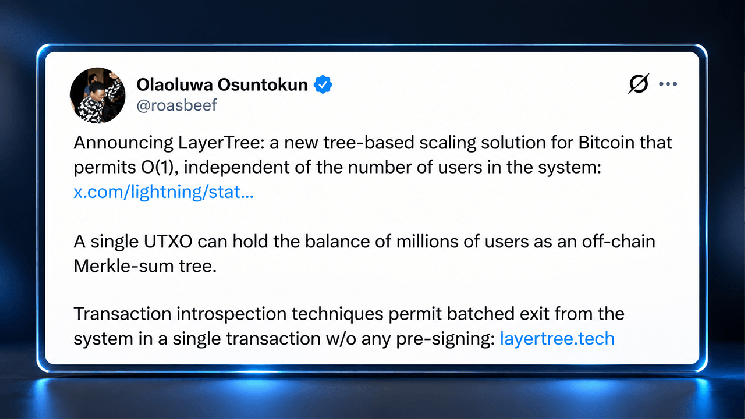
Your Bitcoin, Your Exit, No Approval Needed
The dynamics of this system are quite fascinating. While an administrator oversees the shared platform and admits new participants, they cannot arbitrarily take anyone’s bitcoin or obstruct a legitimate withdrawal. Anyone wishing to exit can present a mathematical proof detailing their bitcoin holdings. An established Bitcoin protocol, known as a covenant, verifies this proof, releases the funds, and adjusts the balances accordingly.
No administration authorizations are required for withdrawals, and there’s no enforced waiting time or expiration for the shared output. In Osuntokun’s research, some figures underscore this concept. In a scenario offering 65,536 positions, a personal withdrawal is estimated to consume about 1,020 virtual bytes (vB), which is a metric Bitcoin uses for calculating transaction fees.
This is about nine times larger than a basic Bitcoin transaction, yet it remains significantly smaller than the roughly 2,511 vB needed for a similar Ark-style withdrawal. Real cost savings become apparent when individuals collaborate. According to the funding parameters discussed in the paper, enrolling around 1,000 individuals could result in costs of less than 1 vB per participant.
The Drawbacks of Bitcoin’s Shared Wallet Concept
Layertree has its complexities, some of which are quite significant. Primarily, administrators have control over who is allowed to join. While they cannot obstruct a legitimate withdrawal, they can deny entry to new users. Additionally, since all members share one Bitcoin output, multiple withdrawals occurring simultaneously may contend for the same limited transaction space. This could lead to substantial congestion if many users attempt to withdraw at once.
Moreover, participants bear a substantial responsibility. Before depositing bitcoin, they must authenticate the mathematical records that validate their balances. Failure to do this could result in permanent inaccessibility of their funds. Most critically, Layertree cannot function under Bitcoin’s existing scripting regulations and requires the implementation of new capabilities that are still proposed and not yet active.
Osuntokun has created reference software, experimented with scripts, and mathematically validated sections of the design. However, these achievements do not confirm that the entire system is secure for regular use. Layertree presents an intriguing opportunity for Bitcoin’s future, where millions could potentially share the costs of blockchain space while keeping control of their bitcoin. Yet, the same communal output that renders this arrangement financially viable may become the largest hurdle when users attempt to exit.