
Historically, Cardano has been recognized for its robust design yet criticized for its slower performance compared to faster blockchain alternatives. Nevertheless, significant advancements in Cardano’s ecosystem in 2026 are altering this narrative, albeit without the dramatic price hikes typically expected by the market. The network continues to enjoy respect even amid past skepticism regarding its pace of progress.
In 2026, the essence of Cardano extends beyond just the price of ADA▲$0.1791. Key areas of focus now include governance, increased liquidity, enhanced scalability, improved developer tools, partnerships with other chains, and meaningful real-world integrations. One lingering question from its academic beginnings remains: can Cardano effectively translate its meticulous design into tangible market engagement?
ADA might be undergoing a transformation, but current indicators don’t entirely support this notion. While fundamental aspects appear more robust, the price trend lacks decisive momentum.
Contents
Cardano in 2026: A Network Testing Its Path
Cardano’s philosophy is rooted in patience. While many rival blockchains opted for rapid development or venture capital investment to foster growth, Cardano has adhered to a different strategy. Its progress has been shaped by a commitment to academically vetted designs, rigorous validation processes, decentralization, and sustainable frameworks.
This method has made Cardano both resilient and a target for criticism.
As we move into 2026, Cardano’s core foundation remains strong. The focus is shifting towards enhancing user interaction, improving liquidity, engaging builders, and attracting institutional interest. Although infrastructure is crucial, it alone cannot spur momentum. For ADA to regain its upward trajectory, conditions must go beyond mere preparedness.
This marks the beginning of significant changes within Cardano’s developments in 2026.
Read more: Best Crypto ETF Contracts for 2026: Which ETFs Will Dominate Trading This Year?
Governance Shifts Toward Actual Treasury Choices
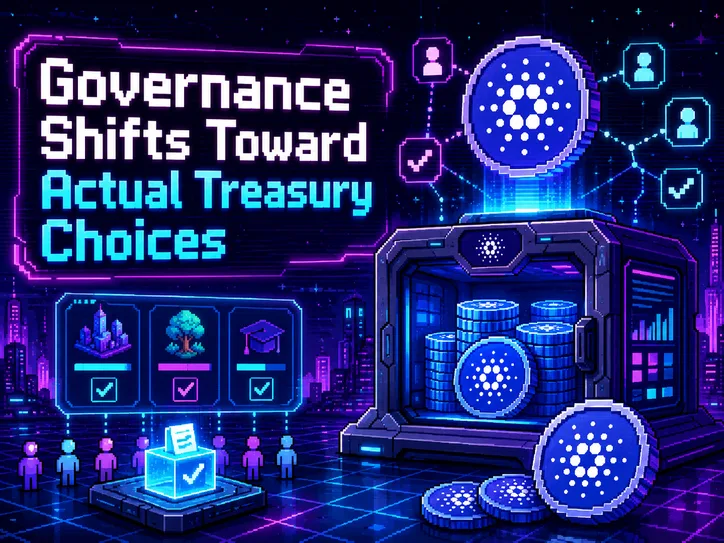
A highlight of Cardano’s developments in 2026 is governance. The Voltaire phase has progressed beyond theoretical discussions to face real-world scrutiny: can a decentralized governance model effectively supervise treasury decisions without descending into chaos, neglect, or distractions?
In January 2026, the Cardano Foundation allocated 220 million ADA across 11 DReps, increasing the total community delegation to 360 million ADA. This shift is significant, as governance only gains credibility when influence extends beyond the original founding groups to active community participants.
Another noticeable shift involves how the ecosystem manages its finances. By 2026, Cardano’s treasury strategies are driven by long-term initiatives, including Vision 2030 and quantifiable ecosystem metrics. In essence, sustainability takes precedence over impulsive funding requests. Structure replaces spontaneity; outcomes dictate resource allocation.
This approach supports sustainable development but may also introduce uncertainties. While collective decision-making can fund vital systems, it may lead to delays, divisions, and intricate processes. Given Cardano’s nature, growth and stagnation may occur concurrently.
Scaling After Leios and Hydra: The Layer 2 Puzzle
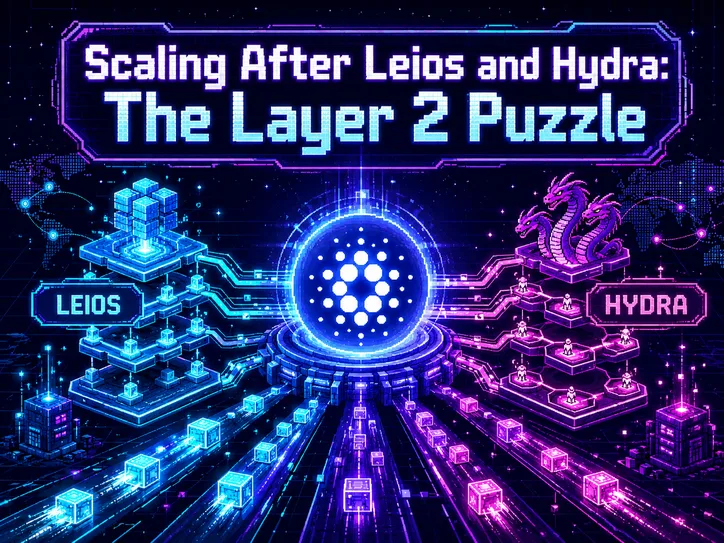
For Cardano to successfully scale, theoretical concepts must translate into practical implementation, enabling ADA to break away from its current price constraint. As we enter 2026, several critical advancements are taking shape.
Ouroboros Leios is a significant Layer 1 upgrade. Input Output presents Leios as the primary pathway for scaling Cardano’s base layer, featuring a revamped consensus model designed to enhance throughput. Mainnet deployment is anticipated in late 2026.
Hydra, a Layer 2 solution based on state channels, operates alongside Cardano. It is not designed to address all scaling concerns but excels in fast interactions among known participants, such as in payments, gaming, and certain DeFi processes where rapid confirmations are essential.
Another pivotal aspect is Midgard, described as a permissionless optimistic rollup. A testnet is due to launch in late 2026. Midgard will allow open applications to run while Hydra serves defined participant groups. With both entities, Cardano’s scaling approach broadens significantly.
In summary, Cardano isn’t depending on a single miraculous scaling solution. It is gradually layering multiple enhancements over time—careful and deliberate, just like Cardano.
Better Liquidity and DeFi Conditions
A major challenge facing Cardano’s DeFi landscape has been a lack of engaging liquidity, often deterring significant players.
This is precisely why the Cardano Foundation’s 2026 initiative to boost liquidity is so relevant. In April 2026, a substantial sum of ADA was allocated to Flowdesk, a Cardano-based decentralized exchange. The initiative aims to deepen market engagement, bolster stablecoin liquidity for USDA and USDM, and minimize slippage.
While these efforts aren’t flashy, they are grounded in practicality. Traders and institutions prioritize functional trading over theoretical models when faced with shallow liquidity or subpar execution. Enhanced liquidity could reshape Cardano DeFi, making it feel more like a legitimate market rather than an isolated sector.
Cardano blockchain data is now also accessible on Dune, providing insights into transactions, staking, smart contracts, governance actions, stablecoins, and DeFi activities. This accessibility grants researchers, developers, investors, and the press a clearer view of network dynamics.
While transparency alone doesn’t equate to growth, its absence complicates the validation of progress.
Cardano Meets AI Payments Through x402
Among notable developments in 2026 for Cardano, its integration with x402 is particularly significant. The x402 standard facilitates payments through AI agents and Web3 applications, providing a framework for machine-based value exchanges.
In April 2026, the Cardano Foundation confirmed the platform’s incorporation into the x402 framework via protocol specifications added to the project’s codebase. Masumi’s smart contract logic also received optional approval, incorporating functionalities related to identity, refunds, disputes, decision logs, and registry operations.
The long-term implications may become clearer over time. While AI-generated payments are still in their infancy and many projects might overstate their prospects, the fundamental idea remains valid: when autonomous software requires value exchange, confirmation of outcomes, choice tracking, or record keeping, low-cost blockchains with reliable accounting could play a key role.
Cardano aims to be among those crucial players.
The challenge for Cardano developers is not a deficiency in technology; it’s the friction they encounter.
Plutus, EUTXO, formal methodologies, Haskell tooling, and Cardano’s inherent design offer power but prove daunting for newcomers. Ethereum managed to capture developer interest partly by allowing quicker builds, even when outcomes were often held together through mere enthusiasm.
By 2026, Cardano’s development strategy emphasizes enhancing the experience for developers. Funding proposals from Input Output include updates to Plutus, automated formal verification, improved tools, performance enhancements, and continuous maintenance.
This focus is essential as Cardano’s promise of high reliability will only resonate if development on the platform doesn’t necessitate an advanced degree to navigate.
If Cardano can streamline the secure development process while maintaining its emphasis on accuracy, it could gain a significant edge. The balance between ease of access and dependability will be pivotal in shaping developers’ perceptions of the platform.
Related: Top 5 Altcoins Whales Are Buying Aggressively in May 2026
Midnight and Partner Chains Extend the Cardano Narrative
Midnight continues to be a critical project associated with Cardano. Established as a privacy-oriented partner chain, it expands the ecosystem beyond the core layer. Rather than functioning directly on the Cardano mainnet, Midnight focuses on confidential smart contracts and secure data applications.
This development signifies an important shift in Cardano’s overarching narrative. Its future does not solely hinge on activities occurring directly on the main chain; partner chains can leverage Cardano’s security, settlement capabilities, and ecosystem partnerships while targeting distinct markets.
This expands Cardano’s reach into areas such as privacy, identity, institutional applications, AI payments, DeFi, and regulated assets.
However, fragmentation remains a concern. If activities disperse widely, ADA holders will seek clear value propositions. While ecosystem growth is desirable, the demand for the token takes precedence.
ADA Shows Signs of Movement?
In simple terms, Cardano appears to be solidifying its fundamentals in 2026. Yet, clear signals of sustained upward price movement for ADA are still absent.
As of May 13, 2026, ADA trades around $0.275, which doesn’t quite inspire triumph. Confidence remains tepid, despite advancements in governance, scaling, liquidity, and application development.
For ADA to experience a meaningful breakout, several criteria must be satisfied:
Leios and Layer 2 initiatives need to deliver credibly. DeFi liquidity must adequately increase to draw substantive engagement. Governance should finance effective projects while avoiding bureaucratic pitfalls. Developers require better tools and more definitive incentives. Visibility into the utility of partner chains and AI payment systems is essential. ADA also needs to experience heightened demand beyond mere staking and speculation.
These conditions are extensive but no longer seem like distant dreams.
The foundational elements of Cardano in 2026 are sturdier than its current pricing indicates. Nevertheless, market value derives from more than just infrastructure; it depends on active users, liquidity, revenue generation, a compelling narrative, and market momentum.
ADA Price Paths Beyond 2025
Bullish Scenario
Positive developments through Leios, Hydra, and Midgard unfold. Governance funding prioritizes valuable infrastructure. Improvements to Plutus tooling emerge. Decentralized exchange liquidity improves. New developers engage through x402 alongside early AI-driven payment applications. Midnight bolsters the narrative surrounding partner chains.
If these components align, ADA might regain recognition as a significant infrastructure asset rather than being perceived as an antiquated Layer 1 solution.
Neutral Scenario
Cardano continues its development trajectory, but user adoption expands at a slow pace. Governance functions are effective, yet implementation may be cumbersome. Scaling efforts progress, but user growth remains stagnant. ADA stabilizes without emerging as a market leader.
This represents the most characteristic outcome one could anticipate from Cardano.
Bearish Scenario
Governance may fragment. Treasury support could fall short. Timelines for Leios or Layer 2 features might lag. DeFi liquidity could struggle to gain depth. Partner chains may fail to generate substantial demand for ADA. Should coordination falter and delays mount, market traction might stagnate.
In such a scenario, Cardano may retain a loyal community but find challenges in convincing broader stakeholders of its value.
Cardano Shows Technical Momentum Ahead of Price Movement
The situation is clear: momentum is building throughout Cardano’s ecosystem, although ADA’s price remains subdued. Infrastructure often develops before market value is recognized.
By 2026, governance structures have strengthened, visibility has improved, scaling initiatives are advancing, institutional access has broadened, and practical integrations are on the rise. Substance is starting to overshadow noise.
Nevertheless, ADA must demonstrate that market demand truly exists.
This validation won’t stem from yet another roadmap visualization but from tangible activity, robust liquidity pools, growing developer interest, effective treasury management, and a recognizable demand for applications built on Cardano.
As we approach 2026, Cardano has the potential to gain relevance beyond its current confines. However, the execution of its plans is crucial. The network cannot continue to appeal solely to its committed base; even they will want enhancements.
FAQ
What are the top Cardano developments in 2026?
The major Cardano advancements in 2026 include enhanced governance through DReps, a structured ecosystem funding mechanism, scaling initiatives via Leios, Hydra’s refinements, Midgard rollup progress, improved DeFi liquidity, integration with Dune analytics, support for x402 payments, and continued expansion of Midnight and partner chains.
Is ADA finally breaking out in 2026?
ADA is displaying stronger fundamental qualities in 2026, yet the price has yet to confirm a significant breakout. Cardano’s foundational systems are becoming more stable, while investor sentiment remains cautiously optimistic.
Why does Cardano governance matter?
Cardano’s governance is crucial as treasury decisions directly impact ecosystem development. Effective governance allows Cardano to finance infrastructure, tools, liquidity, and promotional activities without external oversight. Conversely, failure could result in delays and political strife stalling progress.
What is Leios in Cardano?
Leios is an upcoming Layer 1 scaling upgrade for Cardano intended to boost transaction capacity through an updated consensus model. It is a key technical advancement outlined in Cardano’s 2026 roadmap.
Can Cardano compete with Ethereum and Solana?
Cardano can compete where trust, structure, governance, and verified accuracy are critical. However, it is unlikely to surpass Ethereum or Solana by simply duplicating their rapid-development strategies. Instead, Cardano’s best approach lies in establishing itself as a reliable platform for high-assurance applications.