
This summer, Cardano (ADA) has shown impressive gains compared to many top-tier cryptocurrencies. Following the market slump in June, ADA▲$0.1791 has emerged as one of the leading altcoins, bolstered by a resurgence in investor confidence, an increase in wallet holders, and growing excitement surrounding upcoming network enhancements.
Contents
Reasons for Cardano’s Outperformance This Summer
ADA Shines Among Summer 2026’s Leading Large-Cap Cryptocurrencies
Cardano has captured renewed interest, attributed to its price stability, as investors shift focus back to Layer 1 platforms with robust development activities and ongoing achievement of technical milestones.
Changes Since the Spring Market Correction
While the spring market correction tempered speculative activities, Cardano maintained a steady course as dictated by its roadmap, making significant advances. Key developments such as the Van Rossem upgrade, enhanced interoperability, and strategic corporate partnerships have raised long-term expectations.
Read More: What Is VORF Crypto: Legit Project or Another Hype Memecoin?
The market rally is marked by not only speculation—indicated by growing search interest in Cardano’s upward movement—but also significant governance and ecosystem advancements.
The Return of Smart Money to Cardano
In 2026, institutional-grade infrastructure has become increasingly essential for Cardano. New collaborations, developments in interoperability, and enterprise partnerships render the network increasingly appealing to long-term investors.
A rise in on-chain activity and wallet growth metrics since June provide insight into ADA’s surge while underpinning a more favorable outlook based on fundamental strength rather than ephemeral speculation.
| Metric | Importance for Cardano in Summer 2026 |
| Price Momentum | ADA has outshined several large-cap altcoins during the summer rebound. |
| Network Enhancements | The Van Rossem upgrade, Leios advancements, and improvements in interoperability have fortified investor trust. |
| On-Chain Engagement | Growing wallet numbers and enhancing metrics indicate renewed participation in the ecosystem. |
| Institutional Interest | Corporate partnerships and infrastructure development continue to draw long-term investors. |
| Market Sentiment | This recovery is driven by strong fundamentals rather than mere speculation. |
| Key Risk | The sustainability of momentum hinges on ongoing adoption and the broader state of the crypto market. |
Three Key Drivers of ADA’s Summer Resurgence
Increased On-Chain Activity
Although market speculation and a broader recovery contributed to Cardano’s success, the ecosystem has been active with the testing of Leios, improving interoperability, and advancing the Van Rossem upgrade to bolster scalability and enhance developer experience throughout June.
These advancements have fueled renewed enthusiasm in the crypto space during Cardano’s rally.
Growing Staking Participation
Cardano ranks among the highest in staking rates of major proof-of-stake blockchains, with a substantial portion of circulating ADA allocated to stake pools, showing resilience against shifting market conditions.
This high level of staking engagement lowers the liquid supply accessible on exchanges, marking a crucial factor in the long-term forecast for ADA.
Expansion Beyond DeFi
Cardano’s ecosystem is branching out beyond just DeFi, with growth in enterprise partnerships, educational initiatives, AI-centric infrastructure, and integrations for inter-chain interoperability, such as LayerZero.
Treasury-backed infrastructure initiatives continue to emphasize cross-chain interoperability and institutional adoption, aligning with the long-term growth predictions for Cardano.
Cardano Price Outlook: Is ADA Entering a New Bull Cycle?
Current Price Trends Analysis
The prevailing technical conditions might be viewed as slightly bearish; however, the daily RSI currently sits at 59.8, indicating a neutral market that could trend bullish before hitting overbought levels.
The MACD has turned bullish alongside the 10-, 20-, and 30-day EMA/SMA; on the flip side, the 50-, 100-, and 200-day MA maintain sell signals. The decline hasn’t yet been reversed, suggesting the long-term downtrend is still intact.
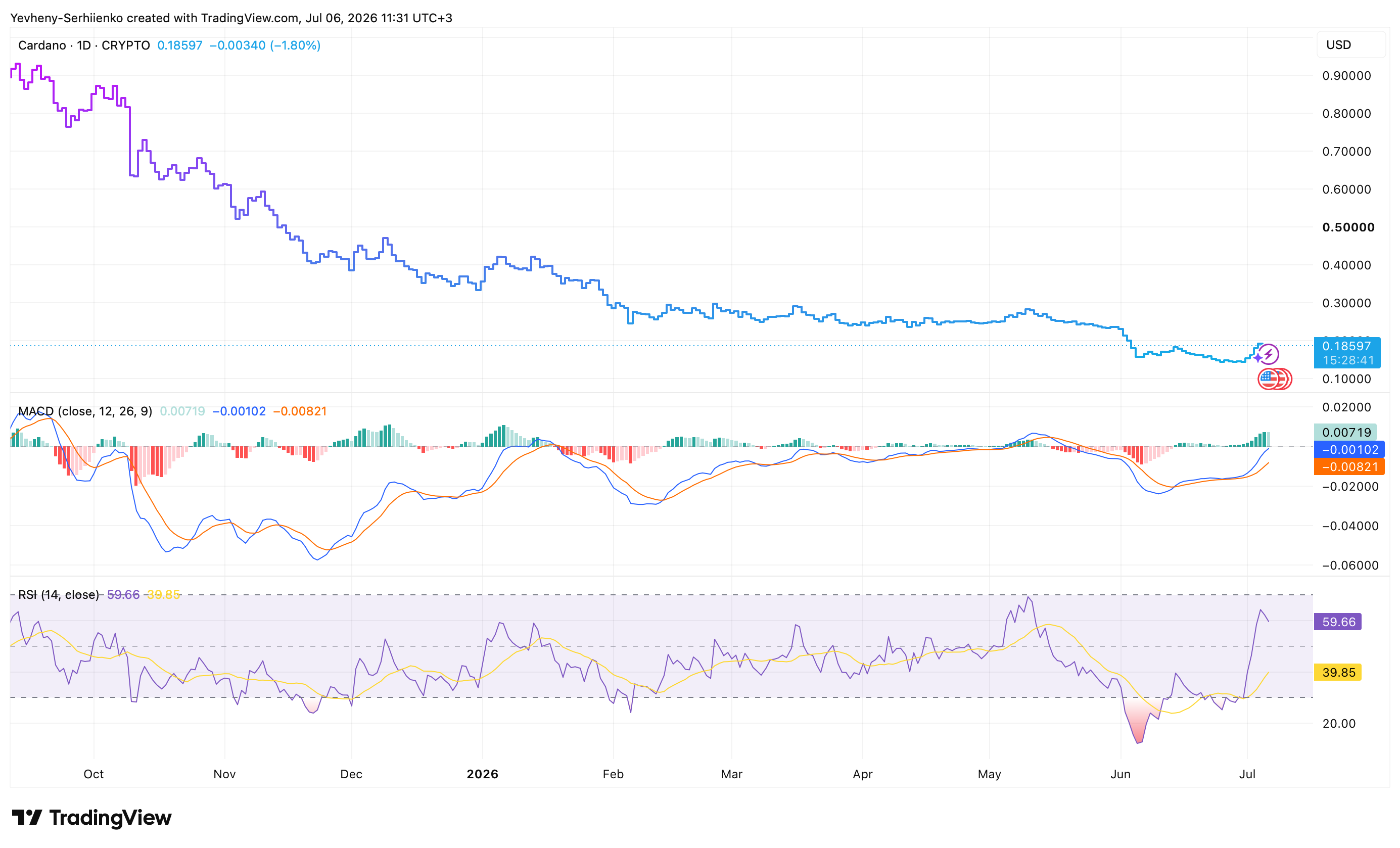
This mixed market structure implies improved short-term prospects for ADA, although it must remain above critical support levels and navigate through significant resistance.
Overall, technical analysis indicates that the market appears to be transitioning from recovery into potential trend reversal rather than signaling a bull market.
The Significance of Breaking Through $1
Psychologically, the $1 mark stands as ADA’s key resistance threshold, prompting speculation on whether Cardano can reach this milestone. A strong breakout above this level could invite renewed interest from both retail and institutional investors.
A successful breakout would add weight to the argument that ADA is in a favorable upward trend; however, continued ecosystem growth, healthy trading volumes, and favorable broader market conditions will be essential for maintaining above the $1 mark.
Can ADA Replicate Its 2021 Surge?
While the last surge was largely fueled by liquidity and retail-driven speculation, this cycle appears increasingly influenced by institutional involvement, ETF inflows, and actual use of the networks.
This does not discount the potential for another strong movement. Bolstered by increasing on-chain activity and a favorable macroeconomic backdrop, bullish sentiment surrounding Cardano’s price in 2026 appears to be growing. Nonetheless, many analysts foresee a new rally progressing at a much slower pace than the dramatic price increases experienced during the previous bull cycle.
Why Cardano Is Considered One of the Most Undervalued Layer-1 Blockchains
Leading Decentralization
Cardano is regarded as one of the most decentralized Layer-1 blockchains, thanks to its on-chain governance model where delegated representatives (DReps) oversee protocol upgrades and treasury expenditures. Recent governance votes have reinforced the idea that decisions are made collectively, rather than by a single figure or organization.
This collective governance enhances Cardano’s appeal to those who value transparency and community-driven projects in the long run.
Exceptional Staking Ratios
Cardano boasts one of the highest delegated staking ratios of any major proof-of-stake network. A significant share of ADA is delegated to thousands of stake pools, thereby enhancing the overall security and decentralization of the network.
Read More: What Is UNNF Crypto? Can the United Nations Nuclear Fund Token Explode 100x or Is It Too Risky?
The staking model continues to represent a crucial element of the network’s fundamentals and is frequently cited in long-term forecasts for Cardano.
Evolving Treasury and Ecosystem Funding
Cardano’s decentralized treasury facilitates development funding via community votes rather than centralized grants. Proposals for development funds will soon be put up for voting by Delegated Representatives (DReps), who will supervise ecosystem expenditures starting in 2026.
This framework supports funding for infrastructure, developer tools, and overall network expansion over the long haul.
A Focused Long-Term Strategy
Ongoing development in Cardano concentrates on peer-reviewed initiatives, with major projects addressing scaling, interoperability, governance, and enterprise applications.
This disciplined approach is a reason why long-term investors maintain a bullish outlook on Cardano despite its short-term price variability.
Cardano vs. Solana vs. Ethereum: Where’s the Greater Potential?
Why Institutions Favor Cardano
In 2026, Cardano’s focus on interoperability and enterprise applications led to additional LayerZero integrations and corporate partnerships with firms like Visa and Circle.
These advancements stimulate institutional interest in Cardano, underscoring its compliance and real-world use-cases for blockchain technology.
Can Cardano Thrive Without the Memecoin Surge?
Unlike Solana, which has largely benefitted from the swift rise of numerous memecoins, Cardano’s commitment to infrastructure development, governance, and enterprise user adoption has paved a slower but steadier growth trajectory that relies less on market speculation.
This raises the important question for investors considering Cardano as a long-term investment—rather than a speculative short-term opportunity.
Which Blockchain Provides the Best Risk-Reward Ratio?
Ethereum stands as the premier smart contract platform, followed by Solana with its remarkable transactions-per-second capacity. Cardano also emphasizes decentralized governance, staking, and a research-informed approach.
For ADA’s long-term success, the evolution of its ecosystem must successfully translate into user adoption and sustained activity on the platform.
| Blockchain | Key Advantages | Main Drawbacks | Ideal For |
| Cardano | Decentralization, staking, governance, research-based progress | Prolonged ecosystem growth | Long-term shareholders and corporations |
| Solana | High throughput, quick transactions, strong retail presence | Reliance on speculative sectors like memecoins | Active traders and high-growth investors |
| Ethereum | Largest developer ecosystem, mature DeFi and tokenization | Elevated transaction fees and scalability issues | Enterprise applications and extensive Web3 opportunities |
What Could Propel ADA to Greater Heights in H2 2026?
ETF Speculation
The anticipation surrounding a potential spot Cardano ETF serves as a significant catalyst for ADA. Grayscale’s pending application for a spot ETF is among several others waiting for approval. Analysts hope that the SEC may reach a decision regarding these applications in the latter half of 2026, although no ETF has yet been greenlit.
Approval of a spot ETF could lead to enhanced institutional buying capacity, substantially impacting ADA’s price predictions for 2026. However, SEC discretion remains a critical factor.
Bitcoin’s Upcoming Bull Movement
Typically, a fresh altcoin cycle is sparked after extended Bitcoin rallies. Thus, an upward price trend for BTC▲$62,630.00 in the latter half of 2026 might redirect liquidity back toward large-cap Layer-1 currencies like Cardano.
If this scenario unfolds, inquiries about whether ADA will rise or whether Cardano will experience price increases will likely focus on Bitcoin’s performance alongside Cardano’s continued network growth.
Growth in Stablecoin Liquidity
Stablecoin liquidity has become a useful barometer for on-chain activity. Cardano’s governance has approved initiatives to enhance the blockchain’s performance regarding stablecoin activities and cross-chain liquidity, thereby fostering a broader on-chain economy.
An upsurge in stablecoin adoption could escalate the utility of dApps and positively influence the Cardano forecast, provided transaction volumes continue to rise.
Innovations Funded by Treasury
Cardano’s decentralized treasury will continue to finance infrastructure, developer resources, governance, and other ecosystem projects through proposals that have received community approval, regardless of immediate market conditions.
Whale Accumulation Trends
Another essential opportunity traders often consider during a recovery is the accumulation by large holders. This can deplete the circulating supply of ADA and possibly increase the overall price target, particularly when combined with heightened trading volume and consistently rising on-chain activity.
Factors That Could Halt Cardano’s Summer Rally
Declining User Growth
Even though the creation of new wallets and network activity have surged during Cardano’s rebound, a halt in developments or the emergence of competing networks may negatively sway investment sentiment.
Continued user adoption is crucial; a downturn could jeopardize the current Cardano rally, even amidst favorable broader cryptocurrency sentiments.
Falling Total Value Locked (TVL)
Despite the influx of liquidity from stablecoin deposits and the TVL metric, TVL is still a closely monitored indicator in the DeFi ecosystem. A drop in TVL could signal diminished usage of DApps and an overall decrease in network capital efficiency.
Read Also: What Is Keeta Crypto? Why Some Investors Believe It Could Be the Next Big Blockchain Breakthrough
A significant decline in TVL would likely negatively impact longer-term expectations for Cardano, especially as alternative Layer-1 networks vie for the same liquidity pool.
Continued Competition from Solana
Solana, one of Cardano’s major competitors, possesses a vibrant developer ecosystem, high throughput capacity, and a substantial consumer base. If Solana attracts more users, developers, and institutions faster than Cardano, it could hinder Cardano’s growth potential.
A Broader Cryptocurrency Market Downturn
Broader market risks might eclipse any fundamental advantages that ADA could possess. Large-cap altcoins have historically shown strong correlations with Bitcoin, making them sensitive to macroeconomic factors and overall market trends.
A significant downturn in the crypto market may delay any potential ADA breakout, notwithstanding advancements in Cardano’s technology and ecosystem.
ADA Price Forecast for Late 2026
Bearish Scenario
If macroeconomic conditions worsen and Bitcoin loses momentum alongside declining ecosystem metrics for Cardano, ADA could revisit the $0.14-$0.17 range by year-end, particularly in the absence of any ETF-related catalysts.
In such instances, the lowered ADA price predictions stem from broader market weakness, rather than project-specific issues.
Base Scenario
In a base case, if the ecosystem continues to grow, and more participants engage in staking while the broader crypto landscape stabilizes, projections suggest that ADA may trade within the $0.22-$0.30 range by year’s end should adoption and liquidity persist.
This scenario represents a conservatively optimistic view, with long-term ADA forecasts for 2027 appearing even brighter if institutional demand and network adoption continue to build.
Optimistic Scenario
For ADA to experience a notable price surge, multiple favorable conditions must align, including a bullish environment in the cryptocurrency market, successful network enhancements, increasing institutional interest, and the approval of ETFs.
Analysts have pointed toward a price target of between $0.45 and $0.65 as reasonable. However, a movement toward $1 would necessitate significant market activation.
In this context, a bullish ADA price projection would hinge on sustained adoption rather than transient increases.
| Scenario | Projected ADA Price | Primary Drivers |
| Bearish Scenario | $0.14–$0.17 | Weak macro conditions, reduced liquidity, delayed ETF approvals |
| Base Scenario | $0.22–$0.30 | Steady ecosystem advancement, rising staker involvement, gradual market recovery |
| Optimistic Scenario | $0.45–$0.65 | Strong crypto bull market, institutional inflows, successful town upgrades, and ETF catalysts |
Can Cardano Achieve $2 Before 2026 Concludes?
Market Capitalization Requirements
Assuming a circulating supply between 35 and 37 billion ADA, reaching $2 per coin would place Cardano’s market capitalization at $70-$74 billion, positioning it among the top cryptocurrencies. However, attaining this price would necessitate a substantial gain in market share.
Some analysts propose that this price target is feasible in a robust bull market, but only if valuations rise to levels not witnessed since before the latest bull cycle.
Required Capital Inflows
To achieve a market cap exceeding $70 billion, price will need to rise significantly, but market capitalization does not equate to actual inflows into the currency. A cryptocurrency’s price tends to rise disproportionately when liquidity on exchanges is lower. Cardano has the highest rate of staked participation.
Continued institutional engagement or the launch of a spot ETF, along with consistent ecosystem advancements, may serve as crucial elements determining whether the question of Cardano achieving $2 becomes a reality.
Is a $2 ADA Price Attainable This Cycle?
Most forecasts do not identify $2 as a probable outcome for 2026, with many predictions falling short of this level. In the most ambitious scenarios, a strong multi-year expansion may continue through 2028 and 2030.
While not outside the realm of possibility, achieving this price target would likely necessitate a favorable alignment of macroeconomic factors, ongoing network adoption, approval of a long-awaited ETF, and renewed investor enthusiasm for large-cap altcoins to elevate “Can ADA reach $2 in 2026” from an optimistic scenario to a credible possibility.
| Metric | Estimate |
| Target Price | $2.00 |
| Estimated Market Cap | ~$70–74 billion |
| Circulating Supply | ~35–37 billion ADA |
| Key Catalysts Required | Spot ETF approval, institutional demand, continuous network growth, strong Bitcoin cycles |
| 2026 Feasibility | Low (more optimistic scenario than market consensus) |
Is a Breakout on the Horizon for Cardano, or Is This Just Another Bull Trap?
Indicators of a Sustainable Breakout
For ADA to sustain a breakout, analysts will look for evidence of increased trading volumes, a rise in wallet addresses, and the successful launch of pivotal upgrades such as Van Rossem and Ouroboros Leios.
These developments would signify a true breakout for Cardano instead of a fleeting surge influenced by market sentiment.
Insights from Volume and On-Chain Data
However, current on-chain data presents a mixed picture: nearly 15,000 new non-empty wallets have emerged since late June, and whale accumulation is ongoing, fostering rebounding confidence among investors. Conversely, network engagement and DeFi transaction volumes remain stagnant, particularly post-Leios launch.
Therefore, ADA must consistently boost transaction volumes and on-chain activity in line with recent technical analysis to confirm a turning point following the recent uptrend in sentiment.
How This Surge Differs From Previous Recoveries
This current recovery for Cardano is occurring in a distinct context compared to past speculative bubbles, driven by genuine advancements in technology, such as the Van Rossem upgrade, the testing of the Ouroboros Leios protocol, and institutional initiatives incorporating stablecoins and ETF eligibility.
Read Also: Why Is America 250 Coin Going Viral? Legit Crypto Trend or Just Hype?
These factors do not guarantee higher valuations but establish a different tone for the current Cardano rally, making it less reliant on broader market movements.
Is Cardano a Solid Investment Option in 2026?
Is ADA Undervalued?
With ADA trading more than 94% lower than its all-time peak in 2021, some analysts suggest that the value of Cardano may not accurately reflect its staking environment, decentralized governance model, or incremental scalability improvements.
A scarcity of activity within the decentralized finance (DeFi) sector and slow growth within the Cardano ecosystem have been noted as contributing factors.
Ultimately, whether ADA is undervalued could clarify why it exhibits price increases alongside stronger adoption catching up to the project’s technical progression.
Should You Consider Buying Cardano After the Summer Rally?
The recent upward trend has been fueled by renewed enthusiasm regarding the Leios scaling enhancement, an influx of interest in altcoins, and shifting technical momentum. Despite this, ADA remains below significant long-term resistance, prompting investors to carefully evaluate the prospects of recovery against the risks of a potential downturn.
Regarding whether Cardano is a wise investment, only time will reveal the answer. Crypto markets are likely to remain volatile in the short term, but the investment premise has always been based on adoption and timely protocol upgrades.
Will ADA Experience a New All-Time High?
Returning to near its previous record of $3.10 would demand a dramatic rise in both market capitalization and adoption, fueling continued inquiries about whether Cardano can achieve $3. Most forecasts do not estimate this milestone for 2026.
Hence, while several analysts maintain a bullish outlook on ADA’s long-term forecast, a new all-time high is not supported as a base scenario for the near term.
Long-Term Perspective for Cardano Investors
Cardano continues to stay committed to a research-first approach, focusing on governance, scalability, and building partnerships. It avoids rapid ecosystem expansion, as it gears up for vital milestones like the Van Rossem hard fork and Ouroboros Leios, which could significantly influence its usage rate moving forward.
The Cardano price prediction for 2030 will less hinge on short-term market fluctuations and more on the successful translation of these technical upgrades into wider user and developer adoption.
FAQ
What sets Cardano apart from other Layer-1 blockchains?
Cardano employs a research-focused development strategy where key protocol upgrades are peer-reviewed prior to implementation. Additionally, it utilizes a proof-of-stake consensus mechanism, on-chain governance, and a treasury governed by the community.
How does ADA staking function?
ADA holders can delegate their tokens to stake pools without locking or relinquishing control over their coins, allowing them to earn rewards while contributing to network security.
What is the maximum token supply of Cardano?
The maximum supply of ADA is established at 45 billion, with approximately 37 billion currently in circulation, representing a significant aspect of the network’s long-term tokenomics.
What key priorities does Cardano have for 2026?
The network is prioritizing scalable solutions like Ouroboros Leios, ensuring interoperability, enhancing governance, and developing use cases for enterprises in an effort to bolster the network’s long-term utility.
What are the primary risks associated with investing in Cardano?
Risks related to the Cardano platform encompass competition from alternative smart contract networks, a slower-than-anticipated growth of its ecosystem, regulatory challenges, and broader downturns in the cryptocurrency market.