

Key Points to Remember
- AI trading assistants, utilizing the capabilities of ChatGPT, are automating trading operations through simple language commands and connected APIs, resulting in faster and more consistent actions.
- Successful implementations typically involve ChatGPT functioning as a supplementary resource rather than a completely independent trading mechanism.
- Problems arise when traders rely too heavily on ChatGPT without integrating real-time data, practicing effective risk control, or providing human supervision.
- The regulatory landscape is increasingly focused on the use of AI in trading, with the development of new rules to guarantee transparency, responsibility, and adherence to legal standards.
Imagine a cryptocurrency trader free from constant chart monitoring, emotional impulses, or sleepless nights tracking market fluctuations. Suppose these tasks could be managed by an intelligent system that understands instructions in everyday language and reacts instantly. That’s the potential of AI-driven trading agents powered by ChatGPT.
These innovative tools combine natural language understanding with live trading data to automate decisions in the notoriously unpredictable cryptocurrency market. ChatGPT is being adapted to serve as a trading assistant, risk manager, and market analyst, all in one, from rebalancing investment portfolios to responding to market sentiment.
But can these AI assistants truly rival or even surpass human trading skills? This article explores the progress of these agents, highlighting their strengths and limitations.
How AI Agents Using ChatGPT Function in Crypto Markets
AI agents driven by ChatGPT are reshaping the way individuals interact with the digital currency landscape. These platforms link ChatGPT’s language processing skills with external trading platforms and APIs, assisting users in tracking prices, analyzing trends, and even executing trades automatically. Rather than merely reacting to charts or statistics, ChatGPT can decipher straightforward instructions like “Purchase Ethereum if its price dips below $2,000” or “Sell Bitcoin if the Relative Strength Index (RSI) surpasses 70.”
These AI trading assistants can integrate with prominent platforms such as Coinbase, Kraken, OKX, and various centralized and decentralized exchanges. They can also access decentralized finance (DeFi) tools and smart contracts. With the correct setup, ChatGPT can help streamline trading strategies based on both technical information and breaking news in the market.
Successes and Failures in ChatGPT-Enabled Crypto Trading
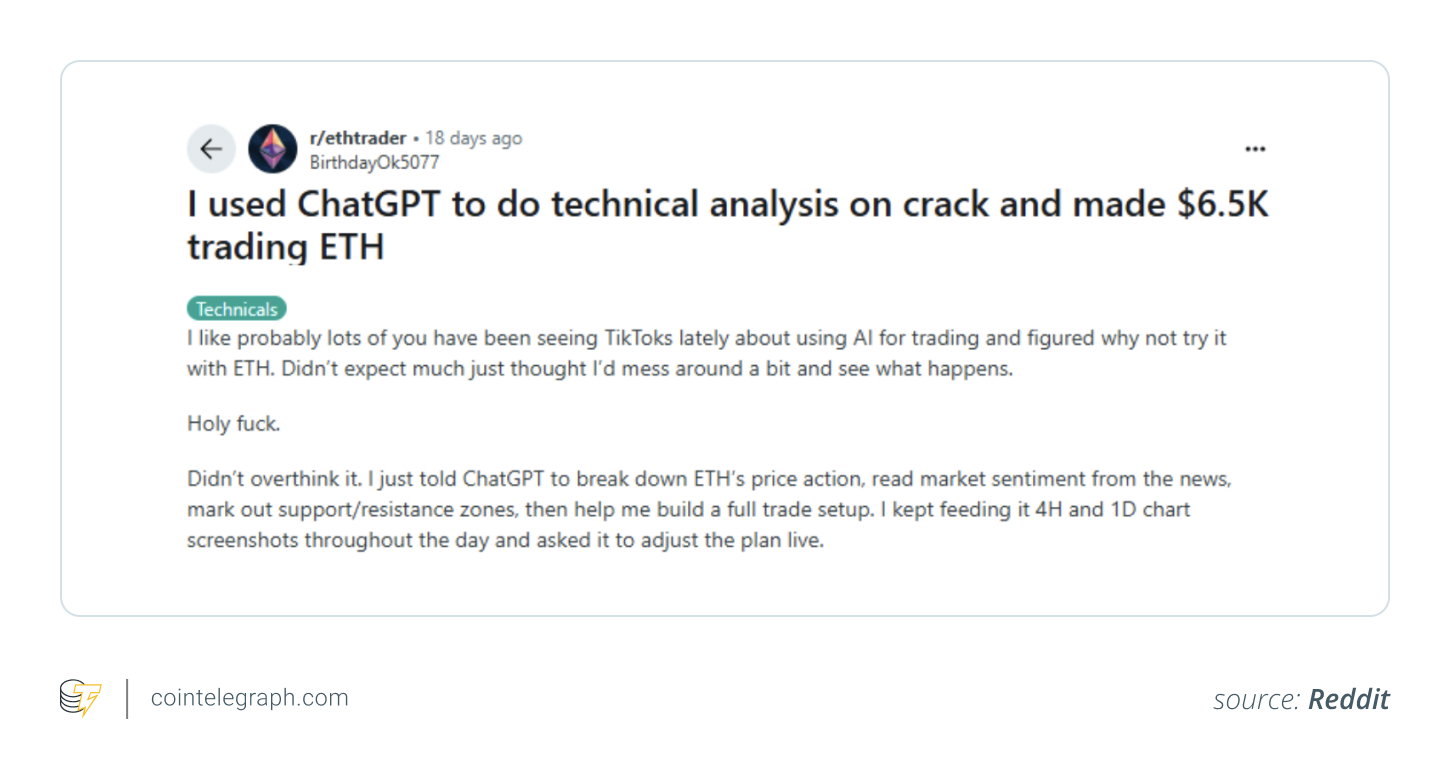
Some traders have reported success using ChatGPT to aid in automating portions of their crypto trading activities, particularly in strategy creation and sentiment analysis. For instance, a Reddit user shared that they utilized a ChatGPT-based AI agent to conduct technical analysis on Ether (ETH), providing it with four-hour and daily chart images. By interpreting market mood, assessing support and resistance levels, and analyzing other indicators, they achieved profits exceeding $6,500.
In a broader application, ChatGPT has aided project development, such as drafting documentation and producing marketing materials. A prime example is the “TURBO” memecoin, which reportedly attained a market capitalization surpassing $50 million in 2024. Here, ChatGPT facilitated documentation and communication rather than direct trading, demonstrating its utility as a support tool in crypto-related ventures.
However, limitations become obvious when ChatGPT is stretched beyond its intended scope. Although it can propose a trading portfolio and rationalize its choices, it lacks real-time market data and can’t respond effectively to sudden market shifts. In one scenario, ChatGPT was allocated $100 across several tokens but failed to dynamically manage the portfolio as prices changed. This led to lost chances and weaker performance when compared to dynamic, algorithm-driven strategies.
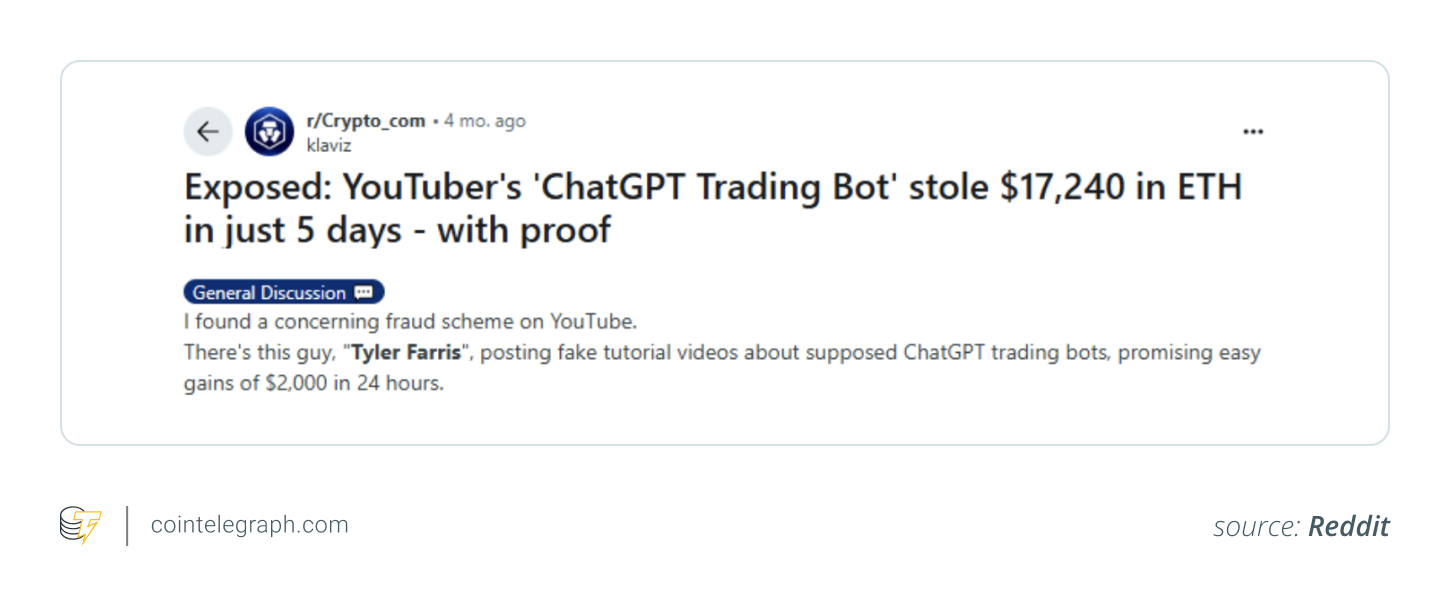
Personal accounts reinforce these observations. A Redditor uncovered a scam involving a YouTuber promoting a “ChatGPT trading bot” tutorial, which directed users to install harmful smart contracts. These contracts, created using ChatGPT and presented as secure, were actually designed to empty users’ digital wallets upon funding. Victims collectively lost $17,240 in ETH, illustrating the risks of blindly trusting AI-generated code without thorough verification.
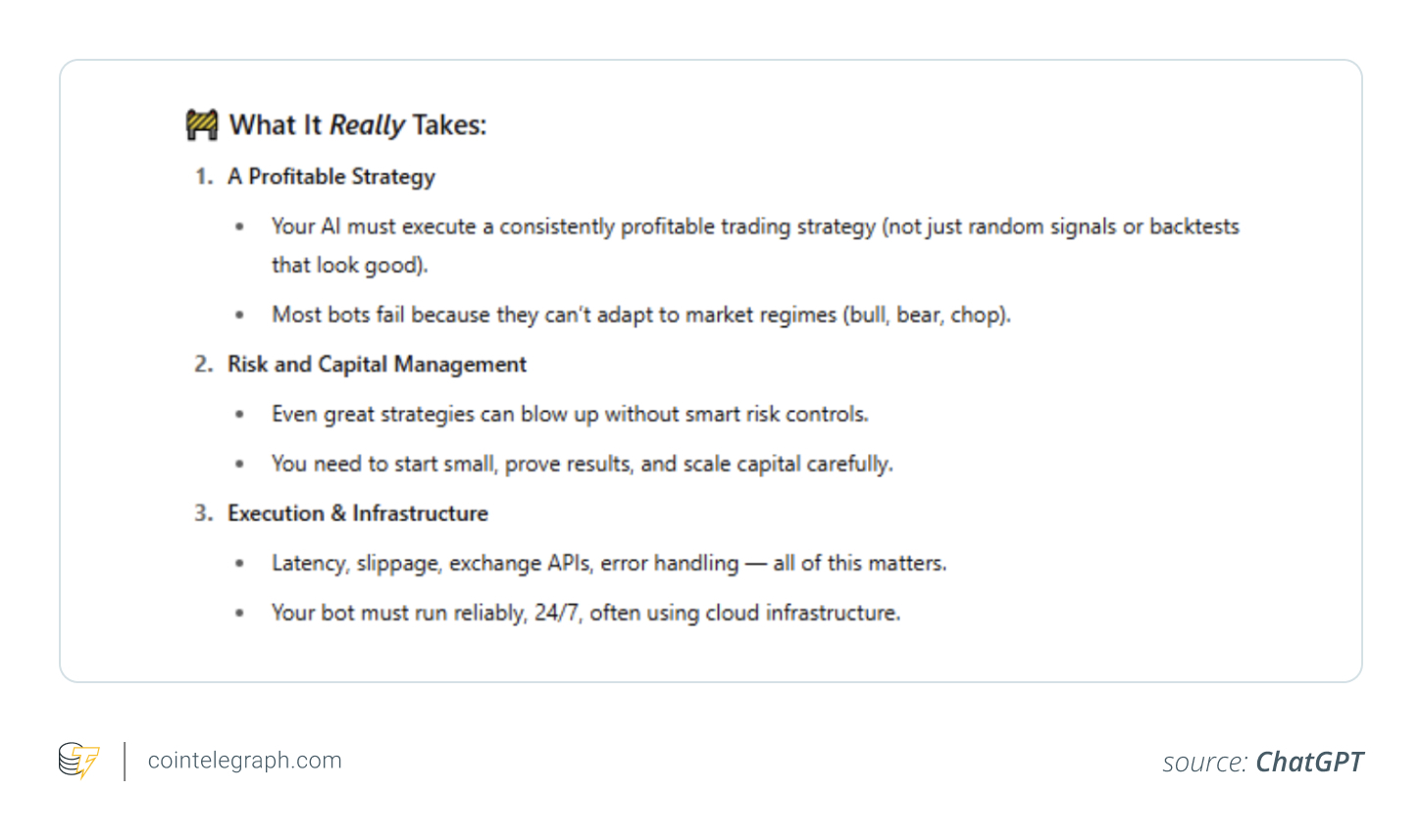
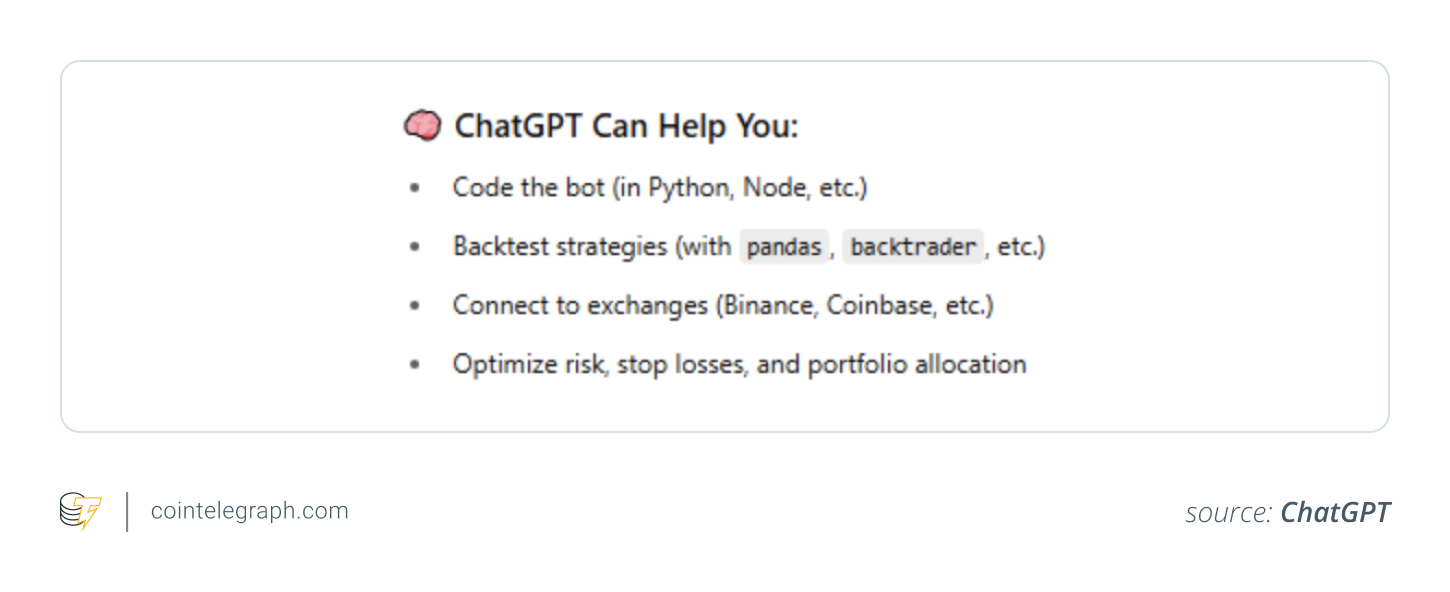
When asked directly, “If I use ChatGPT to build an AI agent for crypto trading, can I become a millionaire?”, ChatGPT offered a realistic response, acknowledging that while possible, success depends on a profitable strategy, sound risk management, and the capacity to scale operations effectively.
Here is ChatGPT’s response:
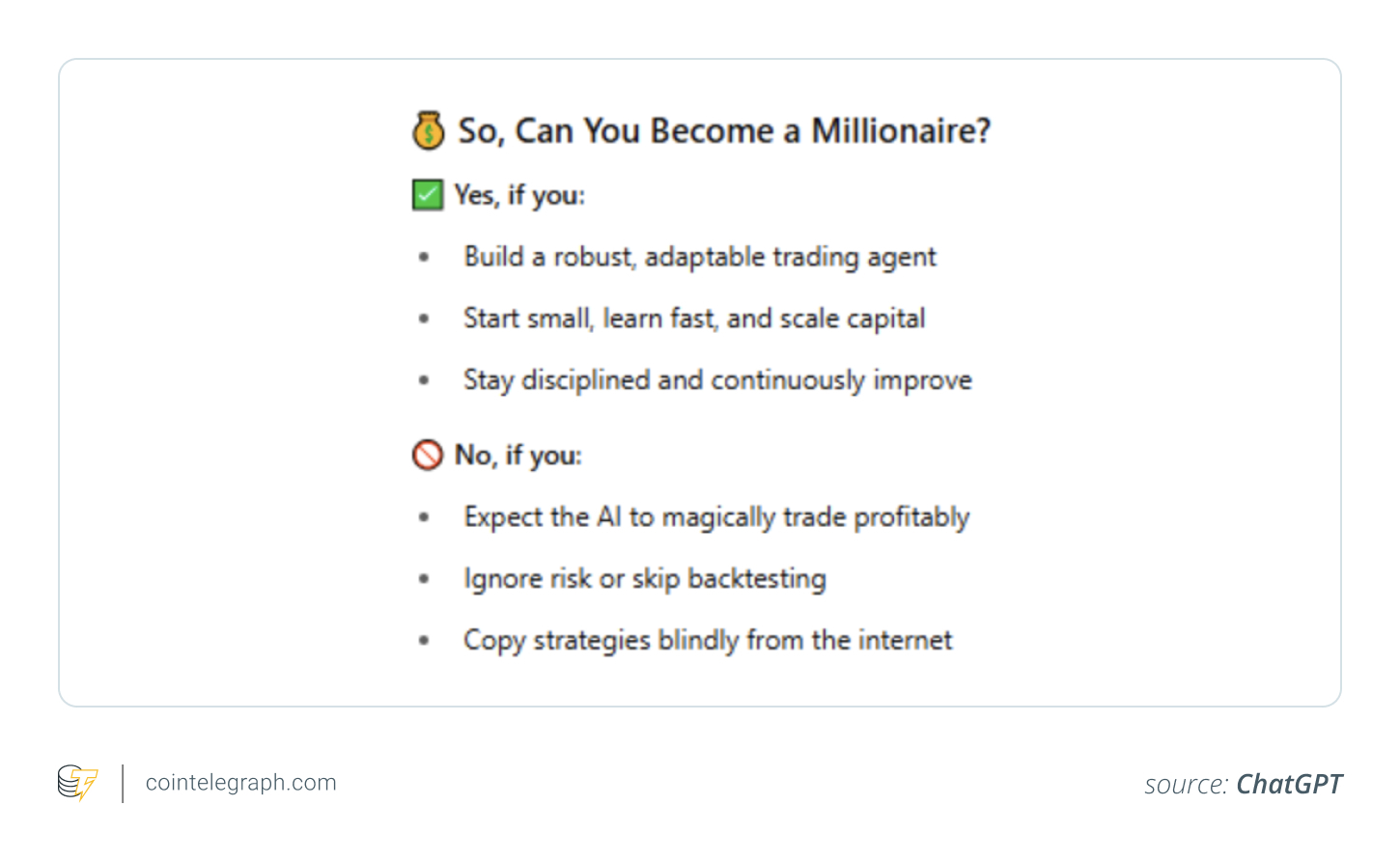
These instances indicate that while ChatGPT can support certain aspects of trading, it should not be viewed as a complete, independent solution for automated cryptocurrency trading.
AI in Crypto Trading: Core Strengths and Weaknesses
AI-powered tools, such as ChatGPT, are increasingly being integrated into crypto trading workflows to enhance speed, precision, and overall efficiency. While they offer significant advantages, they also present limitations that traders must proactively manage. Below is a summary of the key benefits and challenges:
Major Advantages of Using AI for Crypto Trading
- AI bots can execute trades in mere milliseconds, a crucial advantage for seizing opportunities in rapidly changing crypto markets.
- Bots adhere strictly to pre-programmed rules, eliminating emotional biases that often cloud human judgment.
- Crypto markets operate continuously, and AI bots can monitor and react 24/7 without pause.
- A single bot can manage multiple trading pairs, exchanges, and strategies simultaneously, offering significant scalability.
- ChatGPT can interpret specific commands like “Rebalance every Monday” or “Set stop-loss at 5%,” enabling flexible automation.
Limitations of ChatGPT in Cryptocurrency Trading
- ChatGPT does not access real-time market data unless integrated with external APIs (e.g., TradingView, CoinMarketCap, or exchange websockets).
- Instructions must be clear and unambiguous; ChatGPT can misinterpret vague or complex commands.
- Insecure API keys or the absence of two-factor authentication (2FA) can expose trading accounts to unauthorized access.
- ChatGPT’s cloud-based infrastructure may introduce latency, which could impair performance during periods of high volatility.
- ChatGPT does not monitor regional compliance requirements; users must manually enforce trading restrictions based on local laws.
Ethical and Legal Considerations of AI in Crypto Trading
As AI becomes more deeply embedded in trading systems, it raises significant ethical and legal questions that participants across the financial sector are starting to address.
- Accountability: If an AI agent executes a detrimental or illegal trade, questions arise concerning legal responsibility. The liability, in many jurisdictions, remains unclear: Is it the developer, the trader using the AI, or the platform hosting the transaction?
- Market Manipulation Risks: Autonomous AI bots could unintentionally engage in activities like spoofing (placing and canceling orders to mislead the market) or wash trading (creating artificial volume), especially if not programmed without appropriate compliance measures.
- Regulatory Oversight: Financial regulators, including the US Securities and Exchange Commission and the European Securities and Markets Authority, are actively examining the implications of AI and algorithmic trading. These bodies recognize that traditional trading regulations might not fully cover autonomous decision-making by AI systems.
- Policy Developments: In January 2024, the European Commission updated its Digital Finance Strategy, including references to AI-based financial services. While not yet finalized, these draft regulations, under the broader Digital Finance Package, indicate a push toward stricter compliance expectations for companies deploying AI in financial markets.
Meanwhile, ethically conscious crypto platforms are starting to voluntarily disclose their use of trading bots. Simultaneously, open-source communities advocate for clearer audit trails, enhanced model transparency, and the establishment of ethical standards for AI applications in finance to ensure accountability and fairness.
This article should not be interpreted as investment advice or recommendations. All investment and trading activities involve risks, and readers should conduct their own due diligence before making any decisions.