

Circle, the U.S.-based firm behind the USDC stablecoin and a publicly listed entity, has revealed plans to introduce a layer-1 (L1) blockchain compatible with the Ethereum Virtual Machine (EVM) before the year concludes.
The announcement accompanied the release of their second-quarter financial results on Tuesday. The company also unveiled “Arc,” a novel network framework designed to provide a robust, “enterprise-grade foundation” for stablecoin-based transactions, foreign exchange dealings, and applications within capital markets.
Circle’s Arc, expected to initially launch as a public testnet, will utilize USDC (USDC) as its primary gas token. This will allow users to cover transaction fees directly with the stablecoin.
Concurrently with the Arc introduction, Circle reported a substantial 53% increase in year-over-year revenue and reserve income for Q2, reaching a total of $658 million.
“Comprehensive Platform for the Digital Financial Ecosystem”
According to Circle, the forthcoming Arc blockchain is “specifically engineered for stablecoin-driven financial activities,” representing a key advancement toward the company’s overarching goal of establishing a “comprehensive platform for the digital financial ecosystem.”
Beyond utilizing USDC as the native gas currency, Arc will offer an integrated engine for stablecoin foreign exchange, ultra-fast (sub-second) transaction settlement finality, and optional privacy features, as highlighted in the official statement:
“Arc will be seamlessly integrated across Circle’s platform and service offerings, while maintaining complete availability and interoperability with the numerous other blockchain networks supported by Circle.”
As of this writing, USDC boasts a market capitalization of $65.6 billion, operating across a total of 24 different networks.
Currently, Ethereum is the dominant network for USDC, hosting a total USDC supply of $42.6 billion, according to data provided by Circle.
Net Loss of $482 Million Due to IPO Costs
In their report on quarterly financial results, Circle revealed a net loss of $482 million for Q2 – a significant 93% increase compared to the approximate $33 million loss reported in Q4 2024.
The company clarified that the Q2 net loss was substantially affected by expenses related to Circle’s initial public offering (IPO), citing $591 million in non-cash charges associated with the IPO.
Specifically, these charges included $424 million related to stock-based compensation tied to vesting conditions and an additional $167 million increase in the fair value of convertible debt, attributed to the appreciation of Circle’s (CRCL) stock price.
Related: Yield-bearing stablecoin supply surges after GENIUS Act
Following a successful IPO that raised $1.05 billion, Circle began public trading on the New York Stock Exchange on June 5, priced at $69 per share.
The stock price experienced a rapid increase soon after its listing, peaking at an all-time high of $292.8 on June 23, according to TradingView data.
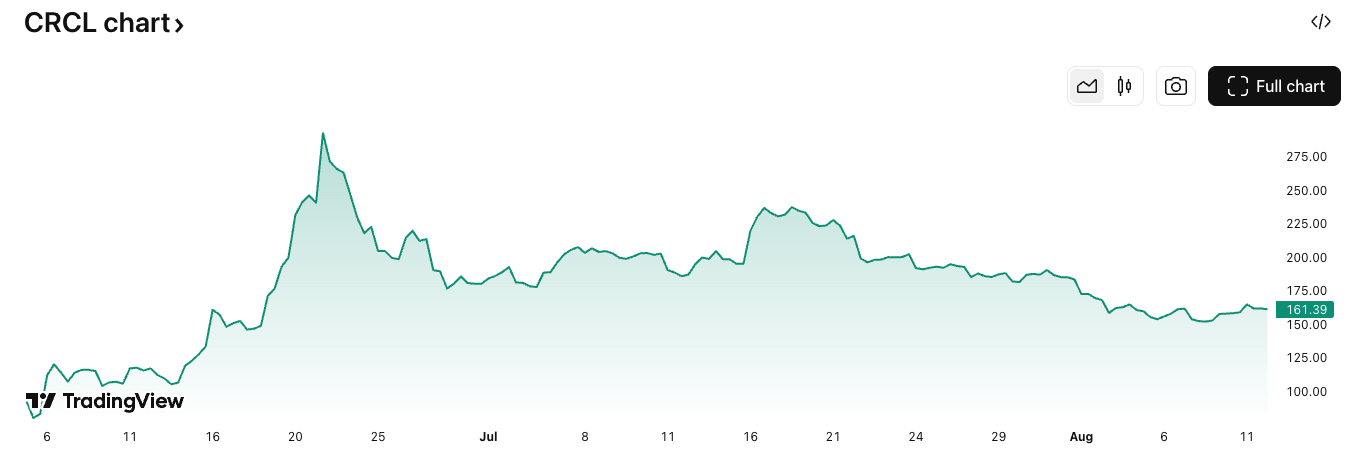
Since then, the stock has seen a decline, closing at $161.2 on Monday, representing a drop of over 21% in the past 30 days.
Growing Trend: Blockchain Adoption in Crypto and Traditional Finance
Circle’s announcement of Arc underscores the increasing trend of major crypto companies and traditional financial institutions launching new blockchain networks.
On Monday, Fortune reported that fintech giant Stripe is developing a blockchain network called Tempo, partnering with crypto venture capital firm Paradigm.
In late June, the crypto-friendly trading platform Robinhood officially announced the launch of a layer-2 (L2) blockchain, with a focus on asset tokenization.
Earlier, in mid-June, global e-commerce platform Shopify provided early access to USDC stablecoin payments on Coinbase’s L2 network, Base.
Magazine: How Ethereum treasury companies could spark ‘DeFi Summer 2.0’