

With a major legal struggle behind them, the U.S. Securities and Exchange Commission (SEC) is reportedly turning its attention towards establishing a well-defined regulatory environment for cryptocurrencies.
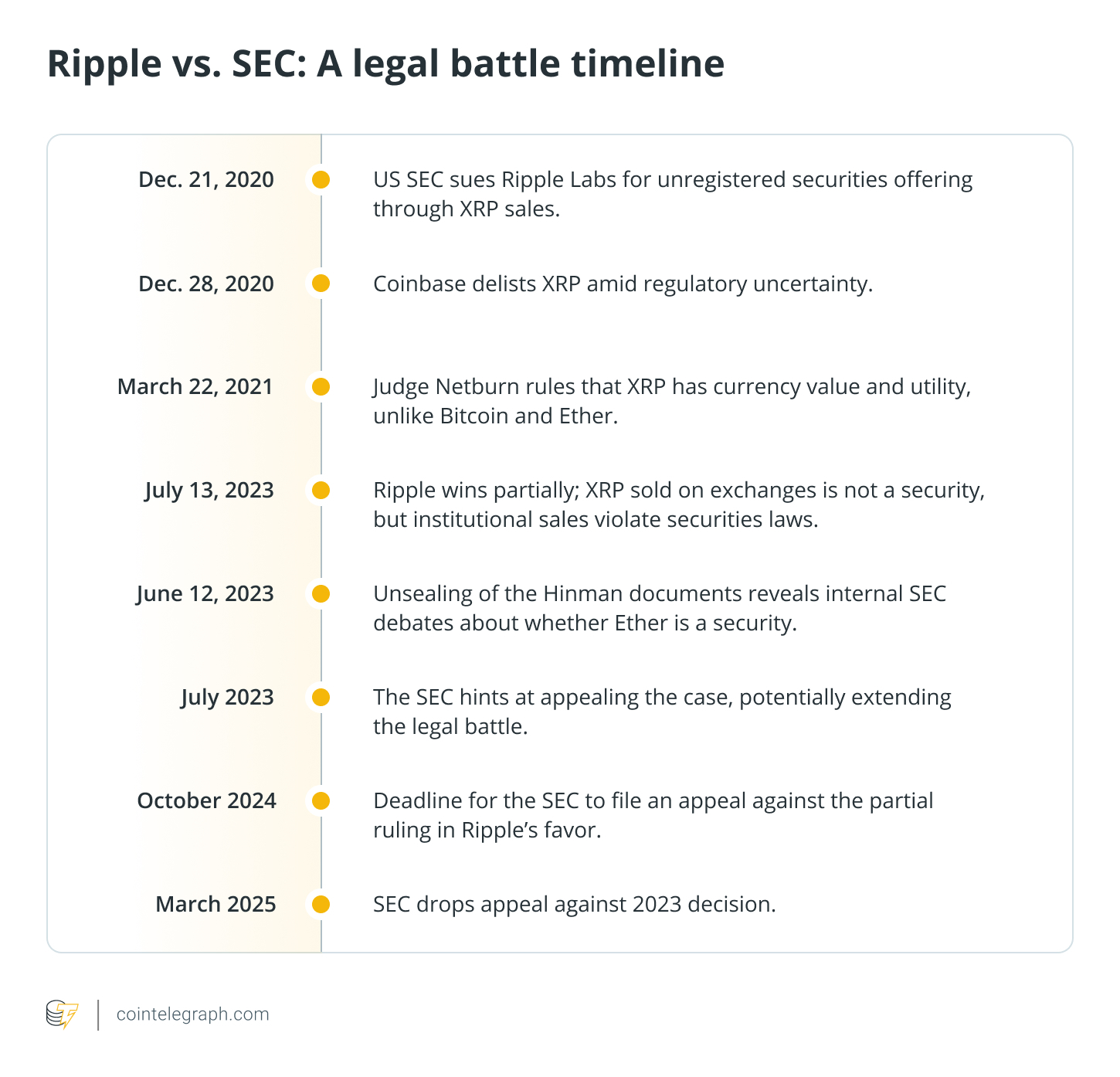
The SEC and Ripple Labs recently concluded their nearly half-decade-long legal battle. Court documents revealed that both parties requested to drop their appeals and agreed to cover their respective legal expenses, according to a court filing.
SEC Commissioner Hester Peirce commented on the resolution, describing it as a “positive step.” She stated in a recent social media post that it allows resources to be redirected from litigation to constructing a clear crypto regulatory framework.
Echoing Peirce’s sentiment, SEC Chair Paul Atkins responded that the agency can now shift its focus. “With this matter resolved, we can now dedicate our efforts from legal proceedings towards crafting policy,” Atkins stated. He emphasized the importance of “building a solid regulatory framework that supports innovation while safeguarding investors.”
Read More: XRP Value Surges as Ripple Case Nears Potential SEC Closure
The SEC initially filed suit against Ripple in December of 2020, alleging that the company raised $1.3 billion through the unauthorized sale of XRP as securities. In July 2023, Judge Analisa Torres determined that XRP was not a security when sold to retail investors but classified it as such in sales to institutional investors. In August 2024, Ripple was subsequently penalized with a $125 million fine.
The resolution of the case coincides with legislative advancements concerning the Digital Asset Market Clarity Act, also known as the CLARITY Act. This proposed law seeks to establish a structured framework for digital asset markets.
Also See: Expert Analysis: White House Crypto Guidelines Offer SEC-CFTC Clarity for US Businesses
CLARITY Act Faces Hurdles
Republican lawmakers and members of the Senate Banking Committee are aiming to finalize the bill by the end of September, despite growing opposition from Democratic legislators.
Earlier this year, key Democratic representatives announced a unified front to resist what they term as “risky” crypto legislation proposed by Republicans, highlighting the widening political chasm on the issue.
House Financial Services Committee ranking member Maxine Waters criticized Republican efforts to “accelerate a problematic package of crypto measures through Congress,” specifically mentioning the CLARITY Act and the Anti-CBDC Surveillance State Act, which aims to prevent the introduction of a U.S. central bank digital currency.
Deep Dive: SEC’s Evolving Stance on Crypto Raises Unanswered Questions