
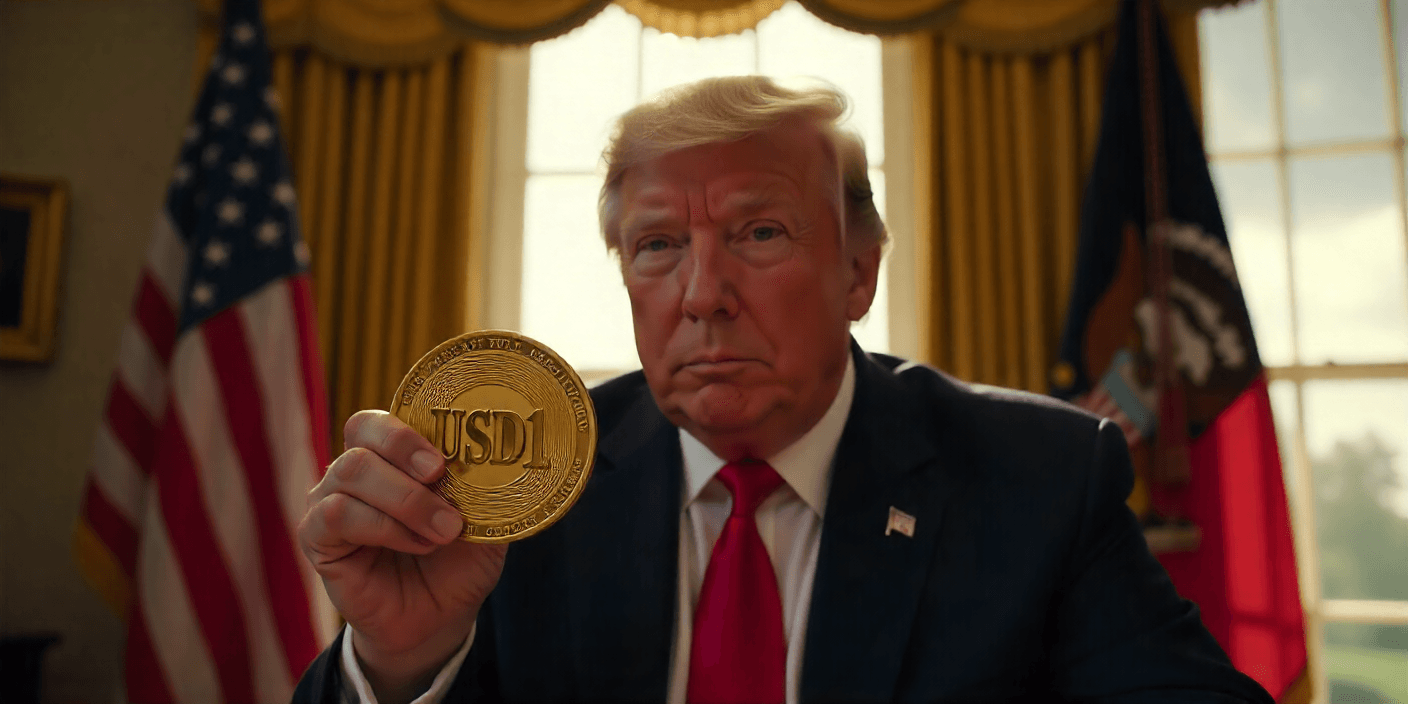
Major cryptocurrency platform Coinbase is considering listing World Liberty Financial’s
USD1 stablecoin. This move suggests the token, which has backing linked to former President Trump, could soon be available on one of the world’s most prominent digital currency exchanges. With over $2.4 billion already in circulation and substantial financial support from Abu Dhabi’s MGX, not to mention public endorsements from Donald Trump and his sons, USD1 aims to be more than just another stablecoin. A key consideration now is whether these political connections and its rapid expansion can transform it into a serious competitor to established stablecoins like USDT and USDC, or if it’s destined to remain a politically charged experiment.
Why Coinbase’s Consideration of USD1 is Significant
Coinbase has formally announced that USD1, the stablecoin created by World Liberty Financial, is under evaluation for potential listing. While this doesn’t guarantee immediate availability, it demonstrates a strong level of interest.
The exchange typically only advances tokens to this stage when they believe sufficient user demand, technical compatibility, and adequate liquidity are achievable. If USD1 is eventually listed, it stands to gain substantial credibility and increased accessibility to retail investors, which could significantly accelerate its adoption.
This is especially noteworthy because USD1 is not just a typical stablecoin. Its public association with Donald Trump and his family places it at the intersection of political influence, financial markets, and digital currencies.
USD1’s Growth Trajectory: Genuine Progress or Overblown Claims?
World Liberty Financial has aggressively promoted USD1 as “the fastest-growing stablecoin,” and there’s evidence to support this claim. In the past week alone, $205 million worth of new USD1 tokens were created for the WLFI Treasury, bringing the total supply to $2.4 billion.
A major catalyst for this growth has been Abu Dhabi’s MGX, which reportedly utilized USD1 in a $2 billion transaction with Binance. This highlights USD1’s existing use in substantial financial operations, providing it with greater legitimacy compared to many new stablecoins that primarily rely on marketing efforts.
Stablecoin Market: A Multi-Trillion Dollar Potential
Recent forecasts from Goldman Sachs indicate that the stablecoin market has the potential to expand into the trillions of dollars. While Tether (USDT) and USD Coin (USDC) currently dominate the landscape, USD1 will need to distinguish itself to gain market share. Its primary differentiator lies in its unique branding, which combines elements of American identity, political affiliation, and high-profile promotion from the Trump family.
If Coinbase proceeds with listing USD1, it could immediately pose a challenge to
USDC on the platform, particularly if WLFI successfully implements its rewards program, which offers incentives for trading, staking, and DeFi integration. This utility-focused approach mirrors the strategies employed by USDT and USDC, but with the added dimension of political influence.
Future Projections: What Lies Ahead for USD1?
Near-Term (0–6 months)
- A Coinbase listing is likely to spark a temporary surge in adoption driven by hype.
- USD1’s total supply could surpass $3–4 billion if MGX continues its financial backing.
Mid-Term (6–18 months)
- If USD1 gains traction within DeFi protocols and trading pairs, it could potentially establish itself as a top-three stablecoin based on trading volume.
- Regulatory bodies in the U.S. may initiate in-depth investigations into potential conflicts of interest or undue political influence on markets arising from Trump’s involvement.
Long-Term (18+ months)
- Long-term success depends on whether USD1 can sustain practical, real-world applications beyond the initial hype. If it becomes integrated into platforms like Binance and Coinbase, as well as within U.S. retail crypto adoption, it could significantly reshape the stablecoin market.
- Conversely, if regulators impose restrictions or political instability alarms investors, USD1 risks becoming a short-lived phenomenon despite its initial momentum.
Key Conclusion
USD1 represents more than just another stablecoin; it’s a convergence of political, financial, and cultural factors. Coinbase’s consideration indicates that even mainstream exchanges are prepared to engage with tokens linked to controversial figures, provided there is sufficient liquidity and market demand.
The critical question isn’t whether USD1 will be listed, but whether it can flourish in a market where credibility, impartiality, and trust are paramount. If USD1 succeeds, it could become a transformative force in the stablecoin sector. If it fails, it may serve as a cautionary lesson about the potential pitfalls of mixing politics with the world of cryptocurrency.