

Crypto-focused investment pools have evolved significantly, transitioning from a fringe asset class to a core component of modern investment portfolios. The escalating interest from both institutional and individual investors reflects substantial gains, innovative technologies, and a broad market demand for diversification beyond traditional investment vehicles. The year 2025 represents a crucial juncture for crypto hedge funds as they continue to mature, navigate updated regulations, and refine their strategies within an ever-changing financial landscape. The growth of these funds provides valuable insights into the future of finance, where blockchain technology and digital currencies are central to investment approaches and performance outcomes.
Key Takeaways
- 1Capital managed by crypto hedge funds achieved a record $136.2 billion in the second quarter of 2025, fueled by new investments and strong market results.
- 2The VisionTrack Composite Index increased by 45%, with numerous crypto hedge funds reporting double-digit percentage returns since the start of the year.
- 3The proportion of traditional hedge funds investing in crypto assets climbed to 52%, a notable jump from 29% the previous year.
- 4Anthony Scaramucci, along with other influential figures, predicts that Bitcoin could potentially exceed $220,000 before the end of 2025.
- 5While 52% of conventional hedge funds now possess digital assets, 71% of those who haven’t yet invested indicate that they are unlikely to enter the market within the next three years.
Crypto Hedge Fund Weekly Growth Overview
- The TerraMatris crypto hedge fund demonstrated consistent and impressive growth from August 2023 through March 2025.
- Starting with nearly no initial value in August 2023, the fund showcased steady weekly increases over a period of 19 months.
- By March 2024, the fund’s valuation had surpassed the $2,000 threshold.
- Following a phase of gradual increases, the fund experienced a significant acceleration in growth between October 2024 and January 2025, eventually reaching approximately $6,000.
- In February 2025, the fund saw a sharp rise, briefly exceeding $8,000, before encountering some instability and falling back to about $6,000 by March 2025.
Growth and Assets Under Management (AUM)
- The total AUM for crypto hedge funds reached $82.4 billion in 2025, exceeding previous projections.
- The average fund size increased to $63 million, continuing the growth seen from 2023.
- Funds managing over $100 million now represent 44% of the market, while those managing under $25 million account for 27%.
- Crypto hedge funds in North America hold 57% of the total global AUM, mainly due to institutional participation.
- Institutional capital inflows experienced a 29% rise compared to the previous year, indicating sustained investor interest.
- The count of crypto funds managing assets exceeding $1 billion AUM has grown to 22.
- AUM instability remains linked to large economic trends, policy announcements, and shifts in investor attitude.
- Crypto funds in developing economies expanded by 47%, fueled by regulatory advancements and increased adoption rates.
- Performance-based fees remain at 20%, with administrative fees holding steady at 2%.
- The AUM of crypto hedge funds is expected to reach $100 billion by early 2026 if current patterns persist.
AUM Distribution: Crypto Funds vs Hedge Funds
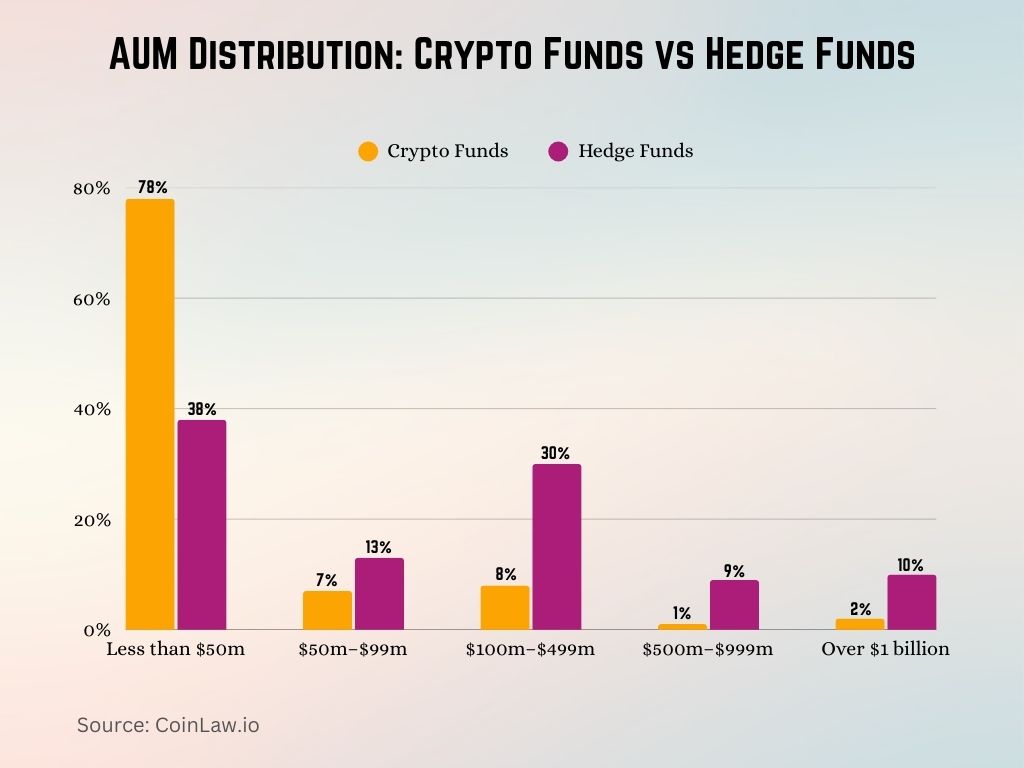
- Compared to traditional hedge funds, crypto funds are generally smaller, with 78% managing less than $50 million in assets. Conversely, only 38% of hedge funds fall into the less than $50 million AUM category, illustrating a greater presence in higher asset ranges.
- Hedge funds dominate the $100m–$499m range, with 30% of these funds operating within this level, compared to only 8% of crypto funds.
- A relatively small portion of both fund types falls into the $50m–$99m range, with 7% of crypto funds and 13% of hedge funds belonging to this category.
- Within the $500m–$999m AUM range, hedge funds still lead with 9%, while only 1% of crypto funds have achieved this size.
- In the top tier, over $1 billion AUM, 10% of hedge funds have reached this milestone compared to just 2% of crypto funds.
Crypto Investment Strategy Segmentation
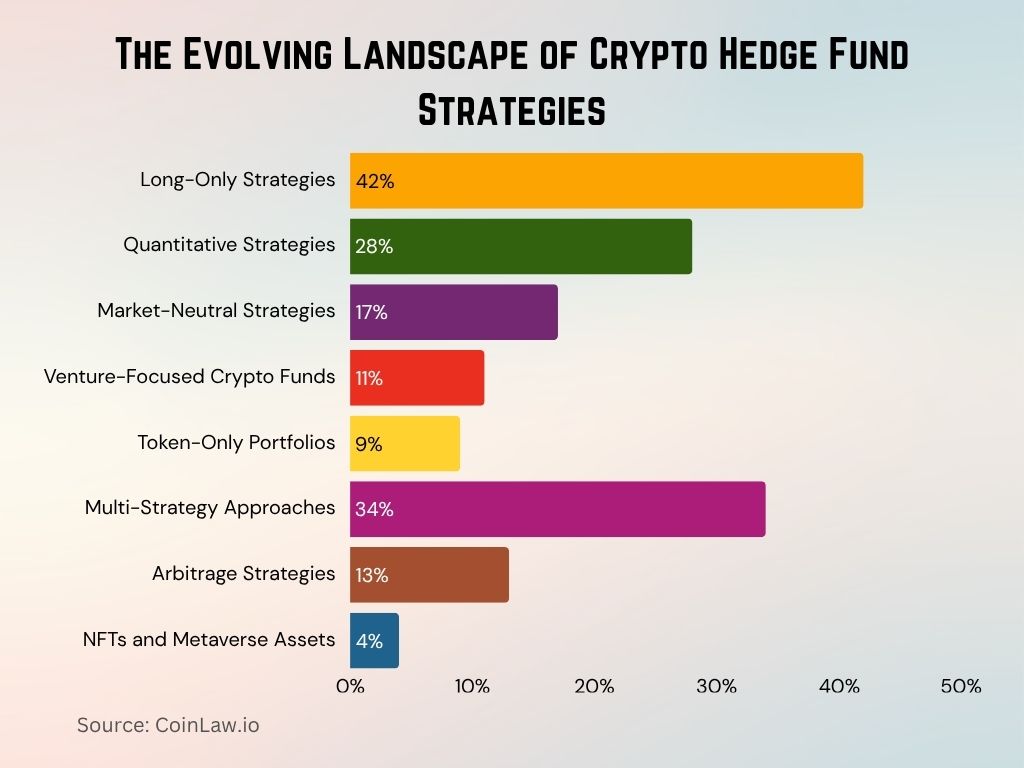
- Long-only strategies remain the primary choice, adopted by 42% of crypto hedge funds, based on the continuing belief in the sector’s growth potential.
- Quantitative strategies now represent 28% of funds, which are utilizing AI-driven algorithms and real-time data analysis.
- Market-neutral approaches are implemented by 17% of funds seeking to minimize exposure to volatility and short-term risks.
- DeFi-focused funds grew by 22% in 2025, with staking and yield farming primarily concentrated on Ethereum and Layer-2 solutions.
- Venture crypto funds account for 11% of the market, supporting early-stage infrastructure and Web3 development.
- Token-only portfolios are used by 9% of funds, focusing exclusively on digital assets without traditional hedging mechanisms.
- Multi-strategy models are adopted by 34% of funds, blending varied techniques to improve diversification.
- Arbitrage strategies are used by 13% of funds, taking advantage of price discrepancies across various platforms and geographic locations.
- Funds exposed to NFTs and metaverse tokens represent 4% of the total, experiencing a slight decline due to market consolidation.
- Token staking strategies increased by 24%, driven by the demand for passive income within PoS ecosystems.
Fund Returns and Performance Measurement
- Average annual returns for crypto hedge funds in 2025 reached 36%, despite macroeconomic pressures and changes in regulations.
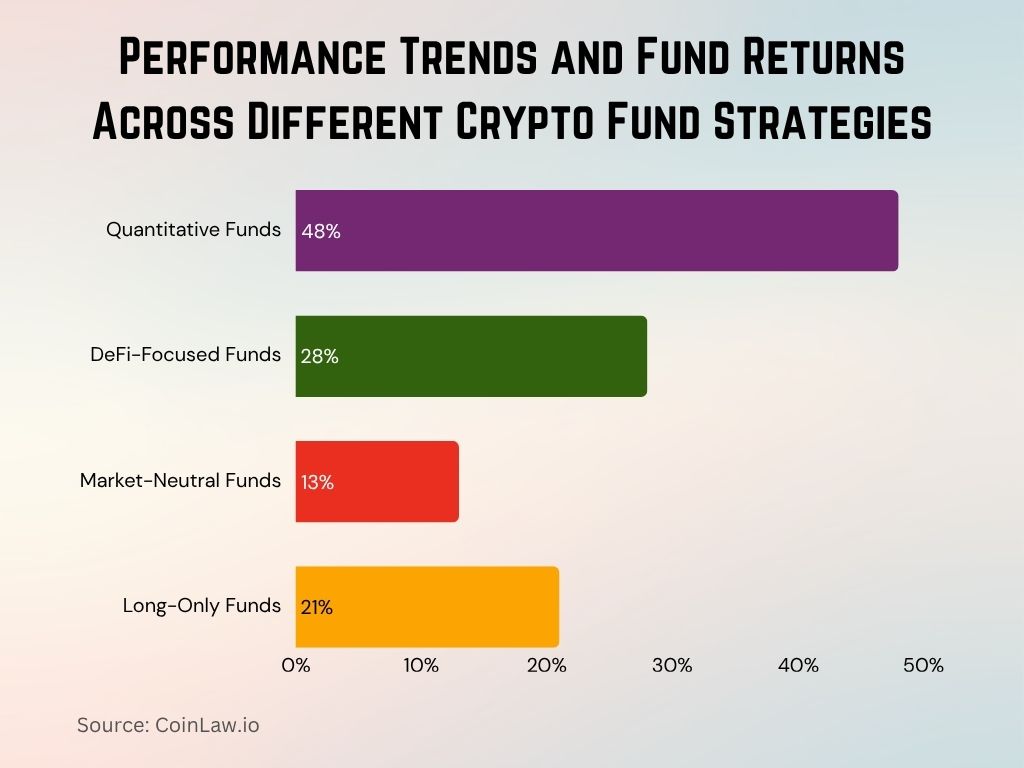
- Quantitative funds once again led with average returns of 48%, supported by algorithmic trading enhanced by AI.
- DeFi-focused funds achieved annual gains of 28%, fueled by staking, liquid restaking, and decentralized lending activities.
- Market-neutral strategies maintained stability with 13% annualized returns, attracting more conservative investors.
- Long-only funds reported returns of 21% in 2025, benefitting from positive market trends in Bitcoin and Ethereum.
- Crypto hedge funds experienced an average volatility rate of 46%, still significantly higher than that of traditional hedge strategies.
- Sharpe ratios averaged 1.6, indicating improved risk-adjusted returns across most major fund categories.
- Monthly performance varied between -18% and +52%, highlighting the importance of flexible portfolio management.
- High-frequency trading funds saw average returns of 22%, capitalizing on short-term price variations.
- More than 83% of crypto hedge funds use BTC as a benchmark, while multi-asset funds use wider crypto indices.
Investment Strategies and Empirical Results
- Active management strategies are now employed by 62% of crypto hedge funds, aiming to generate profits in both stable and dynamic markets.
- More than 54% of funds use algorithmic trading, increasingly utilizing AI-driven predictive analytics.
- Technical analysis is still preferred among 68% of funds, while 37% use fundamental analysis to determine project valuations.
- About 42% of funds factor in broader economic indicators such as inflation rates and central bank actions to determine their strategies.
- 48% of funds use leverage, often up to 3x, to boost potential returns, also increasing risks.
- Arbitrage-focused funds average annual returns of 16%, profiting from ongoing price variances across multiple platforms.
- Staking yields remain stable at 8–11%, with 32% of funds using it as a supplementary income source.
- Token lending and borrowing strategies grew by 23%, boosted by DeFi collateralization and models for passive returns.
- Index-tracking funds earned 24% in 2025, favored by investors who are risk-averse and seek broad crypto exposure.
- Strategies involving convertible bonds gained popularity, offering crypto-backed fixed income while maintaining opportunities for increased participation.
Top Decentralized Exchanges Used by Crypto Hedge Funds
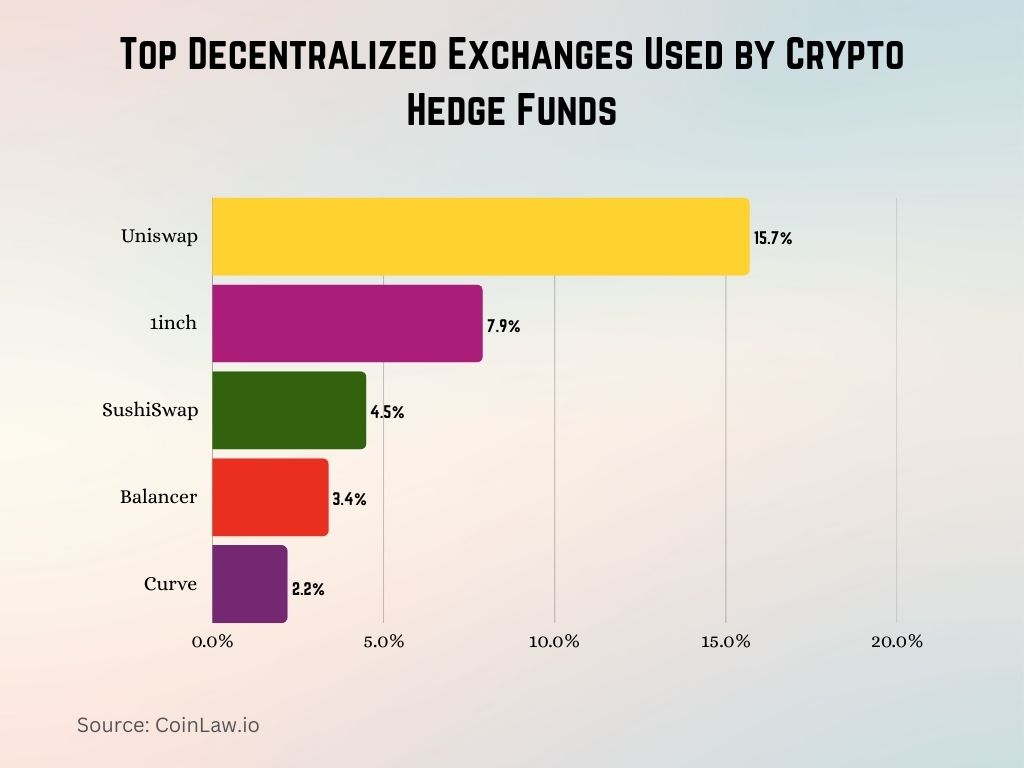
- Uniswap stands out as the most commonly used decentralized exchange, with 15.7% of crypto hedge funds actively trading on it.
- 1inch is second, used by 7.9% of crypto hedge funds, highlighting its appeal in DEX aggregation.
- SushiSwap ranks third, with 4.5% usage among funds, demonstrating its continued relevance despite newer competitors.
- Balancer is utilized by 3.4% of crypto hedge funds and is recognized for its versatile AMM pools.
- Curve completes the top five, with 2.2% usage, particularly favored for swaps involving stablecoins.
Institutional Adoption and Investor Demographics
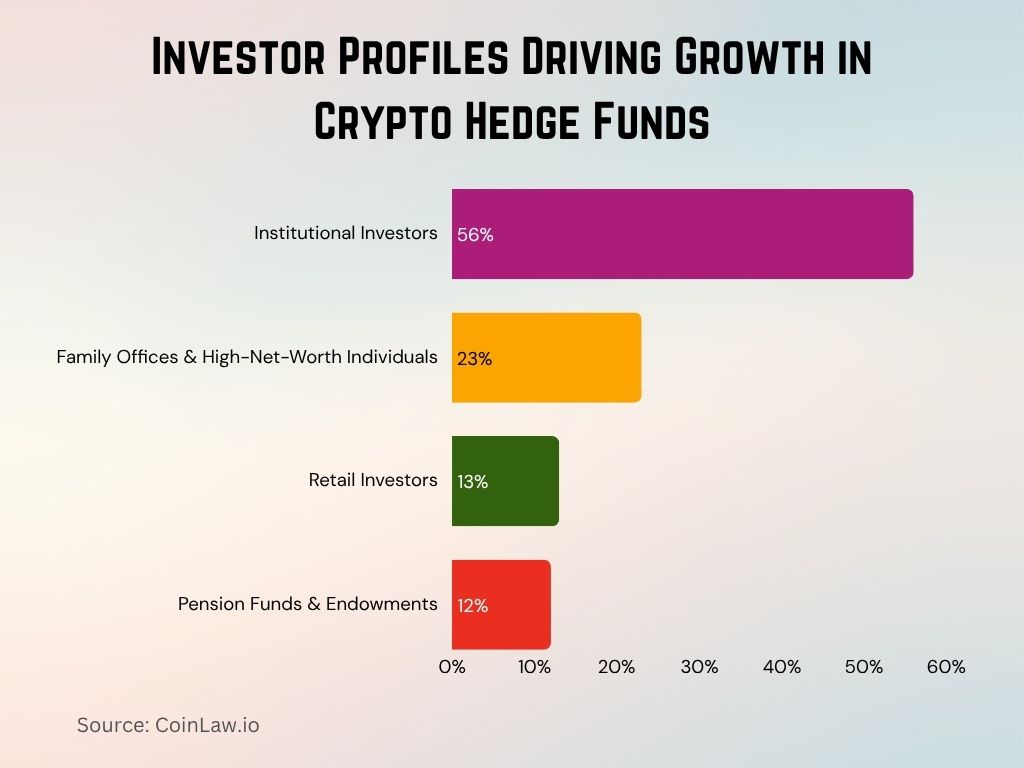
- Institutional investment now comprises 56% of total capital invested in crypto hedge funds, indicating greater confidence in the asset category.
- Family offices and affluent individuals make up 23% of the investor base, showing ongoing interest from private wealth.
- Retail engagement remains limited at 13%, due to accessibility restrictions and developing regulatory environments.
- 58% of institutional investors state that diversification is the key factor for allocating investments to crypto hedge funds.
- Pension funds and endowments now contribute 12% of institutional capital, showing increased interest from more traditional sectors.
- 62% of crypto hedge funds are based internationally, notably in areas with accommodating tax and legal frameworks.
- The average institutional investment has grown to $11.4 million, showing increased confidence and deeper capital commitments.
- Institutions in the United States provide 53% of total crypto hedge fund investment, followed by Europe at 31% and Asia at 16%.
- 47% of new capital in 2025 originated from institutional sources, validating the acceptance of crypto among traditional asset allocators.
- Women now make up 17% of crypto fund investors, showing moderate but consistent demographic diversification.
Technological Innovations and Infrastructure
- Improvements in Blockchain technology have resulted in transaction speeds that are 20% faster for crypto hedge funds, which reduces trading latency and enhances execution effectiveness.
- Data analytics platforms customized for crypto markets saw a 40% increase in usage among funds, enabling more reliable predictive models for investments.
- Automated smart contracts are increasingly used, with 30% of crypto hedge funds implementing them to achieve faster and more transparent transactions, particularly within the decentralized finance (DeFi) space.
- Cold storage solutions are preferred by 85% of crypto funds for their superior security, while 15% use hybrid approaches, combining hot and cold storage for rapid access to liquidity.
- AI and machine learning applications have seen a 35% increase in adoption, assisting funds in analyzing large volumes of market data and adjusting trading strategies in real time.
- Enhanced security measures in blockchain protocols have decreased the number of successful cyberattacks against funds by 25%, indicating progress in protecting digital assets.
- Decentralized exchanges (DEXs) now manage 18% of total trading volumes for crypto hedge funds, an increase motivated by the pursuit of enhanced privacy and reduced fees.
- High-frequency trading systems (HFT) are employed by 20% of crypto hedge funds, enabling real-time decision-making and more precise trading.
- Distributed ledger technology (DLT) is a staple, with 75% of funds using DLT for record-keeping, which ensures transparency and lowers administrative expenses.
- The tokenization of conventional assets, like real estate and bonds, has grown by 30% within funds, enabling varied portfolios and wider investment possibilities.
A Factor Model for Cryptocurrency Returns
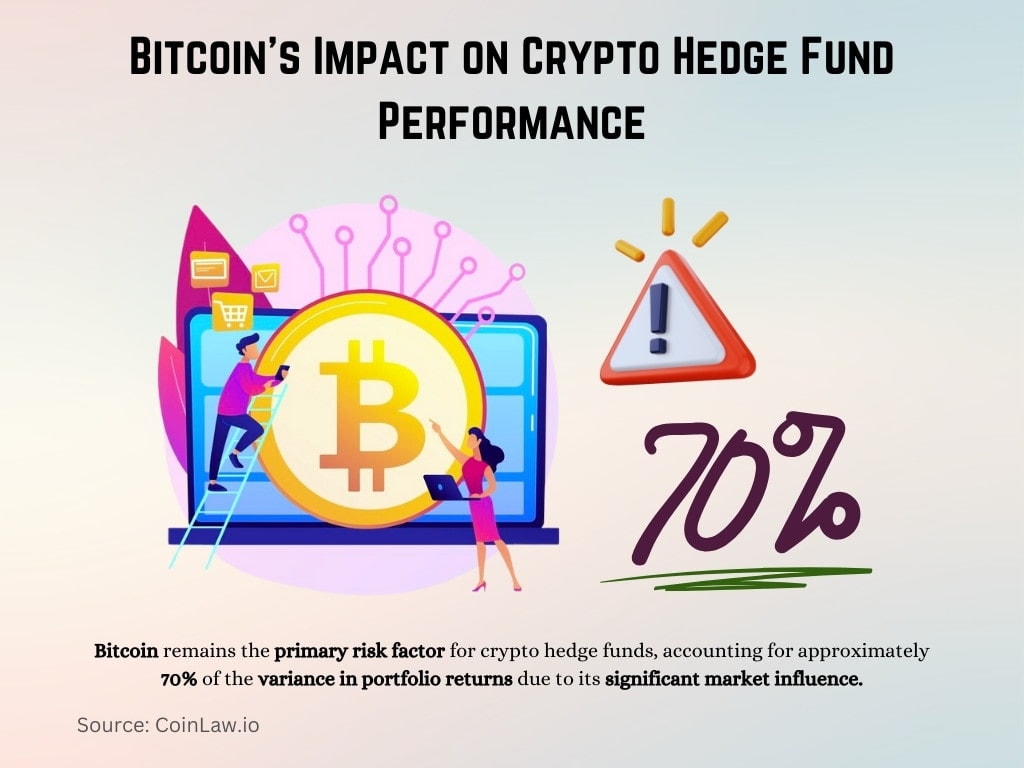
- Bitcoin remains the primary risk indicator for crypto hedge funds, representing approximately 70% of portfolio return variances, due to its strong market influence.
- Liquidity risk factors in crypto funds are high, with 60% of funds facing asset liquidity challenges due to market depth and trading frequency.
- Market sentiment analysis, a new factor employed by 50% of funds, uses social media and blockchain data to assess market moods, affecting fund decision-making.
- A volatility premium is observed, with funds achieving returns of 15% over traditional assets by leveraging crypto’s higher risk acceptance.
- Momentum factor models used by 40% of funds offer insights into asset performance, enabling managers to capitalize on upward trends in volatile assets.
- DeFi sector-specific returns contribute 25% of overall fund returns, with funds using liquidity pools, staking, and lending within decentralized markets.
- Regulatory news impact is a critical factor; approximately 80% of crypto funds adjust their positions based on regulatory events, often triggering significant price changes.
- Tokenomics, including supply, demand, and burn mechanisms, are factored into 45% of fund models, providing a unique methodology for asset assessment.
- Cross-asset correlations are analyzed by 60% of funds to understand relationships between cryptocurrencies and traditional assets, affecting diversification strategies.
- Exchange rate volatility is monitored by 35% of funds, especially those with international holdings, as currency variations can affect crypto values.