

Bitcoin, initially a fringe experiment explored within cryptographic communities back in 2009, has undergone a remarkable transformation by 2025. Today, cryptocurrency wallets are commonplace, utilized by ride-share drivers in Lagos, small business owners in Buenos Aires, and even retirees in Ohio who use stablecoins as a hedge against inflation. The landscape of cryptocurrency adoption has evolved profoundly, expanding both in scope and fundamental nature. It’s no longer solely about speculative investment; rather, it’s about providing access, enhancing utility, and fostering empowerment within an increasingly digital financial environment. This analysis delves into the nations spearheading this transformative shift, explores the distribution of crypto holdings, and examines how governments and economies are adapting to this evolving paradigm.
Key Takeaways
- 1Global crypto adoption has risen to 12.4% of adults with internet access in 2025.
- 2Stablecoin adoption saw a 21.7% increase globally in 2025, primarily fueled by worries concerning inflation and the need for cost-effective remittances.
- 3Mobile wallet installations associated with crypto platforms hit 982 million worldwide in 2025, a 13.8% surge compared to the previous year.
- 4The top 5 nations by crypto exchange traffic are the U.S., India, Brazil, Russia, and Turkey.
Top 10 Countries by Crypto Ownership
- The United Arab Emirates leads in crypto ownership, with 30.4% of residents owning cryptocurrency, representing around 3 million individuals.
- Vietnam is second with 21.2% of its populace involved in crypto, equating to approximately 21 million crypto holders.
- The United States is third by percentage (15.6%) but holds the top spot in total users with a staggering 53 million crypto users.
- Iran displays a robust crypto presence, with 13.5% of its population engaging with digital assets, totaling 12 million people.
- In the Philippines, 13.4% of the population owns crypto, adding up to 16 million users, among the highest in Southeast Asia.
- Brazil has a 12.0% crypto adoption rate, equal to around 26 million users.
- Saudi Arabia exhibits a substantial 11.4% adoption rate, contributing to 4 million crypto owners.
- Singapore showcases 11.1% crypto adoption, with 665,000 citizens actively participating in the digital asset market.
- Ukraine registers 10.6% of its population involved in crypto, approximately 4 million people.
- Venezuela completes the list with 10.3% of residents owning crypto, equivalent to 3 million users.
Global Overview of Cryptocurrency Adoption Rates
- The global cryptocurrency ownership rate is 12.4% in 2025, demonstrating consistent growth.
- The Asia-Pacific region is the leader in ownership, with 6 of the top 10 countries with the highest adoption rates located within its borders.
- In Europe, crypto adoption expanded to 8.9% in 2025, driven by increased institutional involvement and improved regulatory clarity.
- Latin America saw a notable surge, with average national adoption increasing to 15.2%, primarily attributed to its use as an inflation hedge.
- Africa saw the most rapid growth in 2025, increasing crypto users by 19.4%, with Nigeria, Kenya, and South Africa at the forefront.
- The Middle East continued its strong momentum, with 11.3% of adults owning digital assets.
- Institutional investment accounted for 16.5% of total global crypto transaction volume in 2025.
- Stablecoins now dominate transaction volume, rising to 33.2%, signaling a movement from volatile assets towards utility-focused tokens.
- Blockchain-based remittances constituted 9.6% of all global remittance flows in 2025.
- Cross-border B2B transactions utilizing cryptocurrency accounted for 5.4% of global trade settlement value in 2025.
Regional Trends in Crypto Usage
- In North America, usage is predominantly investment-oriented, with 58.4% of crypto holders using it as an asset.
- In Latin America, 43.6% of users utilize crypto for daily spending and cross-border payments.
- Sub-Saharan Africa showcases a dominant trend of mobile-based crypto usage, with 72.9% of transactions occurring on smartphones.
- Western Europe has witnessed growth in regulated custodial wallets, now accounting for 41.2% of total user accounts.
- In Eastern Europe, crypto usage is more diverse, with a 22.8% focus on international transfers because of regional instability.
- Southeast Asia has incorporated crypto into gaming and freelance markets, with 29.3% of users earning income using blockchain platforms.
- Middle Eastern countries, such as the UAE, report institutional-driven usage, with $7.1 billion in crypto assets under management (AUM) in 2025.
- Central Asia has experienced a 12.5% increase in adoption related to mining, particularly in Kazakhstan and Uzbekistan.
- Australia and New Zealand report a combined 10.8% ownership, fueled by self-directed pension investments and Web3 startups.
- China remains restricted, but underground usage and offshore holdings contribute to an estimated 5.2% ownership rate.
Global Grassroots Crypto Adoption Rankings
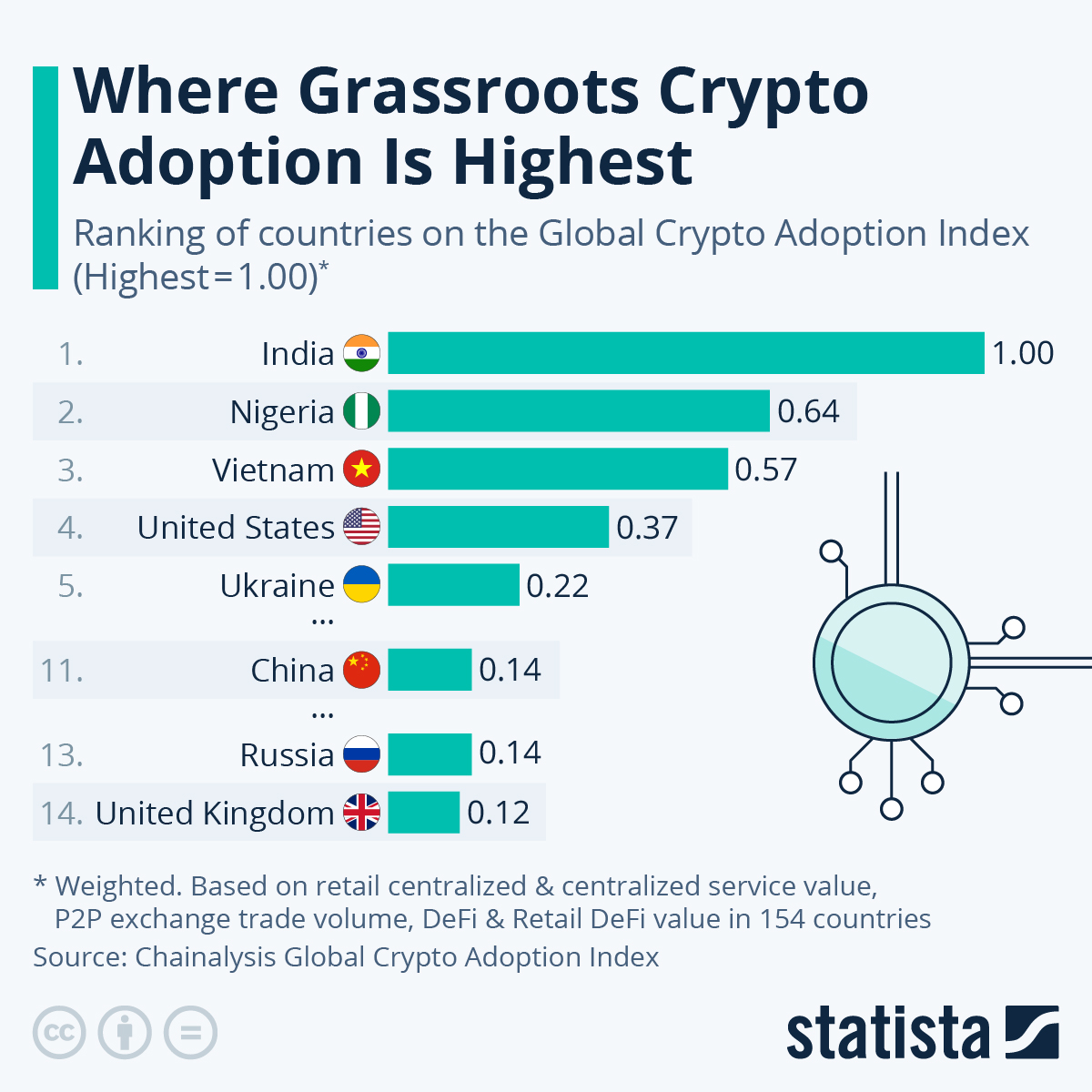
- India is the leader of the Global Crypto Adoption Index, with a perfect score of 1.00, demonstrating the strongest grassroots adoption worldwide.
- Nigeria is ranked second with a score of 0.64, showcasing high engagement in retail and P2P crypto use.
- Vietnam is in third place with a score of 0.57, maintaining its status as a leading crypto-active nation in Southeast Asia.
- The United States is ranked fourth with a score of 0.37, indicative of substantial DeFi and centralized exchange activity.
- Ukraine is in fifth place with a score of 0.22, despite ongoing economic and geopolitical challenges.
- China, despite its lower ranking, still records a score of 0.14 (ranked 11th), pointing to noteworthy activity even with strict regulations.
- Russia is also at 0.14, showing similar adoption levels to China.
- The United Kingdom is ranked 14th with a grassroots adoption score of 0.12, trailing behind leading crypto economies.
Government Policies and Regulations by Country
- The United States maintains a fragmented regulatory environment, with 47 states having specific crypto laws as of 2025, while the Digital Asset Regulation Modernization Act awaits federal approval.
- European Union member states implemented MiCA across all 27 countries, leading to consistent licensing standards for exchanges and custodians.
- Japan enforces stringent custody regulations, mandating 100% asset segregation and monthly audits for licensed exchanges.
- El Salvador remains at the forefront, recognizing Bitcoin as legal tender, with 82% of small businesses accepting BTC as of 2025.
- Nigeria’s central bank switched to a regulatory sandbox approach, resulting in the issuance of 19 new virtual asset licenses over the past year.
- India applies a flat 30% tax on crypto gains, but the proposed 2025 Crypto Tax Review Bill might lower it to 15% for retail investors.
- Brazil’s central bank introduced its digital real pilot in Q2 2025, currently utilized by 6.2 million trial users.
- Turkey enacted crypto regulations in March 2025, legalizing exchanges under the supervision of its Capital Markets Board.
- Singapore remains a global leader, requiring crypto exchanges to adhere to PSA licensing and AML/CFT compliance under its 2024 revision.
- South Korea requires real-name bank account integration for all exchanges, enforced by 19 domestic banks in 2025.
Cryptocurrency as a Payment Method: Country Comparisons
- El Salvador leads the world, with 82% of surveyed vendors accepting Bitcoin for transactions.
- In Japan, over 31,000 retailers accept cryptocurrency payments, including major convenience store chains and technology stores.
- Germany allows crypto for online purchases through more than 26 fintech partnerships, representing 9.3% of e-commerce checkouts in 2025.
- The Philippines has over 1.1 million merchants connected with crypto payment processors like Coins.ph and GCash crypto wallet.
- In the United States, adoption is more distributed; 17.4% of small and medium-sized businesses accept cryptocurrency, mainly stablecoins like USDC.
- Brazil experienced a 22.7% growth in crypto-enabled POS terminals in 2025, reaching more than 92,000 installations.
- South Africa has seen a substantial increase in peer-to-peer payments, with 15.6% of mobile-based transactions using stablecoins.
- In the UAE, the luxury retail and hospitality sectors are leading adoption, with 43% of 5-star hotels accepting crypto payments directly.
- Ukraine has implemented crypto-based payroll systems in over 800 technology startups, especially for international freelancers.
- Thailand restricts crypto payments for goods but permits them for travel and digital services, supported by licensed platforms.
Crypto Ownership by Generation in the United States
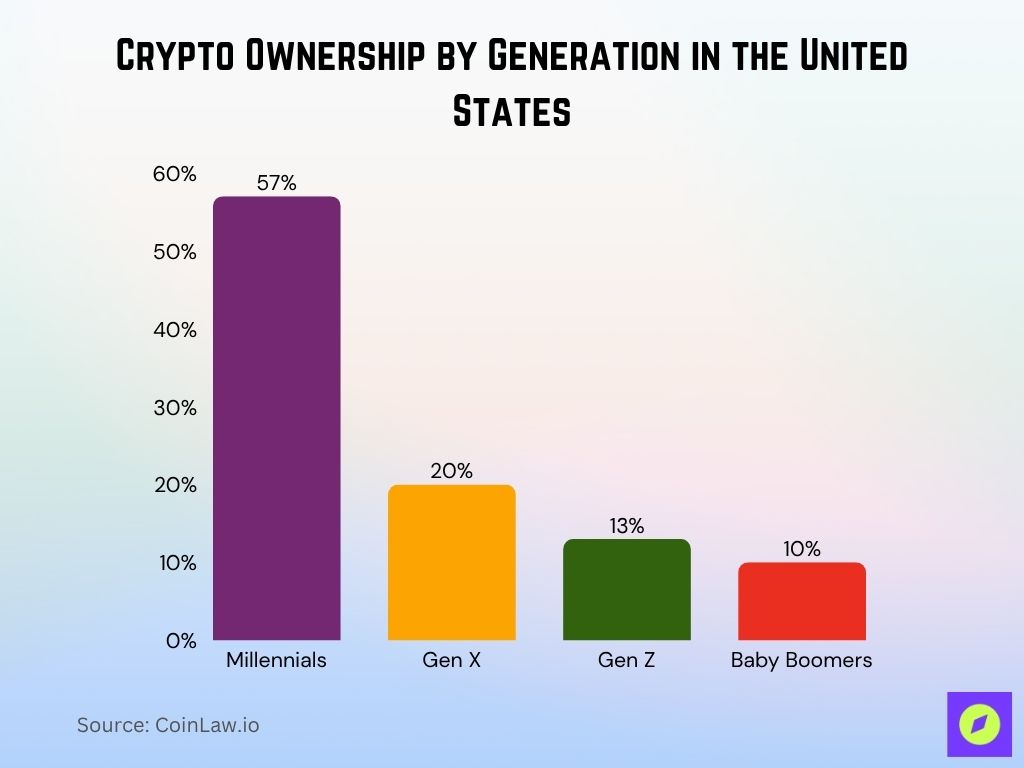
- Millennials are the largest group, accounting for 57% of all crypto owners in the U.S.
- Gen X makes up 20% of crypto holders, displaying significant adoption among those in their 40s and 50s.
- Gen Z represents 13% of crypto users, reflecting increasing interest among the younger digital generation.
- Baby Boomers are the smallest group, holding only 10% of the crypto ownership share.
Demographic Patterns of Crypto Users Across Nations
- Globally, the average crypto user is 34.6 years old with a median portfolio size of $1,220 in 2025.
- In the U.S., 26.5% of Gen Z adults own crypto, representing the fastest-growing age segment since 2024.
- Latin America tends to be younger, with 61% of crypto users aged 18–34, often utilizing it for remittances and peer-to-peer payments.
- In India, men still predominantly own crypto (78%), but female participation has increased to 22%.
- South Korea reports that high-income professionals aged 30–44 comprise 53% of crypto holders.
- Germany shows a broadening user base, with crypto ownership among the 55+ age group rising to 9.8% in 2025.
- Nigeria has the highest youth engagement, with 74% of crypto holders under 30, largely driven by mobile-first platforms.
- Indonesia has gender parity, with 46% female crypto users, the highest among Southeast Asian nations.
- In the UK, crypto use among freelancers and gig workers has grown 3.6x since 2022, now accounting for 14.1% of users.
- Brazilian crypto users are primarily urban middle-class (47%), with the majority residing in São Paulo and Rio de Janeiro metropolitan areas.
Impact of Economic Conditions on Crypto Adoption
- In countries with inflation exceeding 20%, crypto adoption is, on average, 2.7x higher than in stable economies.
- Argentina has the strongest correlation, with crypto ownership at 29.4% amid annual inflation of 85% in 2025.
- Venezuela shows that an estimated 16.3% of households use crypto for daily survival, commonly utilizing USDT or BTC.
- In Turkey, continued Lira depreciation has caused crypto trading volume to increase by 31.5% year-over-year.
- Egypt’s crypto activity increased 42.8% in 2025, due to continuous currency devaluation and capital controls.
- Zimbabwe reports that unofficial crypto transaction volumes equal 6.2% of GDP, the highest on a per capita basis.
- In the U.S., crypto holdings increased during 2025’s Q1 recession dip, with 15.2 million new wallet activations.
- Lebanon, facing banking crises, has 19.8% of its citizens using crypto wallets as their primary means of storing value.
- Pakistan saw crypto remittances increase by 18.7%, primarily through Binance P2P, due to the rupee’s volatility.
- Ukraine reports $2.1 billion in crypto aid donations and DAOs that are supporting local defense and humanitarian efforts.
Confidence in Cryptocurrency Safety and Security
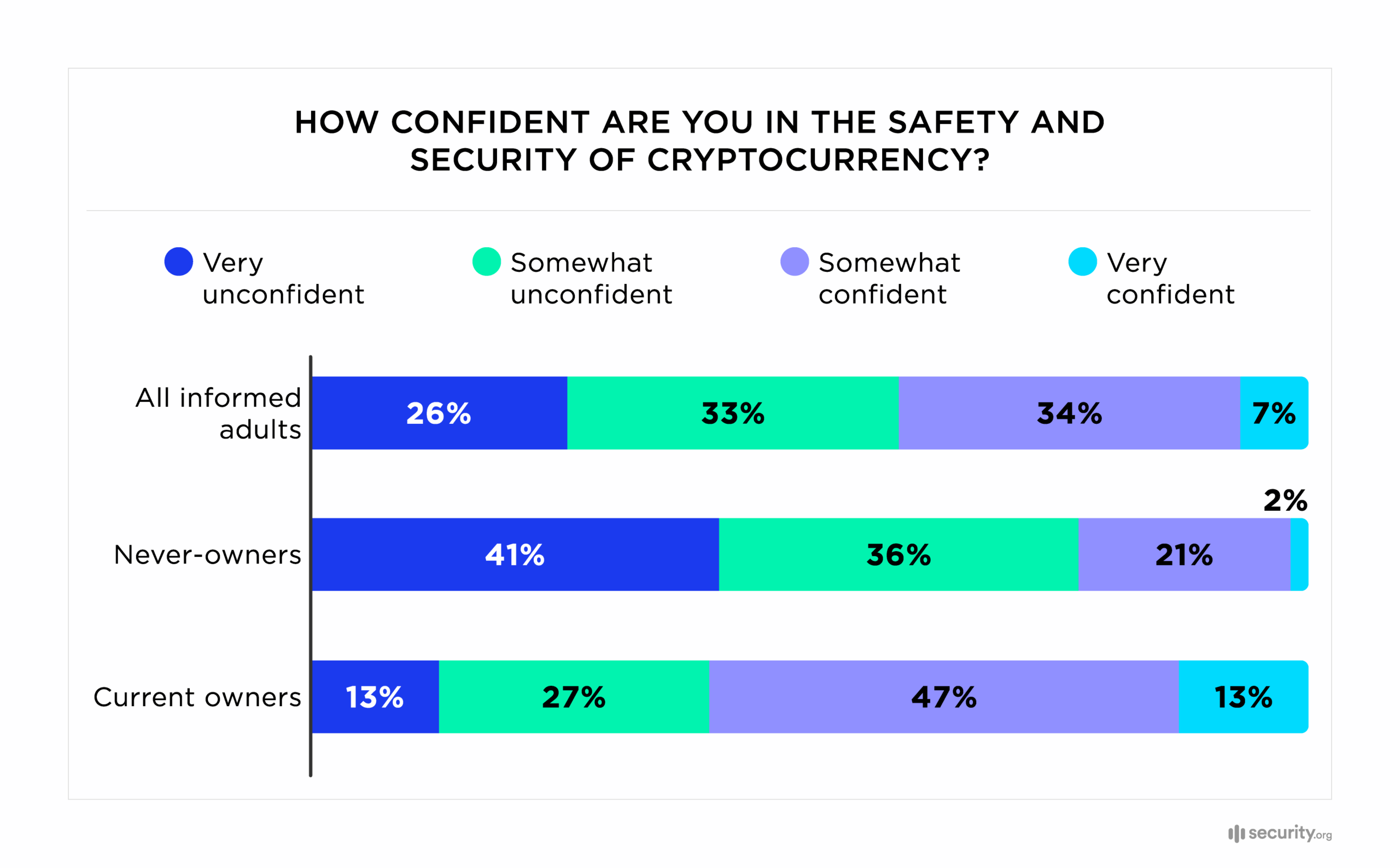
- Among all informed adults, 26% are very unconfident, 33% are somewhat unconfident, 34% feel somewhat confident, and only 7% are very confident.
- Among those who have never owned crypto, skepticism is high: 41% are very unconfident, 36% are somewhat unconfident, with just 21% being somewhat confident and a mere 2% feeling very confident.
- By contrast, current crypto owners are far more optimistic: only 13% are very unconfident, 27% are somewhat unconfident, while 47% are somewhat confident, and 13% feel very confident.
Mobile Wallet and Exchange Usage by Country
- Global crypto wallet installations reached 982 million in 2025.
- Trust Wallet is a global leader, with more than 124 million active users across 93 countries.
- In India, WazirX and CoinDCX reported a combined user base of 56 million.
- Nigeria’s Binance Wallet usage surged to 28.1 million users, with a monthly growth of 4.2% in early 2025.
- The Brazilian platform Mercado Bitcoin reached 19 million users, representing 33.5% of the adult online population.
- Coinbase, located in the U.S., retains 43.7 million verified users, with 58% reporting active usage in the past 60 days.
- The Turkish Paribu app ranks among the top 5 most downloaded finance apps, with 7.6 million verified accounts.
- In Vietnam, the VNDC Wallet exceeded 10 million installations, facilitating crypto and local fiat deposits.
- Upbit in South Korea dominates 78% of the local market share with 12.3 million active traders.
- Kenya’s BitPesa Wallet is used by 5.9 million residents, mainly for remittances and microtransactions.
Influence of Internet Penetration and Digital Literacy
- Countries with internet penetration above 85% exhibit an average crypto adoption rate of 14.3%, compared to 6.7% in nations below 60%.
- South Korea, with 98.2% internet access, has a 12.8% crypto usage rate, demonstrating the importance of technological infrastructure.
- Sweden reports 93.4% digital literacy and 11.1% crypto ownership; most users interact through integrated fintech apps.
- Kenya, despite an internet penetration of 49.6%, displays high mobile-based adoption, with crypto usage at 13.4%, driven by mobile-first platforms.
- In the UAE, where 100% of adults have internet access, 9 out of 10 crypto users access platforms via smartphones.
- Vietnam, with enhanced digital infrastructure, attained 79.3% internet penetration and 27.1% crypto ownership in 2025.
- Estonia, a pioneer in e-governance, has digital literacy above 90%, with 8.7% of its citizens engaging in blockchain-based transactions.
- The increasing rural internet adoption in India (now at 51.5%) has fueled crypto growth in tier-2 and tier-3 cities, with usage outside metropolitan areas growing 33.1% year-over-year.
- Indonesia combines its crypto education programs with rural broadband expansion, resulting in 13.6 million new wallets in 2025.
- Colombia’s national fintech program includes crypto literacy, leading to 10.2% of adults holding digital assets as of 2025.
Top Cryptocurrency Exchanges by 30-Day Trading Volume
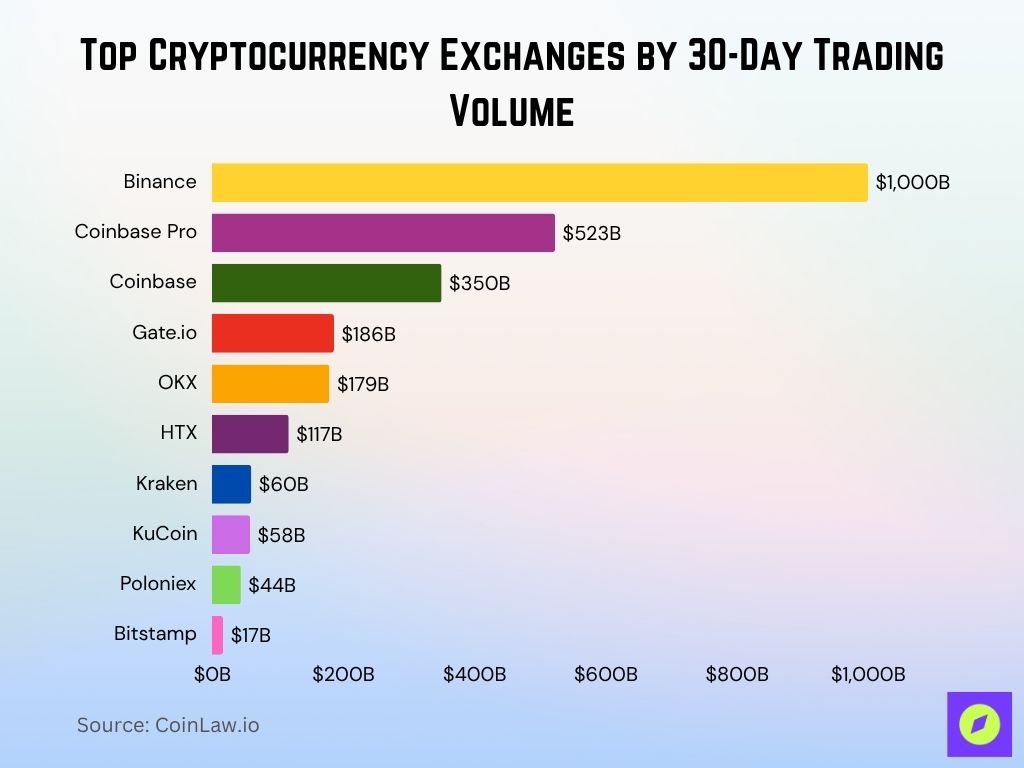
- Binance is the leading exchange, with a volume of $1,000B in 30-day trading, far exceeding all others.
- Coinbase Pro is second with $523B, showing significant U.S. institutional trading.
- Coinbase (retail-focused) is in third place with $350B in trading volume.
- Gate.io is fourth, reporting $186B in monthly trading volume.
- OKX is close behind at $179B, a strong contender based in Asia.
- HTX (formerly Huobi) clocks in at $117B, maintaining a presence in the market.
- Kraken, located in the U.S., records $60B in trading activity.
- KuCoin shows steady user engagement with $58B traded over 30 days.
- Poloniex, one of the oldest exchanges, reports $44B in volume.
- Bitstamp, a European exchange, is last on the list with $17B.
Notable Growth in Emerging Markets
- Philippines crypto ownership grew from 17.8% in 2024 to 22.5% in 2025, influenced by play-to-earn