

Essential Highlights:
- Changpeng Zhao (CZ) emphasizes significant crypto topics at the World Economic Forum.
- Coinbase’s CEO discusses the potential of stablecoins to revolutionize money through the GENIUS Act.
- Brad Garlinghouse advocates for holding crypto firms accountable to the same standards as traditional banks.
Despite a bearish trend in the market this week, exciting developments are emerging from major events, particularly at the World Economic Forum in Davos.
Recent news in the cryptocurrency sector revealed a shift in focus. While market sentiments fluctuated, discussions at the WEF increasingly revolved around blockchain and cryptocurrencies.
Notably, the event provided a platform for prominent crypto leaders, including former Binance head Changpeng Zhao, who noted an increased focus on stablecoins and exchanges in the media.
CZ directed attention to topics such as tokenization, payment systems, and artificial intelligence. He expressed enthusiasm for tokenization, mentioning ongoing discussions with various governments to promote this approach.
CZ believes that tokenization could provide significant financial benefits to governments, potentially encouraging their adoption of this innovative approach. He remarked that while cryptocurrency has not fully penetrated the traditional payments sector, a shift may occur as payment providers start adopting crypto solutions.
Furthermore, Zhao mentioned that artificial intelligence could be a pivotal factor in driving cryptocurrency adoption, as AI agents might utilize crypto as programmable currency suitable for smart contracts.
Coinbase CEO Brian Armstrong Highlights the Benefits of Stablecoins
Brian Armstrong, another crypto leader at Davos, has been instrumental in shaping crypto legislation. He indicated that the United States might move away from fractional reserve banking through the GENIUS Act. Armstrong emphasized that under the proposed stablecoin regulations, banks must maintain full reserves for any stablecoins they manage.
This shift is crucial as the U.S. is leaning more towards cryptocurrency while traditional fiat systems face growing pressures stemming from the fractional reserve model.
A banking system supported by 100% reserves could not only restore trust in the financial system but also yield additional benefits, particularly in the lending landscape.
Brad Garlinghouse Draws Attention to Regulatory Changes in Crypto
Recent shifts in crypto regulation have been notable, according to the latest news. Ripple’s CEO Brad Garlinghouse commented that enhancements in regulatory frameworks are beneficial for the cryptocurrency landscape.
He acknowledged that while new regulations won’t be flawless, recent discussions have hinted at delays regarding the CLARITY Act despite urgent calls for progress. Interestingly, Armstrong from Coinbase reportedly withdrew his support, citing concerns over certain provisions.
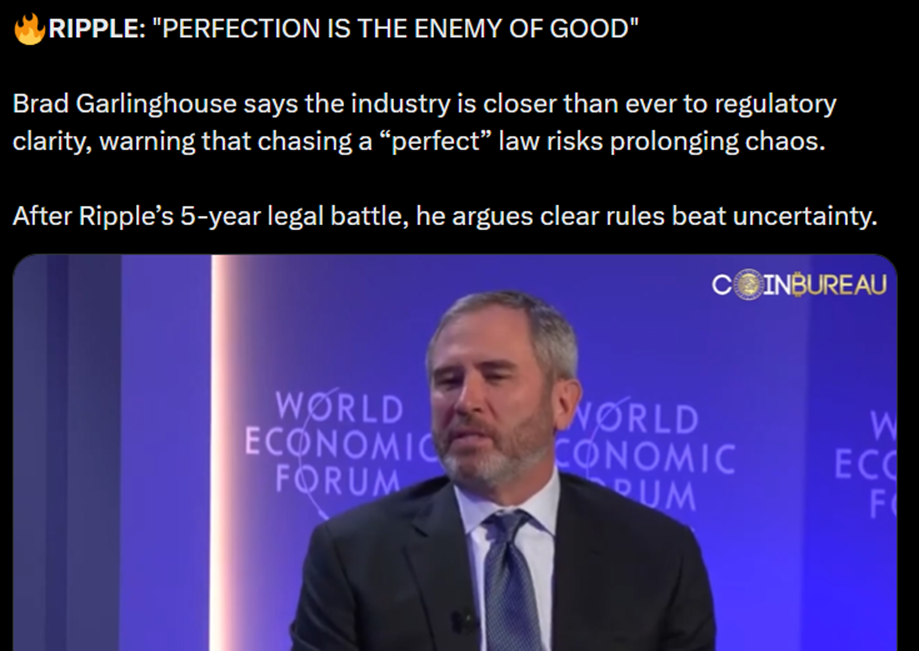
Garlinghouse maintained an optimistic outlook on potential improvements in regulations despite existing limitations. He highlighted that clear regulations are preferable to uncertainty, referencing Ripple’s prolonged litigation with the SEC as a consequence of such ambiguity.
He also stated that the same stringent regulations applicable to the banking sector should extend to cryptocurrency operations, implying that crypto must adhere to similar standards as traditional finance.
These regulatory measures could ultimately prove advantageous for the cryptocurrency market, laying a stronger foundation for wider acceptance in the future.